
We recommend this app as the best ChordPro app for worship teams because it combines full ChordPro editing with real-time setlist sync built for volunteer workflows. It handles import, transposition, and presentation mode without asking your team to learn new technical habits. Below, we map exactly why it fits, plus how to import your first chart and avoid common pitfalls.
TL;DR:
- Before moving the whole team, import one chart, sync a one song setlist to another device, and test presentation mode through a full rehearsal.
- Back up originals, test a small file, remove unsupported tags, and check chord brackets before importing; these steps address common causes of damaged formatting.
- Choose a lightweight viewer for solo reading, an audio transcription tool for learning by ear, or desktop presentation software for advanced projection and media.
- Check that any candidate supports standard ChordPro editing, automatic backup, export, offline access, and steady tempo if it includes a metronome.
Table of Contents
- Why Song7 fits the ChordPro workflow for worship teams
- Checklist: what to look for in a ChordPro app
- Feature deep dive: how each selection criterion maps to Song7 in practice
- How to import ChordPro files safely and troubleshoot problems
- If Song7 isn't right: three categories of alternatives
- Editorial perspective from our team on real worship-team workflows
- Try Song7: import one chart and run a rehearsal
- FAQ
- Sources
Why Song7 fits the ChordPro workflow for worship teams
A worship team's biggest enemy on a Sunday morning is friction: charts that will not transpose cleanly, formatting that falls apart on a tablet, or a volunteer who shows up with the wrong version of a song. Song7 was built around the ChordPro format specifically to remove that friction.
The core workflow lines up with what a ChordPro app needs to do well:
- Import ChordPro files directly or paste raw ChordPro text into a chart, keeping chord placement intact.
- Transpose instantly without re-typing chords or breaking lyric alignment.
- Build setlists by dragging songs into order, then sync that order to every team member's device.
- Switch to presentation mode for a clean, distraction-free display during rehearsal or service.
- Edit and save safely, with changes reflected across the team without manual file sharing.
Real-time sync matters because one in three touring and worship musicians cites app crashes and low-quality tools as a top hassle, according to a third-party roundup that evaluated songbook apps for Windows 10/11. That is exactly the kind of instability a volunteer-run team cannot absorb mid-service.
Checklist: what to look for in a ChordPro app
Before you commit to any app, worship teams and musicians should run through a short list of non-negotiables. These apply whether you are testing Song7 or anything else.
- Native ChordPro editing. The app should read and write standard ChordPro syntax, not a proprietary format that locks you in.
- Safe save and auto-backup. Changes should save automatically, and you should be able to recover a previous version if something goes wrong.
- Reliable import and export. ChordPro text and plain text fallback should both work, and transposition should preserve formatting rather than scrambling chord placement.
- Accurate playback timing. If the app includes a metronome or tempo guide, it needs to stay steady through a full run-through.
- Setlist and presentation mode. Charts should display cleanly on stage, and the setlist order should sync across every device on the team.
- Offline access. Rehearsal rooms and sanctuaries do not always have reliable internet, so charts need to load without a live connection.
- Stability and support. Look for regular updates and documentation you can actually find when something breaks.
Pro Tip: Before switching your whole team to a new app, import just one song and run it through a full rehearsal cycle. That single test reveals more than any feature list.
Feature deep dive: how each selection criterion maps to Song7 in practice
Each item on that checklist has a direct counterpart in how Song7 actually works day to day.
- Import: paste ChordPro text or upload a file, and the chart appears with chords aligned above lyrics, following the structure covered in our ChordPro format guide.
- Transposition: shift keys with one tap, and chord diagrams regenerate automatically, a process we break down further in how to transpose chord charts without losing your mind.
- Presentation mode: charts display full-screen with large, readable text, designed to prevent the mid-phrase page turns we cover in formatting chord charts for worship teams.
- Setlist sync: once a leader builds the order, every team member's app updates automatically, which we walk through in syncing setlists in five minutes.
Stability comes from limiting what can go wrong. Fewer manual file transfers means fewer chances for a volunteer to open the wrong version on a Sunday.
| Selection criterion | Song7 behavior in practice |
|---|---|
| ChordPro import | Paste or upload text, chords align automatically |
| Transposition | One-tap key change, diagrams regenerate |
| Presentation mode | Full-screen display, formatted to avoid awkward page breaks |
| Setlist sync | Leader builds order once, team devices update together |
| Offline access | Charts remain available without an active connection |
How to import ChordPro files safely and troubleshoot problems
Most import headaches come from files that were never quite clean ChordPro to begin with. A short pre-import routine avoids the worst of it.
- Back up the original file before touching it, so you always have a fallback copy.
- Test with one small file first rather than uploading your entire library at once.
- Strip unsupported tags like unusual capo markers or custom directives that were not part of the standard format.
- Check for mismatched brackets around chords, a common cause of garbled playback.
If an editor crashes mid-import, close and reopen rather than retrying the same file immediately. Check our guide on converting PDF chord charts if the source document started as a PDF rather than plain text, since that conversion step is often where formatting breaks down.
Pro Tip: Keep one "clean" ChordPro template saved separately, and run any new file against it as a format check before importing it into your main library.

If Song7 isn't right: three categories of alternatives
Not every team needs the same tool. It helps to know which category actually solves your problem.
- Lightweight songbook viewers work well for solo practice or low-tech gigs where you just need to read a chart, not sync a team.
- Audio-to-chord transcription tools are built for learning a song by ear from a recording, not for running a synced live set.
- Desktop presentation suites make sense when you need advanced projection setups or heavy media integration beyond lyrics and chords.
Matching the category to the actual job keeps you from paying for features you will never use.
Editorial perspective from our team on real worship-team workflows
In practice, the rehearsals that run smoothly are the ones where every musician opens the same synced chart at the same time, already transposed to the right key. Most volunteer frustration we hear about traces back to version mismatches, not musical ability. Removing that one failure point changes the whole tone of a rehearsal.
— Editorial team
Try Song7: import one chart and run a rehearsal
If the checklist above matches what your team actually struggles with, the fastest way to know whether we fit is to test one song, not your whole library.
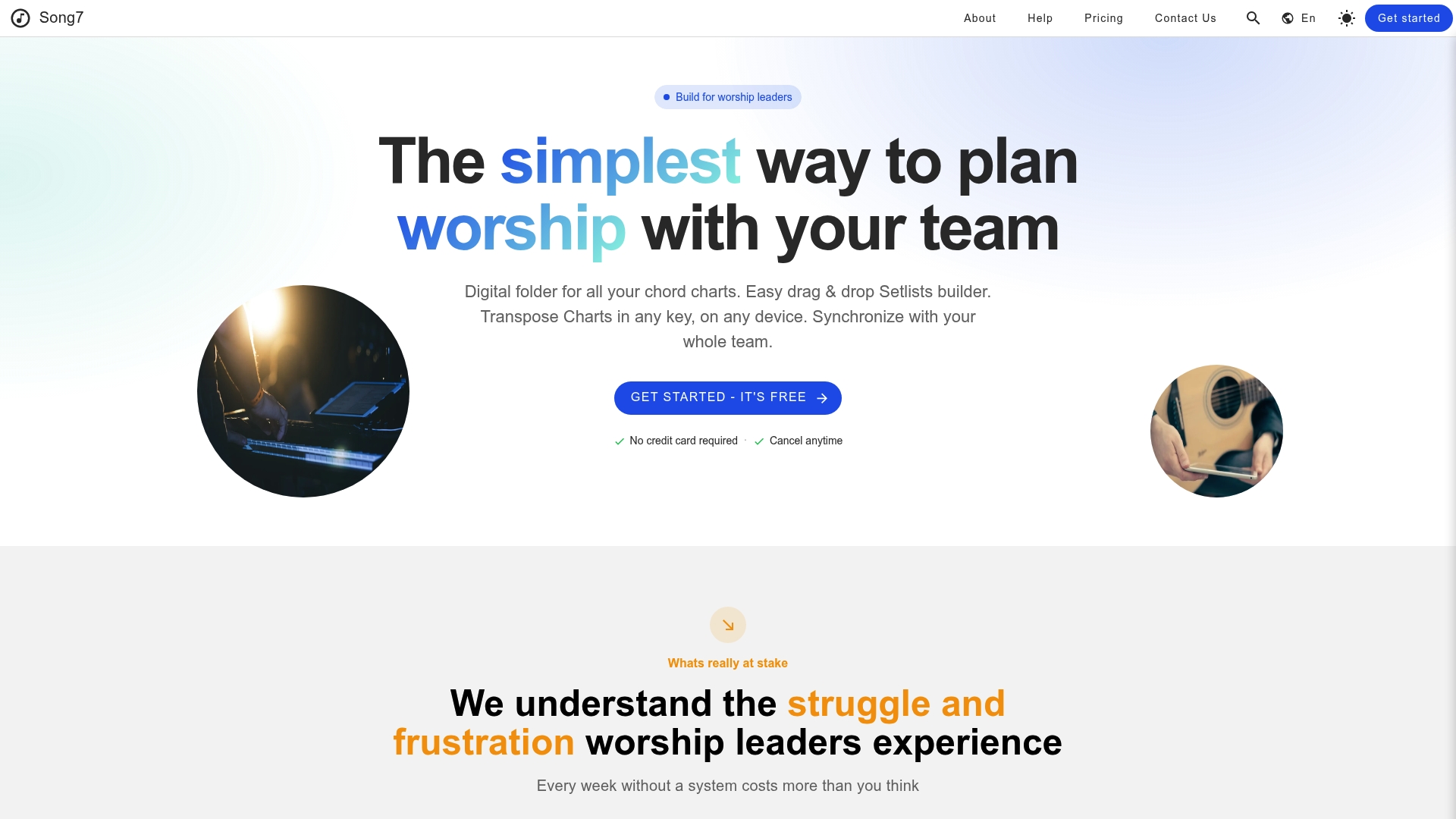
- Import a single ChordPro chart using our format guide as reference.
- Build a one-song setlist and sync it to a second device to see the update appear live.
- Switch to presentation mode and run it through a full rehearsal pass before deciding.
Start a free trial at Song7 or explore the setlist builder and worship tools at Song7 to see whether the fit is right for your team.
FAQ
What is the best app for practicing chords?
For solo practice, a lightweight songbook viewer or a transcription tool that listens to recordings works well. For a worship team that needs synced setlists and presentation mode, Song7 is built specifically for that live, team-based use case.
Is SongbookPro a one-time purchase?
Pricing details for third-party apps like SongbookPro are not something we track, so check the app's own store listing for current pricing. Song7 operates on a subscription model with a free trial rather than a one-time purchase.
Is chord AI better than chordify?
Both fall into the audio-to-chord transcription category, which is built for learning songs by ear from recordings rather than running a synced live setlist. Neither is designed for the team sync or presentation mode a worship team needs on a Sunday morning.
What is the best app for chord charts?
The best choice depends on whether you need solo viewing, audio transcription, or live team sync. For worship teams specifically, an app with native ChordPro support, setlist sync, and presentation mode, like Song7, matches the actual workflow of a rehearsal and a live service.