
To transpose a chord chart, pick your target key, count the semitone distance from the original key, and shift every chord root by that same number. Chord qualities (minor, sus, add9) never change, only the letter names do. Prefer written transposition when you need the exact sound in the new key; reach for a capo when you want to keep familiar open shapes and speed up learning for volunteer players.
Here's the quick decision guide:
- Shift the chart when you need a specific key for a horn section, a track, or a piano player.
- Use a capo when your guitarists need speed and simplicity over precision.
- Use a transposer tool when you're doing this on a deadline or across a whole set list.
Song7 handles this for teams already, transposing instantly and syncing the new chart to every phone and tablet on stage, so nobody's holding the wrong key when the count-off happens.
Key Takeaways
Transposing a chord chart correctly means shifting every chord root by the same semitone count while preserving chord quality, and a capo or synced tool can handle that shift faster than rewriting by hand.
| Point | Details |
|---|---|
| Count semitones first | Find the distance between your original and target key before touching a single chord. |
| Preserve chord suffixes | Keep every m, 7, sus, and add9 intact; only the root letter changes. |
| Match capo fret to key gap | Count down to a comfortable playing key, then capo up the semitone difference. |
| Always retune after capoing | Some capos pull strings sharp, so check tuning with the capo clamped in place. |
| Sync changes across the team | Song7 pushes transposed charts to every band member's device instantly, preventing key mismatches on stage. |
Table of Contents
- How to Transpose Chords Step by Step
- Capo or Written Transposition: Which Should You Use?
- How Do Online Chord Transposers Actually Work?
- Real Examples Worship Teams Actually Use
- Fixing the Most Common Transposition Mistakes
- Song7 Keeps Your Whole Team on the Same Key
- Sources
- FAQ
How to Transpose Chords Step by Step
Transposing by hand is just counting. Once you understand the chromatic scale, you'll never be stuck depending on an app during rehearsal.
- Identify your original key and your target key. Say the song is in C and your singer needs it in D.
- Count the semitone distance. From C to D is two semitones (C to C#, C# to D).
- Shift every chord root by that same number. C becomes D, F becomes G, G becomes A, Am becomes Bm.
- Keep every suffix intact. A 7th stays a 7th, a sus4 stays a sus4, an add9 stays an add9, and slash chords move their bass note the same distance as the root.
This works because chord quality and semitone distance are two separate things. Counting the exact semitone gap between keys is the entire method, and it never changes whether you're moving a simple triad or a stacked jazz voicing.
Two spots trip people up: the semitone pairs E to F and B to C have no sharp or flat between them, so don't go hunting for an "E#" chord that doesn't exist in most charts. And once you're transposing, pick one naming convention (sharps or flats) and stay consistent, since mixing "C#" and "Db" in the same chart confuses anyone reading it live.
Pro Tip: Write your semitone count at the top of the chart in pencil before you start. It's one less thing to recalculate mid transposition if you get interrupted, which, if you've ever run a Wednesday rehearsal, you will be.
Quick example: a song in C with the progression C, G, Am, F needs to move up a whole step to D. Every chord shifts by two semitones: C to D, G to A, Am to Bm, F to G. The shape of the progression stays identical, only the names move.
Capo or Written Transposition: Which Should You Use?
A capo raises pitch by exactly one semitone per fret. Clamp it on fret 2, and every open shape you play sounds two semitones higher, which means you can play a D shape and have it ring out as an E. That single mechanic is why capos exist at all, and it's the fastest shortcut in your entire toolkit.
The math works backward from your target. If the song needs to land in F but your guitarist only knows open shapes in D, count the distance between D and F and capo the appropriate fret. This count down, capo up approach is the standard method worship musicians use to avoid barre chords entirely.
Why bother? A few real advantages:
- Volunteer guitarists can keep playing shapes they already know instead of learning new fingerings under pressure.
- Rehearsal time drops noticeably when players aren't fighting unfamiliar barre chords.
- Multiple guitarists can capo at different frets for layered texture, since higher capo positions naturally brighten the tone as string length shortens.
The trade-off: capo past the seventh or eighth fret and the tone thins out fast, plus you lose access to any low open notes the capo now covers. If your bass note lives below the capo, you'll need to rewrite that voicing or switch to written transposition instead.
Pro Tip: Always tune after the capo goes on, not before. Some capos pull strings slightly sharp, and a guitar that was perfectly in tune open can drift once you clamp down.
How Do Online Chord Transposers Actually Work?
Most browser and app based transposers follow the same four moves. Getting familiar with this sequence means you'll catch errors before they hit the stage.
- Paste or import your chart. Most tools accept plain text, ChordPro format, or a photo of a handwritten chart.
- Confirm the original key (some tools detect it automatically; others ask you to select it).
- Choose your target key or a specific semitone shift, positive to go up, negative to go down.
- Review the output before you trust it.
That review step matters more than people think. Solid transposers preserve every chord suffix and let you shift anywhere from 11 semitones down to 11 up without breaking formatting, but you should still check three things: that chord qualities survived intact, that slash chords moved their bass note along with the root, and that the accidental spelling (sharps versus flats) matches how your team actually reads charts. Most tools also offer a toggle between sharp and flat spellings, which matters more than it sounds since a chart full of "Gb" instead of "F#" throws off readers who aren't expecting it.
If you're running a full band, an isolated transpose is only half the job. What actually saves your Sunday is a tool like Song7 that pushes the updated chart to every band member's device the instant you make the change, so nobody's stuck staring at last week's key.
Real Examples Worship Teams Actually Use
Numbers help, but seeing the mapped chords is what makes transposition click.
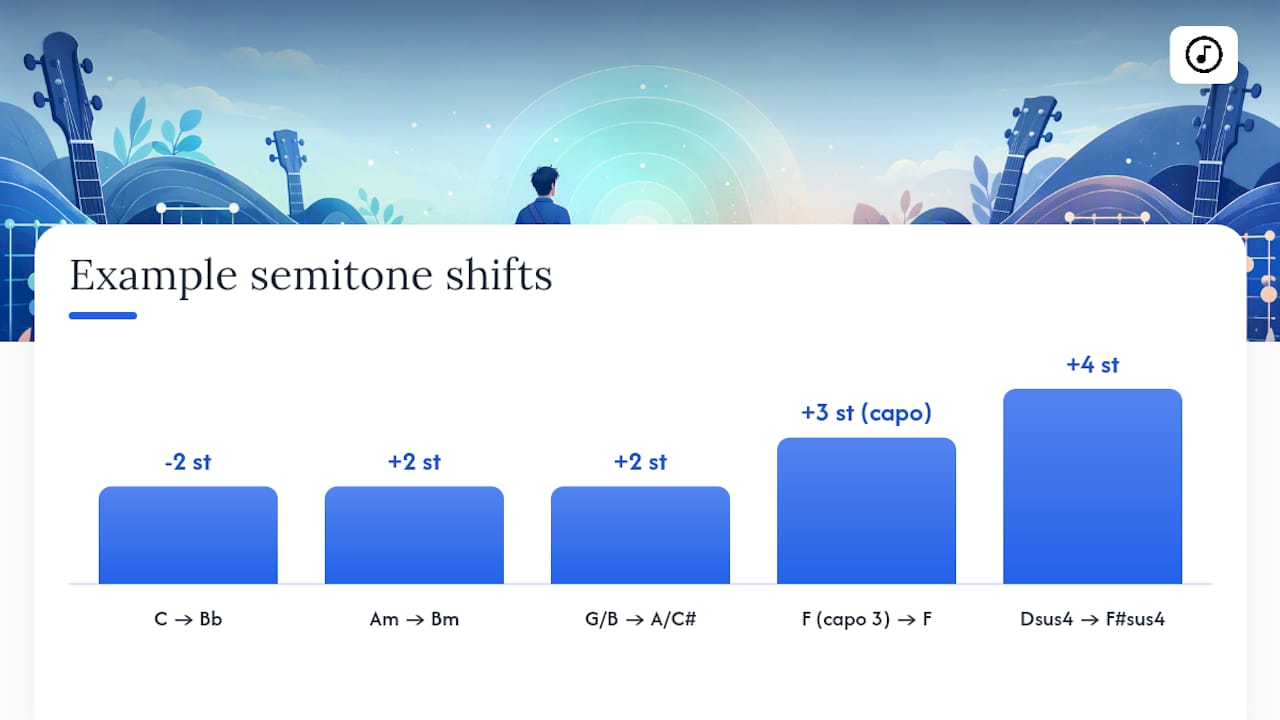
Lowering a key for a tired voice. Your worship leader's voice is running low this week. Drop the song two semitones: C becomes Bb, G becomes F, Am becomes Gm, F becomes Eb.
Capo shortcut into F. Your guitarist only knows D shapes comfortably. F is three semitones above D, so capo fret 3 and play the D-shaped chords exactly as written; they'll ring out in F.
Slash chord check. A chart with G/B transposed up two semitones becomes A/C#. The bass note moves the identical distance as the root, keeping the same inversion sound.
| Original Chord | Shift | Transposed Chord |
|---|---|---|
| C | Down 2 semitones | Bb |
| Am | Up 2 semitones | Bm |
| G/B | Up 2 semitones | A/C# |
| F (capo 3, played as D) | Capo shift +3 | F |
| Dsus4 | Up 4 semitones | F#sus4 |
Fixing the Most Common Transposition Mistakes
Most key disasters on stage trace back to one of a handful of avoidable mix ups. Run through this before you walk into rehearsal.
- Skipping the tune up after capoing. Clamp the capo, then check tuning again. Some capos pull strings sharp, and an out of tune capo sounds worse than an out of tune open guitar.
- Capoing too high for the arrangement. If fret 7 or 8 leaves the tone too thin, either rework the arrangement or bite the bullet and learn the barre shape instead.
- Forgetting horn or brass players. B♭ and E♭ instruments read in a different concert pitch, so a written Bb part sounds a whole step lower than written. Coordinate the written key with your horn section separately from your guitar chart.
- Losing a bass note behind the capo. If your low string is now capoed and you need that open note for the bass line, rewrite the voicing or switch to a written transposition instead.
Pro Tip: Rehearse the whole set with the capo already on, not just the chords in isolation. Confirming the printed chart matches the capoed shapes before Sunday saves you from a scramble mid-service.
Why Fast Transposition Changes How Your Team Rehearses
Transposition speed is a bigger deal than most worship leaders give it credit for. A five-minute delay while someone manually rewrites a chart is five minutes your drummer is checking their phone and your energy is leaking out of the room.
The real cost isn't the transposition itself, it's the version control mess that follows. Someone transposes on paper, texts a photo to half the band, and by Sunday there are three different keys floating around different music stands. Centralized, synced tools solve the actual problem, which isn't math, it's coordination.
That's the gap Song7 was built to close. Instant transposition that syncs to every team member's device in real time means the guitarist, the pianist, and the vocalist are always looking at the same key, whether you changed it Tuesday night or thirty seconds before the service starts.
Song7 Keeps Your Whole Team on the Same Key
Song7 gives worship teams one place to build set lists, transpose on the fly, and know every band member is looking at the current chart, not last week's key. If you've ever watched a bass player start in the wrong key because a text message got buried, this solves that specific problem directly.

It fits naturally if you're already doing what this article walks through: manually counting semitones, juggling capo positions, or texting screenshots of updated charts to your team. Song7 replaces that entire workaround with instant transposition, chord diagrams, and real-time sync across every device your band uses, whether that's a phone on a music stand or a tablet at the piano. For volunteer-heavy teams especially, removing that friction means less time troubleshooting and more time actually rehearsing the song.
Try Song7's setlist and transposition tools with your team this week and see how much smoother rehearsal runs when everyone's chart updates at once.
Sources
- What is a capo? A complete guide to using guitar capos
- Transpose calculator and guide
- How to transpose chords with a capo (guide and examples)
FAQ
Is there a free chord transposer available online?
Yes, several browser-based tools let you paste a chart and shift it instantly without cost, though most cap out at basic transposition without team sync or presentation features.
How do I transpose chords to a different key?
Count the semitone distance between your current key and your target key, then shift every chord root by that same number while keeping suffixes like m, 7, or sus unchanged.
What app can musicians use to transpose chords for a team?
Song7 transposes charts instantly and syncs the updated key to every team member's device, which matters most for bands juggling multiple musicians across different instruments.
What is considered the "forbidden chord" in music?
There's no single universally agreed "forbidden chord." The term shows up informally around certain dissonant intervals or tritone-heavy voicings that composers historically avoided in specific styles, but it isn't a fixed, standardized term in music theory.