
Team rehearsal notes are the song-specific details your worship team needs before they walk into rehearsal: keys, tempos, structure, cues, and who's playing what. The single best practice to adopt this week is simple: send standardized, clearly formatted notes and a final setlist at least three days before rehearsal. Song7 and other worship planning tools exist to make that habit painless.
TL;DR:
- Sending rehearsal notes at least three days in advance ensures teams have enough time to prepare and reduces last-minute confusion.
- Use a consistent chart format with clear measure markers, repeat signs, and explicit tempo changes to minimize decoding time during rehearsal.
- Prioritize confirming the final setlist verbally and updating the master chart immediately after rehearsal to prevent version confusion.
- Different skill levels require tailored notes, with more detailed instructions for beginners and streamlined charts for experienced players.
- Avoid common mistakes like late distribution, incomplete information, inconsistent formatting, and multiple file versions to keep rehearsals focused and efficient.
Table of Contents
- What to Include in Every Song's Rehearsal Notes
- When and How to Deliver Rehearsal Notes and Setlists
- Formatting Charts and Notes Your Team Can Actually Trust
- How to Run a Rehearsal Once the Notes Are Out
- Editorial Perspective: Why This Workflow Protects Volunteers
- Tailoring Rehearsal Notes to Different Skill Levels
- Common Mistakes to Avoid When Preparing Rehearsal Notes
- Building Team Feedback Into Your Rehearsal Notes
- Editorial Take: What the Research Actually Supports
- How Song7 Keeps Your Rehearsal Notes in Sync
- Sources
- FAQ
What to Include in Every Song's Rehearsal Notes
Good rehearsal notes aren't a vague "here's the setlist" text. They're a complete package that tells every musician exactly what to expect before they open their instrument case. A praise chart worth trusting includes title, time signature, key, tempo, structure, rehearsal cues, and role definitions, so nobody has to rebuild the song from memory on Sunday morning.
Here's what belongs on every song sheet you hand out:
- Header block: song title, arrangement version, key, tempo in BPM, time signature, and who wrote or arranged this version.
- Schematic roadmap: labeled sections (Intro, V1, C, B) with measure markers, repeats, and endings spelled out.
- Performance cues: dynamics, instrument entries and exits, harmony notes, and capo or transposition instructions.
- Assignments: who sings lead, who covers harmony, who calls transitions, and tech cues like click track or backing track start points.
- Reference links: the master recording, the chart PDF, the backing track, and the click file if your team uses one.
Skip any of these and you're setting someone up to guess during rehearsal, which burns time you don't have.
Pro Tip: Keep the header block identical across every song in your library. When every chart follows the same layout, your team stops hunting for information and starts reading it automatically, even under stage lights.
When and How to Deliver Rehearsal Notes and Setlists
Timing matters more than most leaders realize. Sending materials at least three days before rehearsal shifts your rehearsal time away from note-learning and toward actually refining the song. If your rehearsal is midweek before a weekend service, Wednesday is the natural deadline for a finalized send.
Follow this sequence to keep notes reliable and easy to find:
- Finalize the setlist with your team leads before you send anything. Last-minute swaps confuse volunteers who already started practicing.
- Share through one authoritative channel. A team planning app or shared cloud link works better than scattered texts, and always attach a printable PDF for people who read paper better than screens.
- Reserve group chat for urgent changes only. If a key drops or a transition changes the day before rehearsal, flag it there, but don't make chat your primary delivery method.
- Label every file with date and version so nobody rehearses off last month's chart by mistake.
- Test readability on a phone screen before sending. If you can't read it comfortably on your own device, your bass player won't either.
Accessibility closes the loop: printable and mobile-friendly versions of the same chart mean nobody shows up unprepared because the format didn't work for them.
Formatting Charts and Notes Your Team Can Actually Trust
Formatting is where good intentions fall apart. A chart packed with correct information but organized poorly still slows a rehearsal down, because musicians spend more time decoding the page than playing the part.
Measure markers and basic notation conventions tell players exactly where chord changes land and how long to hold them. Without that structure, even skilled musicians default to guessing, and guessing eats rehearsal minutes you don't get back.
Stick to these formatting habits:
- Mark every repeat, cut, and ending clearly, with no ambiguity about how a section closes.
- Cross out outdated information completely rather than leaving it half visible, and rewrite messy handwritten notes cleanly in the margin instead of squeezing corrections between lines.
- Always list BPM, and note tempo feel changes (half time, double time) in plain words, not just numbers.
- Keep the primary chart clean. Secondary edits and experimental changes belong in margin notes or a separate versioned file, not scribbled over the main structure.
A recurring theme across worship leadership resources: teams that standardize chart conventions like measure markers and explicit cut/repeat notation report fewer conflicting edits and less rework at the next rehearsal. That consistency is worth building into your template now, before your next song list goes out. A compact template, title block up top, schematic roadmap below it, parts and cues beneath that, gives every chart the same visual logic, and formatting your charts this way prevents the mid-phrase page turns that trip up even experienced players.
How to Run a Rehearsal Once the Notes Are Out
Sending great notes only pays off if rehearsal itself uses them well. The goal isn't to teach songs from scratch. It's to perfect what people already prepared on their own time.
Here's a rhythm that works for a typical 60 to 90 minute rehearsal block:
- Open with a quick tech check and attendance, then a short prayer or vision moment before you touch instruments. This isn't filler. It resets the room from "errand" mode to "ministry" mode.
- Confirm the setlist out loud so everyone hears the final order, not just the one they read three days ago.
- Rehearse the hardest or newest song first, while attention and energy are still high. Save the songs everyone already knows for later in the block.
- Run transitions between songs, not just the songs themselves. Transitions are where services actually fall apart on Sunday.
- Set a time limit per song and move on even if it's not perfect. Chasing perfection on one track steals rehearsal time from everything after it.
- Loop problem spots using a click track when tempo drift is the issue, and record one full run near the end for review later.
Immediately after rehearsal, update the authoritative chart: cross out anything that changed, confirm the final tempo, and reshare the file before people leave the building. Ending rehearsal with one direct question, "does anyone have a different ending, cut, or repeat written down?", catches conflicting notes before they turn into confusion on stage.
Pro Tip: Record that final run-through on your phone and send it alongside the updated chart. A 90-second voice memo of the confirmed arrangement clears up more confusion than another paragraph of written notes ever will.

Editorial Perspective: Why This Workflow Protects Volunteers
Rehearsal notes function as communication tools first, musical documents second. Teams whose leaders teach preparation habits instead of just handing out charts tend to see shorter rehearsals and more confident volunteers.
The measurable pattern across worship leadership resources is consistent:
- Rehearsals run faster when notes are standardized instead of improvised week to week.
- Volunteers report fewer last-minute changes when the three-day send window is honored.
- Team confidence improves when charts use consistent formatting instead of a fresh layout every week.
For deeper workflow structure, Song7's rehearsal planning guide and song library organization tips build directly on these habits.
Tailoring Rehearsal Notes to Different Skill Levels
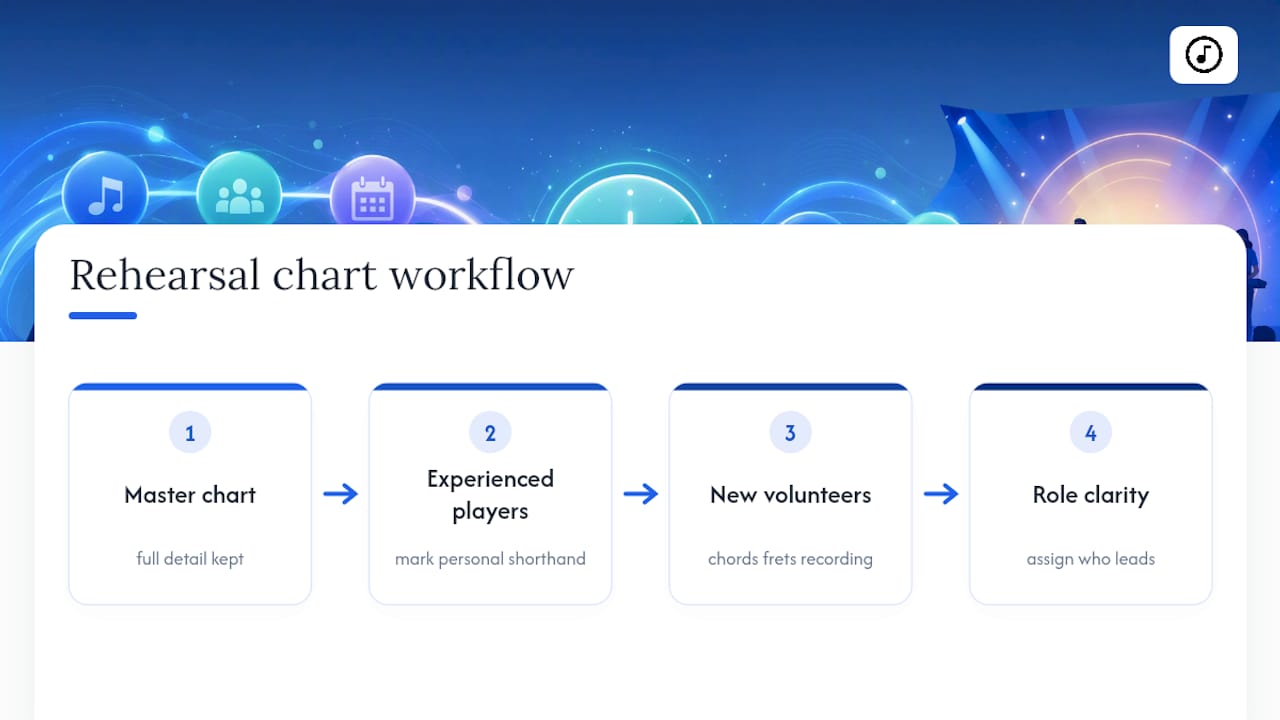
Your acoustic guitarist who's played for twenty years and your new bass volunteer who just joined the team need different things from the same chart. Writing one note format for everyone usually means it works for nobody particularly well.
For newer or less experienced volunteers, add extra scaffolding: spell out chord names in full rather than relying on shorthand, note exact string positions or fret numbers where helpful, and include a link to the master recording so they can hear the part before attempting it. Don't assume they'll recognize a cue like "hit the turnaround" without a plain-language explanation the first few times.
For experienced players, strip the chart down. Overexplaining slows down a musician who already reads structure at a glance, and it can feel condescending over time. Give them the schematic roadmap and let them fill in the details themselves.
A practical middle path: keep one master chart with full detail, then let experienced members mark their own personal copies with shorthand. The role clarity that comes from defining who leads which part also helps you know which format each person actually needs. Ask new volunteers directly what helps them most. Some read notation fluently. Others need chord diagrams and a recording far more than they need written cues.
Common Mistakes to Avoid When Preparing Rehearsal Notes
The most common failure isn't bad information. It's inconsistent delivery. A leader who sends detailed notes one week and a rushed voice memo the next trains the team not to trust either format.
Watch for these recurring problems:
- Sending notes too late. Anything delivered the night before rehearsal doesn't give volunteers real preparation time, which defeats the entire purpose.
- Leaving old information half-visible. A crossed-out tempo that's still readable invites someone to follow the wrong number by accident.
- Skipping the schematic roadmap. Without labeled sections, every talk-through wastes minutes re-explaining song structure that a diagram would show instantly.
- Formatting differently every week. Charts that change layout constantly force your team to relearn how to read notes instead of focusing on the music.
- Forgetting to note tempo feel changes. A number alone doesn't tell a drummer that the bridge switches to half time.
- No single authoritative file. When notes live in three different chat threads, nobody knows which version is current.
Most of these mistakes come from good intentions under time pressure, not carelessness. The fix isn't more effort. It's a repeatable system that doesn't depend on remembering everything fresh each week.
Building Team Feedback Into Your Rehearsal Notes
Rehearsal notes get better when they're a conversation, not a one-way memo. The musicians actually playing the parts often catch formatting problems you'd never notice from the front of the room.
Build a short feedback moment into your rehearsal closing routine. Asking directly, "was anything on the chart confusing or missing?", surfaces small issues before they become recurring frustrations. Creating space for questions during rehearsal also builds the kind of trust that keeps volunteers engaged over the long run, not just for one Sunday.
When someone flags a problem, fix the template, not just that week's chart. If your drummer keeps missing a tempo change because it's buried in tiny text, move it somewhere more visible for every future song, not just the one that caused the complaint. Small structural fixes compound over months.
Keep a lightweight log of recurring feedback, even a running note on your phone works, so you can spot patterns instead of treating every complaint as a one-off. If three different musicians ask for the same clarification across separate weeks, that's a formatting gap worth solving permanently, not a coincidence worth ignoring.
Editorial Take: What the Research Actually Supports
The conventional advice on rehearsal notes treats them like an administrative afterthought, something you dash off between Sunday services. That framing gets the priority backwards. Notes are the actual mechanism that turns rehearsal from a note-learning session into a refinement session, and the three-day send window is the single highest-leverage habit worship leaders can adopt.
What's overrated: chasing perfectly polished notation every week. What matters more is consistency, the same format, the same send day, every time, so your team builds a reflex around it.
What we'd prioritize first, if you only fix one thing: stop sending notes the night before. That single change does more to protect your volunteers' time and confidence than any formatting upgrade ever will. Everything else, chord diagrams, schematic roadmaps, tempo markings, matters, but it matters less than timing.
— Editorial team
How Song7 Keeps Your Rehearsal Notes in Sync
Song7 solves the exact problem most worship teams hit every week: someone rehearses off an old chart because the update never reached them. Instead of chasing down text threads and mismatched PDFs, your whole team pulls from one synced setlist that updates instantly the moment you make a change.

The features map directly onto the workflow this article just walked through. Setlist building tools help keep your order current without rebuilding it from scratch each week. Instant transposing helps handle key changes without manual chart rewriting. Presentation mode and chord diagrams display formatted notes on phones and stage displays, and a built-in metronome helps keep tempo markings accurate during rehearsal. Role management and real-time syncing ensure that updates made are visible to everyone promptly, avoiding version confusion and outdated paper charts.
If your team is still passing around inconsistent PDFs, start building your first synced setlist with Song7 and see how much rehearsal time comes back to you.
Sources
- How to Run Better Worship Team Rehearsals - WorshipLeader
- 15 Worship Rehearsal Tips That Actually Save Time - Worship Online
- How to mark charts you can trust on stage - Soundbrenner
- Worshipinfo
FAQ
What Should Team Rehearsal Notes Include?
Every song's notes should cover the header block (title, key, tempo, time signature), a schematic roadmap of sections, performance cues, and clear assignments for vocalists and instrumentalists.
When Should I Send Rehearsal Notes and Setlists?
Send finalized notes and the setlist at least three days before rehearsal, typically Wednesday for a weekend service, so volunteers have real preparation time.
How Do I Format a Chord Chart People Actually Trust?
Use measure markers, mark repeats and endings clearly, list BPM explicitly, and cross out outdated information completely rather than leaving it half visible on the page.
What's the Biggest Mistake Worship Leaders Make With Rehearsal Notes?
Sending notes too late, often the night before rehearsal, which eliminates the preparation window and forces rehearsal back into note-learning mode instead of refinement.
Can Song7 Help Keep Rehearsal Notes Synced Across My Team?
Yes. Song7 syncs setlists, chord charts, and transpositions in real time, so every team member sees the same current version on their own device.