
Use an order-of-risk rehearsal with a protected final run-through. Tackle your hardest or newest song first, drill transitions before anyone gets tired, and never let song work eat into the one uninterrupted pass through the whole set. This structure prepares volunteer teams faster and treats their time as valuable. Your next move is to send the setlist and parts at least three days out, and set a hard, public start time for the final run-through.
TL;DR:
- Rehearsing the hardest or most unfamiliar song first ensures it receives focused attention before volunteers tire, reducing last-minute surprises on Sunday.
- Sending detailed setlist information, reference recordings, and personal notes at least three days before rehearsal helps volunteers come prepared, saving time and minimizing teach-in during practice.
- Limiting rehearsal to 60-90 minutes and following a structured agenda focused on risk areas, transitions, and the final run-through improves efficiency and volunteer retention.
- Addressing problem spots through targeted, isolated drills rather than full song repeats accelerates fixes and respects volunteers' time.
- Consistently starting rehearsals on time and ending as scheduled builds trust, creates a culture of punctuality, and ensures the final run-through remains a protected, high-energy practice.
Table of Contents
- What Is Worship Rehearsal Planning, and Why Does Order Matter?
- Pre-Rehearsal Planning: What to Send Before Anyone Shows Up
- Building a Church Rehearsal Schedule: 90 Minutes and a 60-Minute Backup
- How Do You Fix Trouble Spots Without Derailing Rehearsal?
- Fast, Effective Soundcheck and Tech Coordination
- Shifting Practice Home: Tools That Keep Everyone in Sync
- Running the Protected Final Run-Through
- Strategies for Accommodating New or Inexperienced Team Members
- Turning Team Feedback Into Better Rehearsals
- Handling Unexpected Challenges and Last-Minute Setlist Changes
- Creating a Rehearsal Atmosphere That Builds Morale
- Editorial Perspective: Leadership, Not Talent, Fixes Bad Rehearsals
- Try Song7 to Run This Plan Every Week
- Sources
- FAQ
What Is Worship Rehearsal Planning, and Why Does Order Matter?
Worship rehearsal planning is the process of deciding what your team practices, in what order, and for how long, so that Sunday's service comes together without wasting anyone's Tuesday night. Most teams get this backwards. They rehearse in service order, front to back, and by the time they hit the bridge that always falls apart, the drummer has to leave for work and the sound guy has already tuned out.
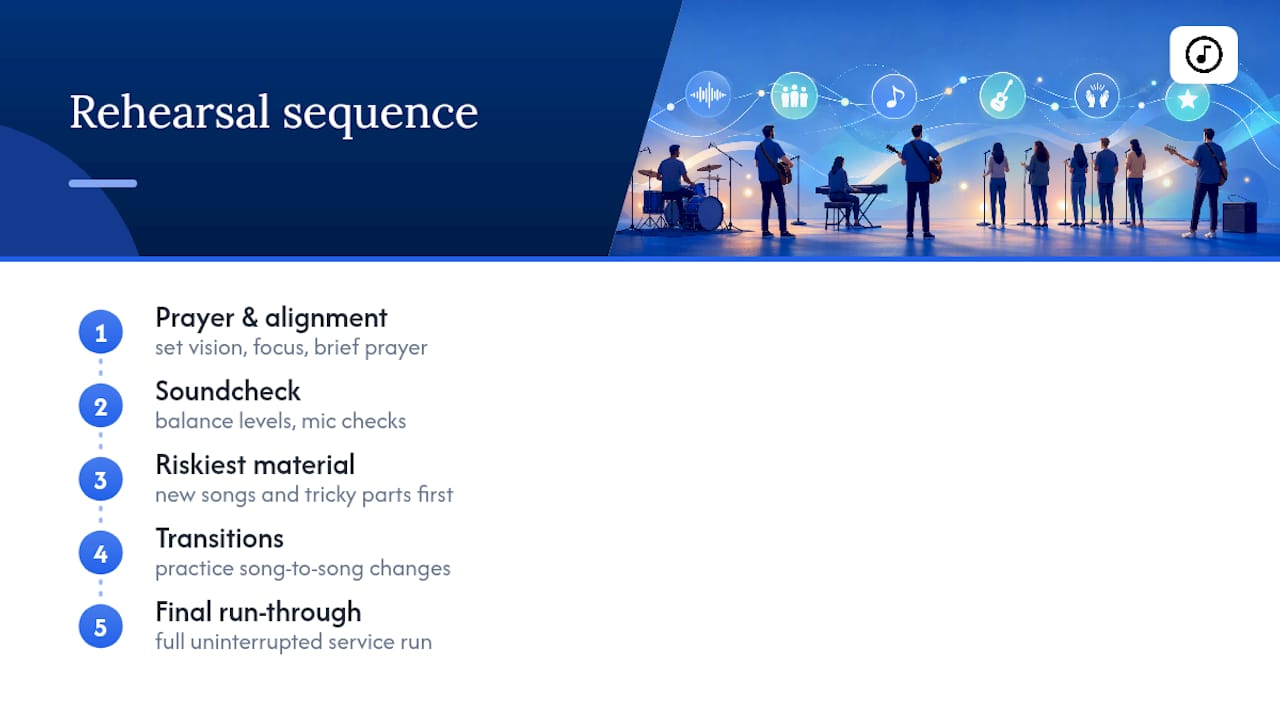
A better rehearsal planning worship structure flips the sequence: alignment first, soundcheck second, the riskiest material third, transitions fourth, and a full uninterrupted run-through last. That sequencing isn't arbitrary. A focused rehearsal sequence of prayer and alignment, soundcheck, targeted song work, and a final run-through consistently produces better outcomes than rehearsing straight through in service order. The reasoning is simple: your team's energy and attention are highest at the start. Spend that energy on what's actually hard, not on the song everyone already knows.
This also solves the "we ran out of time" problem that plagues almost every volunteer rehearsal. When the new song, the tricky key change, or the unfamiliar transition gets bumped to the end of a two-hour block that started fifteen minutes late, it never gets the attention it needs. Put it first instead, and you guarantee your riskiest moment gets your best focus.
Pre-Rehearsal Planning: What to Send Before Anyone Shows Up
The best rehearsals are won before they start. If your team walks in cold, having never heard the arrangement or looked at the chart, rehearsal time becomes teaching time. That's not rehearsal. That's a first read, and it eats the clock.
Here's what to send at least several days ahead of rehearsal:
- The full setlist with keys and tempos (BPM) for every song
- Part-specific reference audio or a link to the original recording plus notes on what's different in your arrangement
- Chord charts and lyric sheets, tagged and easy to find
- A short note on any custom arrangement changes (a shortened bridge, a key change, a different ending)
Assigning individual parts matters as much as sending the list. A generic "here's the setlist, see you Tuesday" text doesn't create accountability. A short, personal message to your bass player confirming she's on the set and flagging the one section that's new to her does. That kind of direct follow-up, paired with clear attendance confirmation, is one of the simplest tips that actually save rehearsal time.
For custom arrangements, a quick voice memo of you or another musician playing through the changed section beats a written note every time. Volunteers can listen to it three times on their commute; they can't rehearse from a paragraph of text describing a chord substitution.
Don't forget your tech lead. Send a tech note alongside the musical setlist covering track order, click needs, and rough slide timings. This lets your tech team prepare instead of guess.
Pro Tip: Spend 30 minutes the day before rehearsal walking through your own plan, song by song, and flag the two or three moments most likely to eat time. A short planning window before rehearsal prevents you from discovering problems live, in front of the whole team.
Numbered version for your own prep checklist:
- Send setlist, keys, tempos, and reference audio (3+ days out)
- Confirm attendance with individual, direct messages
- Record quick voice memos for any custom sections
- Share tech notes with your sound and media team
- Do your own 30-minute walkthrough the day before
The Worship Team Scheduling guide covers call times and timing allocation in more depth if you want a template to build from.
Building a Church Rehearsal Schedule: 90 Minutes and a 60-Minute Backup
A worship rehearsal checklist is only useful if it's paired with a timeline your team can actually follow. Most volunteer teams do best with a 60 to 90 minute rehearsal window. Beyond 90 minutes, focus drops fast, and you start paying in volunteer burnout what you gained in extra polish.
Here's a 90-minute agenda built on order-of-risk, not service order:
- Setup and load-in (0 to 10 minutes) — Team arrives, instruments and stations are ready. You should not be tuning a guitar at minute 12.
- Prayer and alignment (10 to 15 minutes) — Five minutes. Ground the team spiritually and set expectations for the night. Leader-led.
- Soundcheck (15 to 22 minutes) — Seven minutes, no more. Covered in detail below.
- Hardest or newest song first (22 to 40 minutes) — Eighteen minutes on the one song most likely to fall apart Sunday. Leader-led, with direct input from whoever wrote or arranged it.
- Transitions (40 to 55 minutes) — Fifteen minutes drilling the connective tissue between songs, not the songs themselves.
- Remaining song work and vocals (55 to 70 minutes) — Fifteen minutes for the rest of the set, prioritizing anything with new harmony parts.
- Endings and tags (70 to 75 minutes) — Five minutes isolating how songs actually end, since ragged endings are the most noticeable mistake in a live room.
- Final run-through (75 to 88 minutes) — Thirteen minutes, uninterrupted, full set energy.
- Wrap and debrief (88 to 90 minutes) — Two minutes. Say thank you. Send everyone home on time.
Rehearsing the hardest or newest song first and rehearsing transitions explicitly fixes the most common structural mistake in volunteer worship rehearsals: running out of energy exactly when the hardest material shows up.
If you only have 60 minutes, here's what survives:
- Alignment: cut to 3 minutes
- Soundcheck: hold at 7 minutes, non-negotiable
- Hardest song: 15 minutes
- Transitions: 10 minutes
- Remaining songs: 15 minutes (combine with endings, no separate slot)
- Final run-through: 8 minutes
- Wrap: 2 minutes
What gets sacrificed in the 60-minute version is depth on your easiest, most familiar songs. That's the right trade. Cut time from what your team already knows, never from the final run-through.
Starting on time, every time, changes your team's culture more than any single rehearsal technique. When a leader consistently starts at the posted time and consistently ends on schedule, volunteers stop budgeting extra time "just in case" and start trusting the plan. That trust is what makes the protected final run-through actually protected. Nobody skips it, because nobody has anywhere else to be yet.
How Do You Fix Trouble Spots Without Derailing Rehearsal?
Song work is where rehearsals go sideways. A leader spots a problem, stops the band, explains what's wrong for ninety seconds, tries again, stops again, and suddenly eighteen minutes of planned time has produced two shaky passes through one section.
Fix this with a tighter loop. Before you touch an instrument, give a 30 to 45 second pre-song brief: name the one or two trouble spots you already know about and describe the dynamic you want (quieter verse, bigger chorus, whatever it is). This gives everyone a target before they play a note, instead of discovering the target through trial and error.
When something breaks, isolate it. Don't run the whole song again. Split the section: have the rhythm section drill the specific bar where the groove falls apart, or have your vocalists run the harmony phrase on its own, away from the full band. Fix the small piece, then reassemble it into the song. This is faster than a full replay almost every time, and it respects the musicians who already had that section locked.
Transitions deserve their own dedicated drill, separate from song work:
- Play the outro of one song directly into the intro of the next, several times in a row
- Rehearse spoken counts and hand cues out loud, not just musically
- Simulate any capo change, instrument swap, or key modulation exactly as it will happen live
Endings and tags are worth a short, isolated drill too. Most bands can play a song fine but end it messily, because nobody actually rehearses the last four bars on their own.
Pro Tip: Never use your one protected final run-through to "practice" a transition you haven't drilled yet. If a transition isn't solid by the time you reach the run-through, it stays rough on Sunday. The run-through is for flow, not fixing.
Fast, Effective Soundcheck and Tech Coordination
A soundcheck that drags past seven minutes is stealing time from song work. The intro/verse/chorus method keeps it tight: run a short section of one representative song, ask each musician a specific mix question ("can you hear your click?", "is your vocal loud enough over the acoustic guitar?"), adjust, and move to the next input.
A quick checklist to run through:
- Confirm in-ear or monitor mixes for every vocalist and musician individually
- Check every mic line and DI connection before anyone starts playing
- Confirm backing track playback is cued, labeled, and in the right order
- Introduce click tracks early in rehearsal, not for the first time during the final run-through
- Loop in your tech lead during transitions, not just during the run-through
Concise soundcheck routines that stay under seven minutes preserve the time you need for the parts of rehearsal that actually change Sunday's outcome.
Involving tech in rehearsal whenever slides, video, or tracks drive the service flow prevents the Sunday morning surprise where a slide advances a beat late or a track starts in the wrong key. If your service depends on visual or track cues, your tech team needs to be inside the transitions drill, not watching from the booth. Our guide to click tracks in worship walks through rollout strategy if your team is introducing clicks for the first time.
Shifting Practice Home: Tools That Keep Everyone in Sync
The single most common rehearsal mistake is reteaching parts during group time that a musician should have learned alone, at home, during the week. Every minute spent teaching one person their part in front of eight other volunteers is a minute stolen from everyone else.
Set the expectation clearly: musicians practice their individual parts, along with the click, before rehearsal. Give them a practice deadline, not just a vague "look this over before Tuesday."
Package materials so home practice is actually easy:
- Isolated instrument or vocal parts where possible, not just the full mix
- Short clips highlighting the one tricky section, rather than the whole song
- Annotated charts marking the exact changes from a standard arrangement
Communication is the glue holding this together. A confirmation that materials were received, a reminder two days out, and a short encouraging note before rehearsal do more for preparedness than any amount of nagging in the room.
This is exactly the gap a tool like Song7 is built to close. It centralizes setlists and chord charts so updates sync instantly instead of living in five different group chats. It transposes songs on the fly, runs a clean presentation mode for lyrics, and keeps the whole team synced in real time on roles and rehearsal notes. When practice materials live in one place your team already checks, "I didn't see the update" stops being an excuse.
Pro Tip: Send practice materials the same day every week. Predictability trains your team's habits faster than reminders ever will.
Running the Protected Final Run-Through
The final run-through is not another chance to fix a bad transition. It's a full simulation: play the entire set non-stop, with spoken parts, prayers, and slide or video cues exactly as they'll happen Sunday. No stopping, no do-overs.

Record it. A recorded run-through gives you and your team something concrete to review afterward, catching issues nobody noticed live and giving quieter volunteers a low-pressure way to offer feedback later.
Close with a two-minute debrief, no longer:
- One thing that worked well tonight
- One thing that needs follow-up before Sunday
- Who needs a quick one-on-one coaching note, sent privately, not called out in the room
Then release the team on time. Ending rehearsal exactly when you said you would is one of the most underrated leadership habits in volunteer ministry. Teams that consistently get released on time stay longer, show up more reliably, and trust the plan enough to give their best energy to the parts that matter, like that protected run-through itself.
Strategies for Accommodating New or Inexperienced Team Members
A new vocalist or a guitarist who just joined the team needs a different kind of preparation than your veterans, and pretending otherwise slows the whole rehearsal down.
Pair new members with a seasoned teammate before rehearsal starts, not during it. A five-minute walkthrough of the chart and the arrangement's quirks, done one-on-one earlier in the week, means the new player arrives already oriented instead of discovering the key change live.
During rehearsal itself, give new members simplified assignments for their first few weeks. A new vocalist might sing melody only, skipping the harmony part until the melody is second nature. A new drummer might play a simplified groove on the trickiest song while learning the full arrangement over several weeks.
Position new members near an experienced player they can watch and follow, and brief that veteran ahead of time that they're an informal mentor for the night. Never single out a new member's mistake in front of the group. Address it quietly, one-on-one, after rehearsal or in a follow-up message.
The goal is for a new team member's first few rehearsals to build confidence, not anxiety. A volunteer who feels supported in their first month stays on the team. One who feels exposed usually doesn't come back.
Turning Team Feedback Into Better Rehearsals
Every rehearsal generates information about what's working and what isn't, and most leaders let it evaporate the moment the room empties. That's a missed opportunity.
Build a short feedback loop into your rehearsal rhythm. After the debrief, ask one or two team members privately what felt rushed or unclear. Volunteers often notice friction points a leader misses because they're focused on running the room instead of playing in it.
Track recurring issues across multiple weeks, not just single rehearsals. If transitions have felt shaky three weeks running, that's a structural problem in your rehearsal plan, not a one-off fluke, and it deserves a dedicated fix, like adding an extra five minutes to the transitions block.
Act on feedback visibly. When a bass player mentions the click was too quiet in her monitor last week, and you open the next rehearsal by confirming that got fixed, you teach your whole team that feedback actually changes things. That single habit does more to build a feedback culture than any survey or suggestion box ever will.
Handling Unexpected Challenges and Last-Minute Setlist Changes
A vocalist calls in sick an hour before rehearsal. The drummer forgot the click adapter. The pastor swaps the sermon topic Thursday night, and now Sunday's setlist needs a different closing song. Last minute setlist changes are not a sign your planning failed. They're a normal part of running a volunteer team.
What separates a leader who handles this well from one who doesn't is having a shallow bench and a fast communication channel ready before the crisis hits. Know in advance who can cover a missing part on short notice, even if their version is simpler than the original.
When a setlist change lands late, protect the final run-through above everything else. Cut song-work time on familiar material to make room for the new song, rather than shortening or skipping the run-through. A team that has never played the new closing song together as a full pass is far more exposed than a team that skipped an extra rep on a song they already know.
Communicate changes the moment you know about them, not at the start of rehearsal. A quick group message the night before, even with incomplete information, beats a surprise announced live in the room. Volunteers handle change far better when they've had even a few hours to mentally prepare.
Creating a Rehearsal Atmosphere That Builds Morale
The tone a leader sets in the first five minutes of rehearsal often determines how the whole night goes. A leader who walks in stressed and rushes straight into song work signals that this is a task to get through. A leader who opens with genuine warmth, a moment of prayer, and a specific word of encouragement to someone on the team signals something different: that this time matters, and so do the people in the room.
Celebrate specific wins out loud. Not generic praise, but naming the exact moment someone nailed a hard transition or caught a mistake before it became a problem. Specific encouragement lands as sincere in a way generic encouragement never does.
Correct in private, praise in public. Mistakes get addressed quietly and kindly, one-on-one. Progress gets celebrated in front of the whole team.
Protect breaks, even short ones, during longer rehearsals. A team that's mentally fried by minute 60 doesn't play better because you kept going; they play worse. A two-minute breather often saves more than it costs.
None of this requires extra time in your schedule. It requires intention in how you use the time you already have.
Editorial Perspective: Leadership, Not Talent, Fixes Bad Rehearsals
Poor rehearsals almost never come down to a talent shortage. They come down to leadership that hasn't structured time around risk, respect, and clarity. A team that gets a clear checklist, a protected run-through, and an on-time release learns to trust its leader, and that trust shows up in retention long before it shows up in polish. The structure isn't about control. It's about honoring people who are giving their Tuesday nights for free.
— Editorial team
Try Song7 to Run This Plan Every Week
Every checklist item in this article, sending the setlist early, assigning parts, prepping tech notes, drilling transitions, protecting the run-through, depends on your team actually having the right materials in hand at the right time. Song7 handles that backbone. Setlists sync instantly across the team, so nobody's working from a stale chart. Songs transpose on the spot when a key changes midweek. Chord charts and lyrics live in one searchable library, presentation mode runs clean during the service, and team roles keep everyone clear on who's covering what.

If Tuesday nights currently involve texting three group chats and hoping everyone opened the PDF, Song7 replaces that scramble with one shared space your whole team already checks. Start a trial and build your next rehearsal's setlist before this week's practice.
Sources
The rehearsal sequence and timing in this guide draws on a worship rehearsal plan built around respecting volunteers' time, which establishes the core sequence of alignment, soundcheck, song work, and run-through.
The order-of-risk principle, rehearsing the hardest song first and drilling transitions deliberately, comes from a breakdown of why most rehearsals run backwards.
Pre-rehearsal checklist items and time-saving habits are grounded in a list of practical rehearsal tips, while the soundcheck method and leader planning window come from a guide to running rehearsals that actually work. A rehearsal checklist resource also informed the pre-rehearsal and wrap-up task lists.
- A Worship Rehearsal Plan That Respects People’s Time: A Simple System That Works
- Your worship rehearsal is probably backwards—here’s the fix
- 15 Worship Rehearsal Tips That Actually Save Time
- How to Run A Worship Rehearsal That Actually Works
FAQ
What Are the 5 C's of Worship?
Definitions vary by ministry, but many teams use a version built around Call to worship, Confession, Communion, Celebration, and Commission, marking the spiritual arc of a service rather than a strict rehearsal formula.
What Are Some Good Techniques for Rehearsals?
Rehearsing your hardest or newest song first, drilling transitions separately from songs, using a 30 to 45 second pre-song brief, and protecting an uninterrupted final run-through are among the most effective techniques for volunteer teams.
What Are the 7 Elements of Worship?
Common lists include elements like prayer, singing, Scripture reading, preaching, communion, giving, and benediction, though the exact grouping varies by church tradition and denomination.
How Do You Plan a Worship Experience?
Start with the sermon theme or service focus, choose songs that support it, build a setlist with keys and tempos, send it to the team early, and structure rehearsal around risk rather than service order. Tools like Song7 help keep that plan synced across the whole team as details change during the week.
What's the Best Rehearsal Length for a Volunteer Team?
Most volunteer worship teams do best with a 60 to 90 minute rehearsal, with a hard priority on protecting the final run-through even when the window shrinks to 60 minutes.