
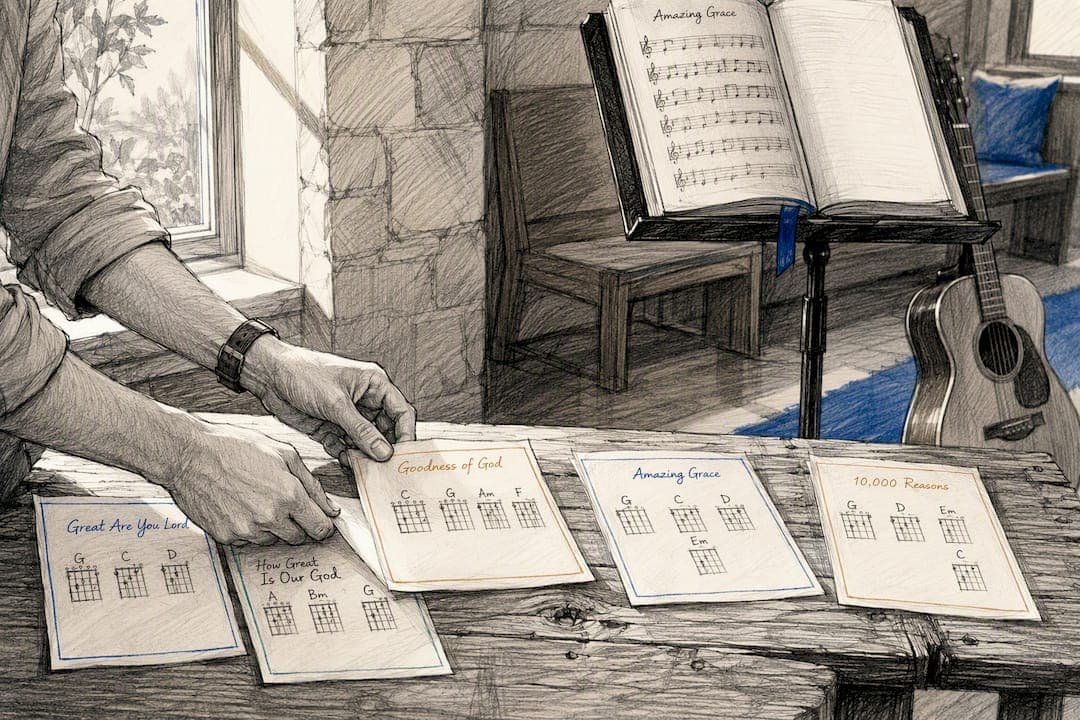
Worship team scheduling is the process of ordering songs, assigning accurate timings and transitions, and syncing setlists and chord charts to the whole team so a service can run as planned. Here's the one-paragraph plan: lock your theme and anchor verse, pick 3 to 5 songs that build a clear arc, assign a timing to each song plus transition notes, then get the finished setlist and charts into every team member's hands, not just the band's.
Do these three things today:
- Finalize your theme and pick the anchor verse driving the service.
- Choose your 3 to 5 songs and put them in order.
- Send the finished setlist and chord charts to the whole team, tech included.
Key Takeaways
Worship team scheduling works best when a theologically grounded arc, accurate timings, and one centralized tool replace scattered emails and last-minute guesswork.
| Point | Details |
|---|---|
| Audit every song | Check biblical fit, singability, familiarity, and necessity before scheduling anything. |
| Build a three-part arc | Sequence songs through Invitation, Reflection, and Response, ending on a vertical song. |
| Plan 4 to 6 weeks out | Finalize song choice early and lock the setlist by Wednesday of service week. |
| Write a flow sheet | Include key, BPM, length, transition plan, and cues so non-musicians can follow along. |
| Centralize with Song7 | Use one synced tool for setlists, chord charts, transposition, and presentation mode. |
Table of Contents
- Is Your Setlist Actually Ready to Schedule?
- How Do You Build a Worship Set That Actually Flows?
- What Does a Realistic Scheduling Timeline Look Like?
- How Do You Set Accurate Timings and Transitions?
- What Should You Centralize in One Planning Tool?
- How Do You Get the Team Ready to Play It Well?
- What Do You Do When Plans Change at the Last Minute?
- Worship Planning Is Ministry, Not Just Logistics
- Ready to Stop Rebuilding Setlists From Scratch Every Week?
- Where to Go for Deeper Planning Help
- Sources
- FAQ
Is Your Setlist Actually Ready to Schedule?
Before you assign timings or send anything out, run each song through a quick audit. Worship leaders who build sets that connect with a congregation ask five questions of every song: is it biblical, is it clear, is it singable, is it God-centered, and is it necessary? That song audit cuts weak material before it ever hits rehearsal.
Balance matters too.
Once the songs pass the audit, check readiness:
- Keys are mapped and confirmed for your vocalists.
- Tempos or BPM are noted next to each title.
- Arrangement notes (intro, bridge, tag) are written down, not just remembered.
- Transitions between songs are decided, not improvised.
- Charts are uploaded where the whole team can see them.
How Do You Build a Worship Set That Actually Flows?
A setlist isn't just four or five songs in a row. It's a spiritual and emotional arc, and the strongest sets move through three distinct movements: Invitation and Praise, Reflection and Surrender, and Response and Commitment. Ending on a vertical, God-centered song matters because it leaves the congregation looking up, not just feeling good.
Here's what that looks like in practice, using a common 4-song set:
- Opening (Invitation). An upbeat, welcoming song that gathers the room and turns attention toward God. High energy, simple lyrics, a key most voices can reach comfortably.
- Building (Praise). A song that raises intensity and declares who God is. This is often the loudest, most anthemic moment of the set.
- Reflection (Surrender). Tempo drops. Lyrics turn inward, toward confession or surrender. This is where the congregation gets quiet, and that quiet is doing real work.
- Response (Commitment). A closing song that answers the reflection with commitment or trust. Keep it vertical. This is not the moment for a song about how worship makes us feel.
A few selection rules keep this arc intact. Pick one anchor verse for the whole service and let it shape song choice. Cap new songs at one per set. Run every candidate through the same audit: is it biblical, is it singable, is it necessary? And watch your keys and tempos across the set. If the reflection song, ambient and delicate in D, gets followed immediately by a response song, fast and driving in F sharp, your transition is going to feel like a car crash instead of a bridge. Building sets around a thematic arc that supports the sermon, rather than a random string of favorites, is what separates a set that moves people from one that just fills time.
What Does a Realistic Scheduling Timeline Look Like?
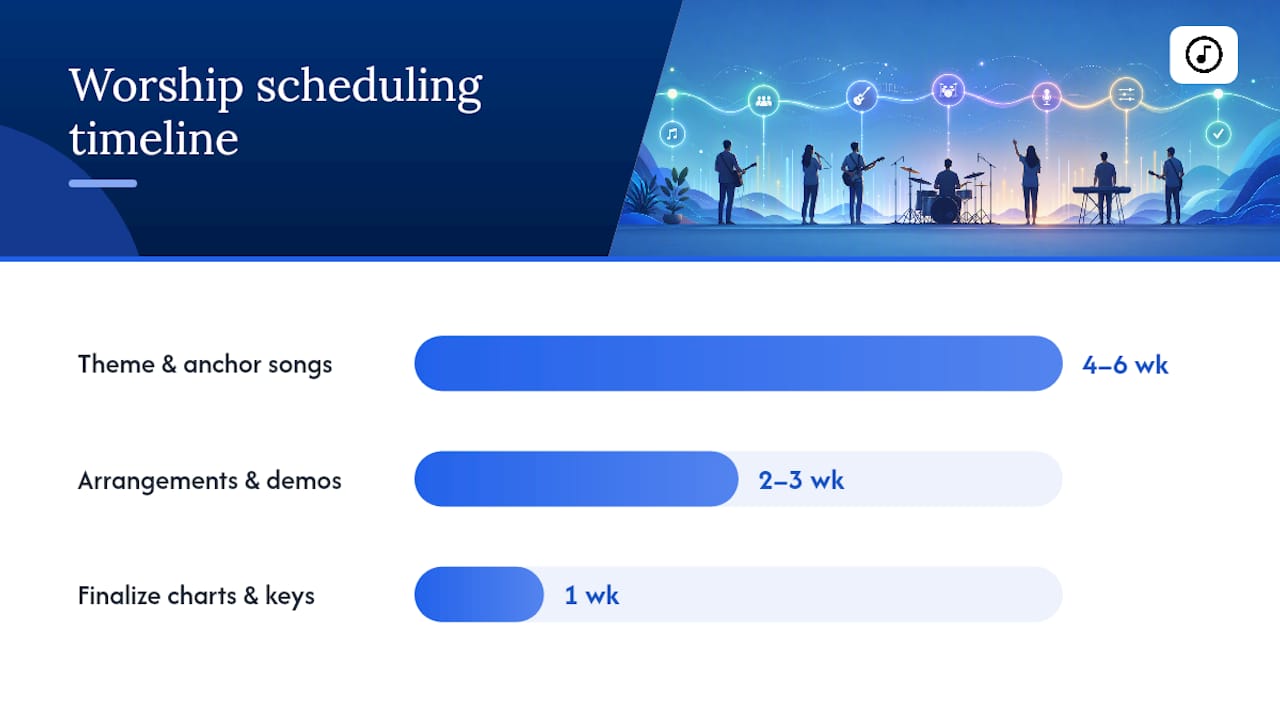
Most worship leaders wait too long to start, then scramble the week of. A better rhythm starts 4 to 6 weeks before the service. That window gives you room to introduce new songs strategically, repeat familiar ones with intention, and build real arrangements instead of settling for whatever the band can throw together on a Tuesday night.
Here's how responsibility typically breaks down at each milestone:
- Worship leader: owns theme selection, anchor verse, and final song order.
- Music director: builds arrangements, assigns vocal and instrumental parts.
- Band captain: coordinates rehearsal logistics and confirms who's playing what.
- Tech lead: aligns slides, lighting, and sound cues to the finalized flow.
- Volunteers: confirm availability early and flag conflicts before the week of.
| Weeks Out | Key Tasks |
|---|---|
| 4 to 6 weeks | Choose theme, anchor verse, and candidate songs |
| 2 to 3 weeks | Finalize arrangements, record demos, assign musician parts |
| 1 week | Upload chord charts, confirm keys and tempos, finalize by Wednesday |
| Service week | Rehearse full run, drill transitions, confirm tech cues |
Pro Tip: When the sermon topic lands late, keep one or two flexible "anchor" songs in your back pocket that fit almost any theme. That way a late sermon shift doesn't force you to rebuild the whole set from scratch.
How Do You Set Accurate Timings and Transitions?
A flow sheet is what turns a mental setlist into something the whole team, including people who don't read music, can actually follow. A good flow sheet translates musical decisions into plain instructions: who leads what, when, and how it connects to the next moment.
Each line item on your flow sheet should include:
- Song title and key
- BPM or tempo marking
- Planned length, including intro
- Transition plan into the next song
- Slide or Scripture cue
- Who leads that moment (vocalist, pastor, tech)
To estimate timing accurately, walk through each song's structure. Intro, verses, any repeats, and the tag or ending, and add a few seconds of padding for congregational singing, since a room full of people never sings as fast as a click track.
For transitions, you have real options:
- A musical bridge that keeps momentum without a hard stop.
- A spoken prayer or Scripture reading that resets the room.
- A moment of silence, which is underused and often more powerful than another verse.
- A quick technical cue when a slide or lighting change needs to land exactly on time.
Mapping keys and tempos before you finalize the order prevents the jarring key jumps that make transitions feel like a mistake instead of a choice.
What Should You Centralize in One Planning Tool?
Fragmented communication, a text here, an email there, a shared doc nobody updates, is how volunteers end up rehearsing from an outdated chart. Using one centralized tool for setlists, chord charts, and scheduling closes that gap.
A tool worth trusting with your whole team needs a few non-negotiable features:
- A drag-and-drop setlist builder so reordering songs takes seconds, not a rewritten email.
- Real-time sync so every phone and tablet shows the current version, not last week's.
- Instant transposition so a vocalist's key change doesn't mean redrawing every chord chart by hand.
- Chord chart import and display, ideally from ChordPro, text, or photos.
- Presentation mode for live lyrics and cues.
- Attached demos and rehearsal notes, plus role-based access so volunteers see what they need.
Song7 was built around exactly this list. Its drag-and-drop builder, real-time team sync, instant transposition, chord diagrams, and presentation mode mean a key change or song swap updates everywhere at once, not just on the leader's laptop.
Pro Tip: Save your common openers, closers, and communion songs as templates inside your planning tool. Pulling from a template with demos already attached cuts your weekly build time down to minutes.
How Do You Get the Team Ready to Play It Well?
Sharing a setlist isn't the same as preparing a team. Communicating the "why" behind each song turns rehearsal into something closer to ministry formation than mechanics, and musicians who understand the arc lead with more unity than musicians who are just hitting cues.
Build your communication checklist around these habits:
- Send the final setlist by Wednesday, not Saturday night.
- Include keys, BPM, and a demo recording with every song.
- Attach chord charts and presentation slides in the same place.
- Note transitions and any pastor cues directly on the flow sheet.
In rehearsal, run each song once, then immediately drill the transition into the next one. Use a click or metronome to lock tempo, and practice tags and endings separately. That's usually where a live set falls apart.
Pro Tip: Spend two minutes before rehearsal explaining why you chose the reflection song. A band that understands the moment plays it differently than a band that's just reading chords.
What Do You Do When Plans Change at the Last Minute?
Pick a replacement song in the same key and tempo as whatever you're swapping out, keep one or two standby songs rehearsed and ready, and assign one person to push updates so nobody's chasing five different text threads. Update the setlist in your central app first, then send one clear notification flagging exactly which parts changed. Keep a short list of simple, high-participation songs on hand. They're your fastest fallback when a sermon shifts Thursday night.
Worship Planning Is Ministry, Not Just Logistics
Every hour spent mapping keys and timing transitions is time spent shepherding a room toward God, not just running a rehearsal. Preparation is a pastoral act. It removes distractions so people can actually meet with the Spirit instead of watching the band figure out what's next.
Encouragement: Plan carefully, then hold it loosely. Leave room in your set for the Spirit to interrupt your best-laid order, and treat that interruption as the plan working, not the plan failing.
This piece comes from the Song7 editorial team, drawing on practical worship-leadership experience across volunteer-based churches.
Ready to Stop Rebuilding Setlists From Scratch Every Week?
Everything in this guide, the arc, the flow sheet, the audit checklist, still depends on getting it into your team's hands without version confusion. That's the exact gap Song7 was built to close.
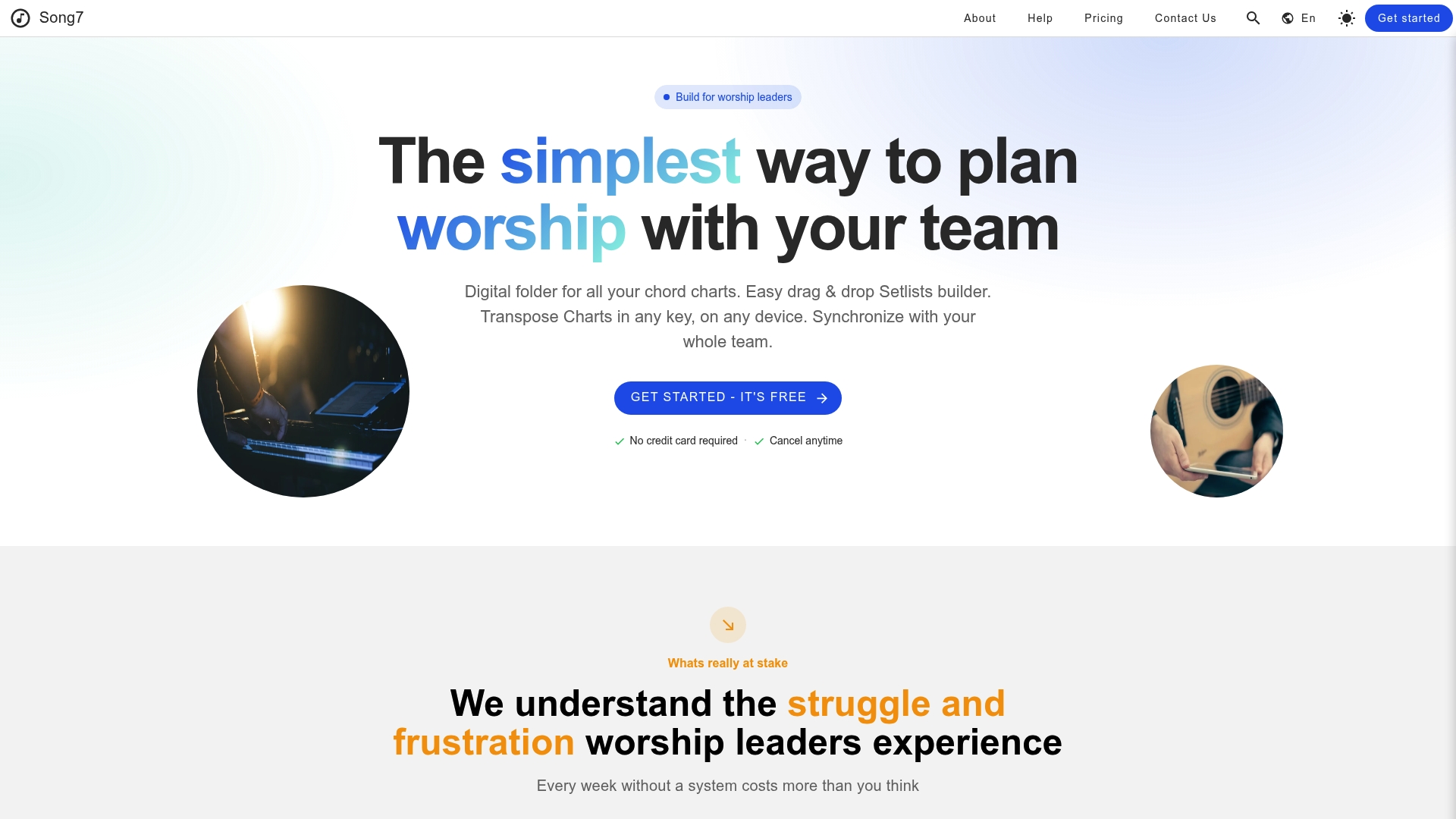
Song7 gives your team one place to build setlists by drag-and-drop, transpose instantly when a vocalist needs a different key, attach chord charts and demos, and see updates sync in real time across every phone in the room. For a volunteer-based team, that means:
- Faster setlist finalization, even on a tight week.
- Timings and transitions that stay accurate because everyone's looking at the same version.
- Presentation mode ready to go the moment rehearsal starts.
- Last-minute swaps that reach the whole team instantly, not just the band.
Start a free trial at Song7 and build your next setlist in the same place you'll rehearse and lead it from.
Where to Go for Deeper Planning Help
- Effective setlist sequencing: the three-part arc explained in more depth.
- Weekly planning cycle: how to structure your 4 to 6 week rhythm.
- Setlist flow guide: step-by-step help mapping keys and transitions.
- Prayer room design ideas: inspiration for intentional worship spaces.
- Song7: explore the tool built for setlist scheduling and team sync.
Sources
- Effective Setlist Planning: Worship Song Sequencing That Works | Worship Leader Magazine
- How to Build a Healthy Weekly Worship Planning Cycle | Worship Leader Magazine
- How to Plan a Worship Setlist That Flows (Step-by-Step Guide) - Worship Online
FAQ
What is worship team scheduling?
It's the process of ordering songs into a setlist, assigning accurate timings and transitions, and syncing that finished plan and its chord charts to the whole team.
How far in advance should I plan a worship set?
Most worship leaders plan 4 to 6 weeks out, which gives enough time to introduce new songs, build arrangements, and finalize by midweek of the service.
What is the three-part worship arc?
It's Invitation and Praise, Reflection and Surrender, and Response and Commitment, a sequence that moves a congregation emotionally and spiritually toward a God-centered close.
What should I do if the sermon topic changes late in the week?
Swap in a replacement song in the same key and tempo, notify the team through your central planning tool immediately, and keep a couple of standby songs rehearsed for exactly this situation.
What features matter most in a scheduling tool?
Real-time sync, instant transposition, chord chart import, and presentation mode matter most. Song7 combines all four in one app built specifically for volunteer-based worship teams.