
Sunday service planning is the process of aligning your sermon, songs, people, place, and cues into one timed run-of-show that everyone on your team can follow without guessing. Get this right and your Sunday morning feels unified. Get it wrong and even gifted musicians and a great sermon can feel disconnected.
Here's a six-item checklist you can start on today:
- Define the theme or sermon focus for the upcoming week
- Build the order of service around that theme
- Pick songs that support the message, not compete with it
- Assign volunteers to every role, not just the visible ones
- Set a rehearsal time and stick to it
- Publish a run-sheet the whole team can see before Sunday
Most churches start this process one to four weeks out, though sermon series often get mapped months in advance at larger congregations, according to the Calvin Institute of Christian Worship's planning research. The Calvin Institute's planning process and the 4 Ps framework (Preparation, People, Place, Post-Service) give structure to that timeline. Tools like Song7 exist to handle the logistics piece so your team can focus on the spiritual one.
Key Takeaways
Sunday service planning succeeds when a repeatable process, the 4 Ps of Preparation, People, Place, and Post-Service, turns weekly logistics into a habit instead of a scramble.
| Point | Details |
|---|---|
| Start with the sermon | Choose songs and scripture only after the sermon theme and intended response are set. |
| Use the 4 Ps rhythm | Preparation, People, Place, and Post-Service give volunteer teams a repeatable weekly structure. |
| Build a run sheet | Include start/end times, leader names, keys, files, and specific tech notes for every element. |
| Debrief for five minutes | A short post-service check on what worked and what needs fixing prevents repeat problems. |
| Centralize with Song7 | Song7's setlist builder and real-time sync keep every volunteer on the same version of the plan. |
Table of Contents
- What Is a Typical Order of Worship Service?
- How Do the 4 Ps Structure Your Planning Process?
- How Do You Schedule Volunteers Without the Chaos?
- How Do You Choose Songs and Run an Efficient Rehearsal?
- What Belongs on a Run Sheet or Planning Template?
- How Does Song7 Help Teams Plan and Rehearse Faster?
- A Note From the Song7 Editorial Team
- Try Song7 for Your Next Service Plan
- Resources for Deeper Worship Planning
- Sources
- FAQ
What Is a Typical Order of Worship Service?
A dependable order of service follows a shape, not a rigid script. Most services move through a call to worship, a block of worship music, corporate prayer, scripture reading, the sermon, a response element like offering or communion, and a closing benediction. That structure isn't arbitrary. Each piece does a job: the call to worship gathers scattered attention, the music opens hearts before the mind engages with scripture, and the benediction sends people out rather than just letting the service fizzle.
For a typical service, here's a workable timing template:
- Call to worship (2 to 3 minutes) — a short verbal or musical cue that says "we've started"
- Worship set (15 to 20 minutes) — three to five songs, usually building from gathered praise toward reflection
- Corporate prayer (3 to 5 minutes) — often led by someone other than the worship leader
- Scripture reading (2 to 4 minutes) — tied directly to the sermon text
- Sermon (25 to 35 minutes) — the theological anchor the rest of the service supports
- Response (5 to 10 minutes) — offering, communion, or an altar call, depending on tradition
- Closing song and benediction (3 to 5 minutes) — sends the congregation out with intention
Transitions matter as much as the elements themselves. Scripted transitions (a spoken line, a scripture verse read over instrumental underscoring) keep the flow cohesive rather than choppy, and someone on your team, usually the worship leader or the pastor, should write them out in advance. Musical or visual transitions (a key change bridging two songs, a slide fade) do the same work without a spoken word. During Advent, Lent, or a baptism Sunday, expect to stretch the response section and shorten the worship set. The order flexes; the purpose behind each piece doesn't.
How Do the 4 Ps Structure Your Planning Process?
Preparation, People, Place, and Post-Service give you a repeatable checklist instead of a fresh scramble every week. Practical guidance from Tithely frames this as the backbone of a sustainable planning rhythm, and it holds up whether your team has five volunteers or fifty.
Preparation covers the theme, the song list, and the technical files. Lock the sermon topic first, choose songs and keys second, and get chord charts or slides into your team's hands with real lead time.
People means matching roles to available volunteers, confirming attendance, and briefing anyone new on their part.
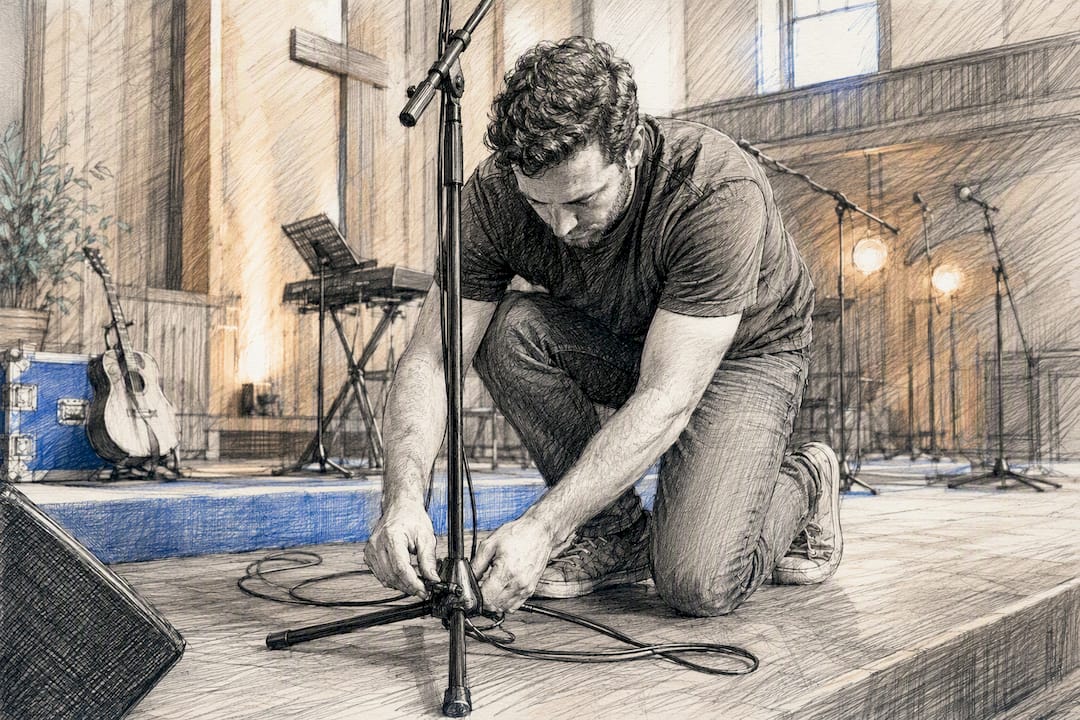
Place covers the physical and digital space: sound check, stage layout, camera angles for livestream, and whether the projector actually works this week.
Post-Service is the short debrief that catches problems before they repeat.
Timelines differ by church size:
- Small church, one to two weeks out: finalize theme and songs by midweek, confirm volunteers by Thursday, run through the set Saturday or Sunday morning
- Medium to large church, three to four weeks out: lock the sermon series months ahead, finalize individual week songs and keys ten days out, schedule a full run-through the Thursday or Friday before
Songs, keys, and tech cues should be locked well before the Saturday rush. Waiting until the last minute is how a volunteer ends up sight-reading a chord chart mid-song.
How Do You Schedule Volunteers Without the Chaos?
Every service needs clarity on who does what, and vague assignments are the number one cause of Sunday morning confusion. A short list of essential roles helps: worship leader, vocalists, instrumentalists, sound operator, slide/lyric operator, and a greeter or usher team.
Scheduling works best when you build in a buffer:
- Send availability requests at least two weeks ahead
- Require a confirmation, not just a "maybe"
- Always name a backup for tech-heavy roles like sound and slides
- Share chord charts and slide decks by midweek so volunteers can practice at home
Volunteer-first scheduling, meaning early assignment paired with simple, clear expectations, tends to improve retention because people don't feel ambushed on Sunday morning. A quick 5 to 10 minute debrief after the service, focused on two questions (what worked technically, and what helped or hindered the team), catches small problems before they become recurring ones.
Pro Tip: Ask your debrief question the same way every week: "One thing that worked, one thing to fix." Consistency turns feedback into a habit instead of an awkward afterthought.
How Do You Choose Songs and Run an Efficient Rehearsal?
Song selection starts with the sermon, not the setlist. The Calvin Institute's planning process puts prayer and scripture study first, because a worship set chosen before you know the sermon's intended response is a worship set built backward. Once the theme is set, balance one or two familiar songs your congregation can sing without looking at a screen against one newer song introduced gently.
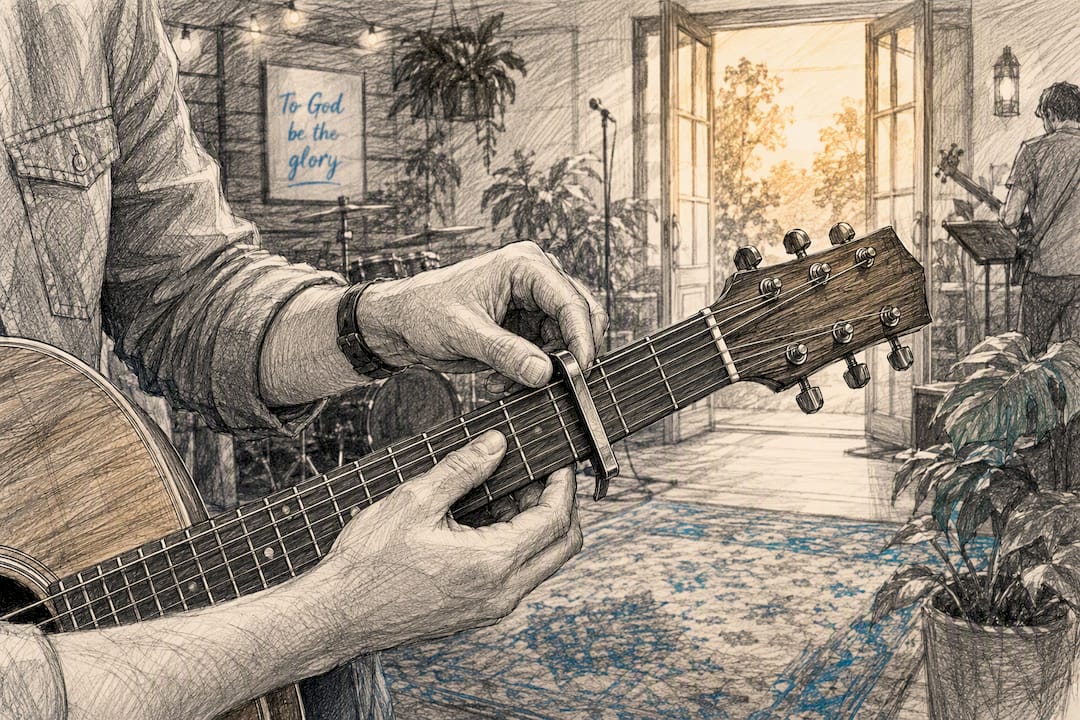
Decide keys early. If your vocalist can't comfortably hit the melody in the original key, transpose it and get the new chart out that week, not the night before. Rehearsal works best as a rhythm rather than a single cram session: home practice with the chart, then a sectional run (vocals together, then instruments), then one full-band run-through with all the tech cues live.
For the live service itself, lyric clarity beats visual flourish every time, and slide timing should follow the vocalist's phrasing, not a fixed countdown. Give your slide operator written notes, not verbal reminders shouted across the stage.
Pro Tip: When staffing is thin, choose fewer songs played well over a full set played thin. A congregation engages more with three strong songs than five underrehearsed ones.
What Belongs on a Run Sheet or Planning Template?
A run sheet is the single document that keeps everyone, from the pastor to the newest volunteer, on the same page. The fields that matter most are start and end times, element name, the leader responsible, lyric or key information, attached files, and specific tech notes.
A sample entry might read: "9:14 to 9:17 AM, Call to Worship, Pastor Dave, no slides, mic check 45 seconds prior." That level of detail removes the guesswork.
Planning tools generally fall into three categories:
- Planning workspaces that hold the order of service, notes, and files in one shared place
- Live presentation tools that display lyrics, chords, and slides during the service itself
- Volunteer schedulers that handle availability, confirmations, and reminders
| Tool Category | Problem It Solves |
|---|---|
| Planning workspace | Keeps the order, files, and notes in one synced location instead of scattered texts |
| Live presentation | Displays lyrics and chords clearly for the team and congregation in real time |
| Volunteer scheduler | Reduces no-shows through automated confirmations and backup coverage |
Use a fixed template for a normal Sunday, and customize it only when a holiday, baptism, or communion service genuinely changes the flow. A five-step planning cycle, define theme, assign responsibilities, plan order, select music, then review and finalize, keeps that customization from turning into chaos.
How Does Song7 Help Teams Plan and Rehearse Faster?
Song7 was built around exactly these planning tasks, not as a generic scheduling app retrofitted for churches. Its setlist builder lets you drag and drop songs into an order in minutes, its transpose function updates chord charts instantly when a vocalist needs a different key, and its presentation mode puts lyrics on screen without a separate slide-building step.
- One canonical setlist means the pastor, worship leader, and slide operator all see the same version
- Real-time sync updates every team member's chart the moment a key or lyric changes
- The built-in metronome and tuner support rehearsal without extra apps
The recurring failure point in volunteer-run services isn't talent. It's version control: someone rehearsing from an old chart because nobody told them it changed.
Inside a one to four week planning window, a setlist and run-sheet tool removes that specific failure point before it happens.
A Note From the Song7 Editorial Team
Volunteers are giving their Saturday, not their salary. Plan with that humility. Clear songs, a simple order, and a shared plan matter more than polish. Song7 exists to carry the logistics so your team can carry the worship.
— Editorial team
Try Song7 for Your Next Service Plan
Song7 gives your team one shared setlist instead of five conflicting text threads. That's the real time savings: no chasing down who has the latest chord chart, no last-minute transposing by ear, no volunteer showing up with the wrong version of the run sheet.
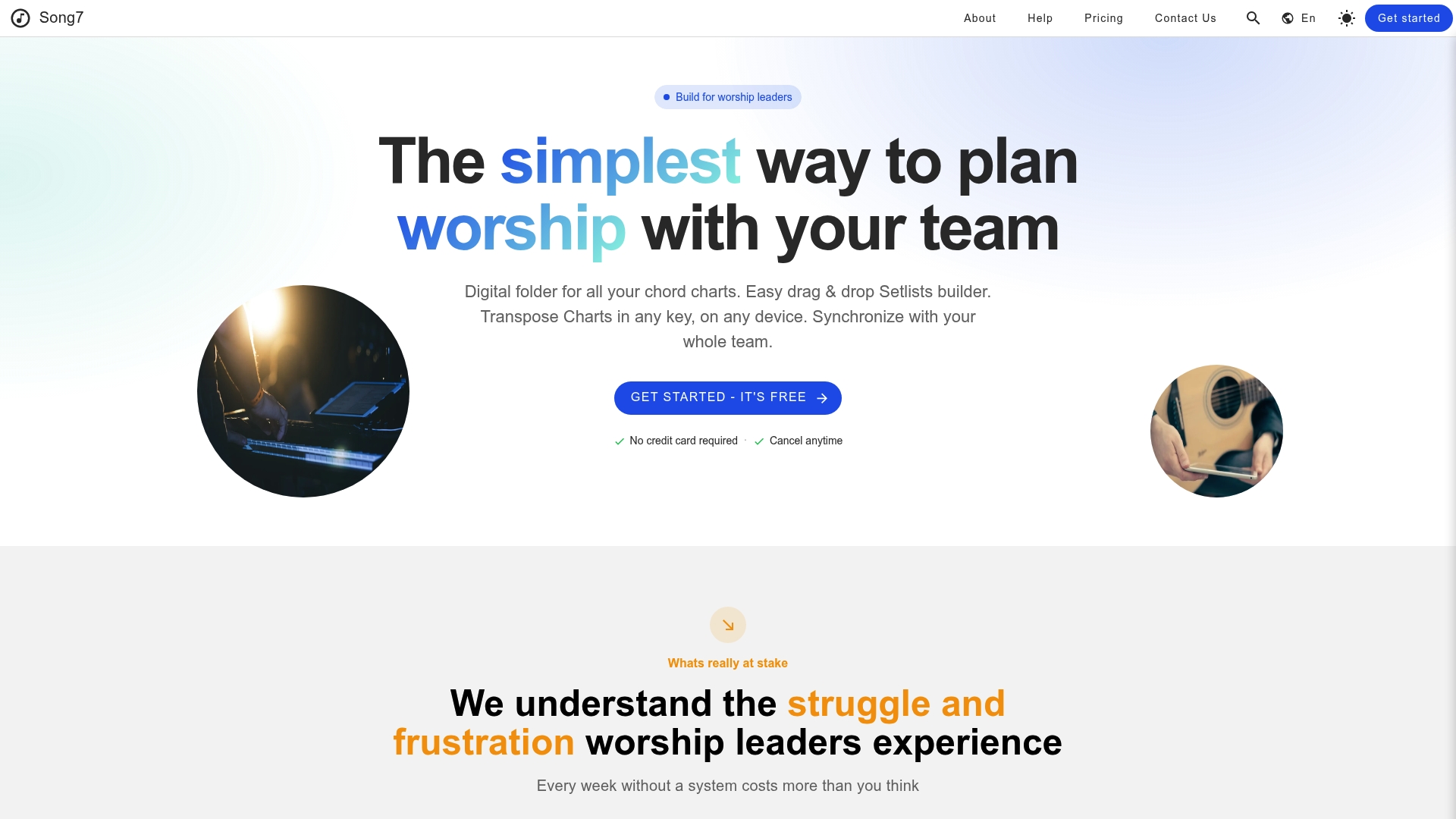
Getting started takes a few minutes. Build your first setlist, invite your team, and let real-time sync handle the updates that used to require a group text. Whether you're planning next Sunday or a whole series, Song7's setlist builder keeps your worship leader, musicians, and tech volunteers working from the exact same plan. Start a trial and build this week's run sheet before your next rehearsal.
Resources for Deeper Worship Planning
- Calvin Institute of Christian Worship: planning process and guiding questions
- WorshipIdeas: practical five-step planning templates
- Gordon-Conwell Theological Seminary: further study in worship and theology
- Tithely: execution checklists and the 4 Ps framework
Sources
- Designing Worship Together — Calvin Institute of Christian Worship
- Worship Service Planning Template — WorshipIdeas
- Get
FAQ
What Is the Typical Order of a Sunday Worship Service?
A standard order moves through a call to worship, a worship music set, corporate prayer, scripture reading, the sermon, a response element like offering or communion, and a closing benediction, typically lasting around an hour.
What Is the 80% Rule for Churches?
Definitions of this rule vary by congregation and aren't tied to a single documented standard, so treat any specific percentage as a rule of thumb rather than an established figure rather than a fixed benchmark to plan around.
What Is a Good Prayer to Say During the Sunday Service?
The strongest corporate prayers stay short, connect directly to the sermon theme, and invite the congregation into response rather than simply reciting words, which is why many worship leaders plan the prayer's content alongside the sermon topic, not separately from it.
How Far in Advance Should We Plan a Sunday Service?
Most churches begin detailed planning one to four weeks ahead, while larger congregations map entire sermon series months in advance to give volunteers and musicians adequate lead time.
What Should Go on a Run Sheet?
A usable run sheet lists start and end times, the element name, the leader responsible, keys or lyrics, attached files, and specific tech cues, ideally built in one shared tool like Song7 so every volunteer sees the same version.