
For volunteer worship teams that need chord-aware setlists and rehearsal syncing without the seat costs, some newer tools aim to meet these needs. If your team leans toward free and open-source, FreeShow or OpenLP cover you. If you want a familiar desktop workflow at a lower price point, EasyWorship or MediaShout fit. And if cloud collaboration across multiple sites matters most, Proclaim or WorshipTools are worth a serious look.
TL;DR:
- Teams should prioritize tools that support accurate chord import and reliable real-time setlist synchronization to prevent last-minute errors during rehearsals.
- Open-source options like FreeShow or OpenLP are free but may require more volunteer troubleshooting and manual formatting of chord charts.
- Desktop-first tools such as EasyWorship or MediaShout offer familiar workflows for volunteers but come with per-seat licensing costs, making them less flexible for growing teams.
- Cloud-based solutions like Proclaim or WorshipTools excel for multi-campus churches needing remote collaboration but depend on stable internet connections during services.
- Running real-world import tests with messy files and rehearsing the setlist build process beforehand significantly reduces Sunday morning mistakes, regardless of software chosen.
Table of Contents
- Which ProPresenter Alternatives Actually Fit Volunteer Teams?
- What Should You Actually Test Before Switching?
- How Do the Leading Alternatives Compare?
- Why Song7 Reduces the Volunteer Workload
- How Do Lyrics and Chord Charts Import and Display?
- What About Streaming, Multi-Output, and Stage Displays?
- Can You Try These Tools Before Committing?
- Does the Software Support Your Audio and Video Files?
- How Customizable Are the Themes and Layouts?
- Is the Support and Community Actually Helpful?
- Will It Hold Up During a Live Service?
- Rehearsal-First Thinking Beats Feature Checklists
- Ready to Simplify Setlists for Your Volunteer Team?
- Sources
- FAQ
Which ProPresenter Alternatives Actually Fit Volunteer Teams?
Here's the fast version, sorted by what each option solves best. Your rehearsal night looks different from a paid staff production team's, and that's exactly why these picks differ from a generic software roundup.
- Song7 handles collaborative setlist building, chord charts, and lyric display with real-time sync, so your rhythm section and your slide operator are always looking at the same version of Sunday's plan.
- FreeShow or OpenLP for teams with no software budget at all. Both are genuinely free, cross-platform, and community supported, though chord imports sometimes need a quick reformat before they display cleanly.
- EasyWorship or MediaShout for teams that want a desktop-first, seat-based license and a workflow that feels close to what a longtime volunteer already knows from ProPresenter.
- Proclaim or WorshipTools for churches running multiple campuses or heavy rehearsal collaboration, where cloud sync and content libraries matter more than a one-time price tag.
None of these are wrong choices. They're built for different Sunday mornings.
What Should You Actually Test Before Switching?
Software specs look great on a vendor page. They mean nothing until a nervous volunteer is trying to find the bridge of a song thirty seconds before the pastor asks for it. Test against your real workflow, not a features list.
- Check the price model first. Some tools charge per seat or per device activation, some are subscription based, some are one-time purchase, and a few (like FreeShow) run on donations instead of licenses.
- Import two real songs, not demo files. Pick one with straightforward lyrics and one with a messy chord chart or unusual layout, and see what breaks.
- Time a rehearsal. Have the person who will actually run slides on Sunday build and run a setlist start to finish, and note every place they hesitate.
- Test stage view and remote control. Can the vocalist see the next line without leaning over the operator's shoulder? Can someone control it from a phone if the primary laptop freezes?
- Confirm your outputs. If you run a second screen, stream to Facebook, or record for later upload, verify the software actually pushes to all of those destinations without a workaround.
- Ask about offline access and backup. If your internet drops mid-service, does the app keep running?
Chord formatting deserves special attention. OpenLP's documentation explains that it parses chord text using bracket syntax, meaning charts pulled from different sources may need a quick search-and-replace pass before they display correctly on stage.
Pro Tip: Run your import test with the messiest chord chart in your church's library, not the cleanest one. If a tool survives your worst PDF, it will survive everything else your volunteers throw at it.
How Do the Leading Alternatives Compare?
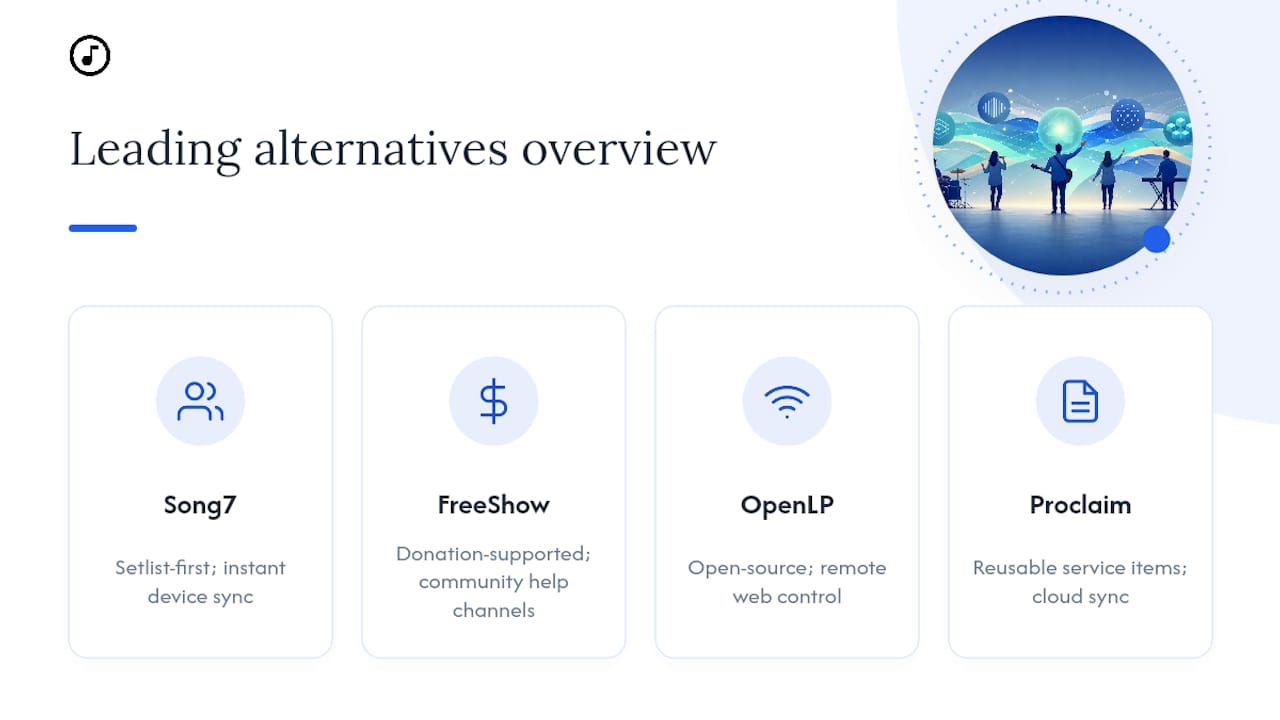
Song7 leads this list because it's built around the part of the job that actually causes Sunday morning stress: getting the right setlist, in the right key, in front of the right people, before rehearsal even starts. It offers drag-and-drop setlist building, instant sync across every team member's device, chord diagrams, one-tap transposition, and a presentation mode for lyrics display, plus a built-in metronome and tuner for rehearsal. Song7 accepts imports from ChordPro, plain text, and photos of handwritten or printed charts. It's built for volunteer-led teams first, not enterprise production crews, which shows in how little training a new volunteer needs to get productive.
FreeShow is a genuinely free, donation-supported presentation app that advertises import support for PowerPoint, ProPresenter, EasyWorship, and OpenSong files. Support runs through community channels rather than a help desk, so response times vary.
OpenLP is open-source and installs on Windows, macOS, and Linux with no per-seat fee. Its remote control web app is one of its strongest features, letting a volunteer adjust slides from a tablet across the room, but bracket-style chord parsing means some charts need reformatting first.
EasyWorship runs on a familiar desktop, seat-based license model that plenty of longtime volunteers already know from other church software, making it a low-friction switch for teams that don't want a big workflow change.
MediaShout also runs desktop-first with a seat model, and it's held up well for teams that need reliable multi-output stage displays during live services.
Proclaim organizes content around reusable "service items," which is genuinely useful if your order of service repeats the same automated elements week to week, and it bundles cloud sync with its pricing tiers.
A handful of others round out the field. WorshipTools stands out for multi-language presentation, useful for congregations serving several language groups in one service. RhemaCast markets itself around AI-assisted content features for teams willing to experiment. Holyrics keeps chord and lyric display simple and musician-focused. SlideDog is built to stitch mixed media types (video, slides, web pages) into one running playlist. Yodeck leans toward digital signage rather than live worship presentation. Switcher Studio is a video production and multi-camera switching tool, useful alongside a presentation app rather than instead of one. Altar Live and Risen Media both position around streaming and online campus support. Tithe.ly and ChurchTrac are church management platforms with giving and administration tools, not presentation software, though some churches pair them with a presentation tool for a fuller stack. GoTo Meeting is video conferencing software, handy for remote team rehearsals but not a stage display replacement.
Why Song7 Reduces the Volunteer Workload
Most of the actual pain in worship tech isn't the Sunday service. It's everything leading up to it: chasing a chord chart in the wrong key, texting three people to confirm who's playing keys, and hoping the version everyone rehearsed matches what's on the screen.
The gap between a good rehearsal and a rough Sunday morning usually isn't talent. It's whether everyone was looking at the same setlist, in the same key, with the same chords, before they ever walked in the building.
Song7 targets that gap directly:
- Drag-and-drop setlist building so a leader can assemble Sunday's flow in minutes, not a spreadsheet session.
- Instant sync across every team member's device, so a last-minute key change or song swap reaches everyone at once.
- Chord diagrams and one-tap transposition, useful when your vocalist and your guitarist need different keys on the same chart.
- Presentation mode for clean lyric display during the service.
- Built-in metronome and tuner for rehearsal, so the tools musicians actually need live inside the same app as the setlist.
For a volunteer-run team, fewer apps and fewer manual handoffs mean fewer mistakes on a Sunday morning.
How Do Lyrics and Chord Charts Import and Display?
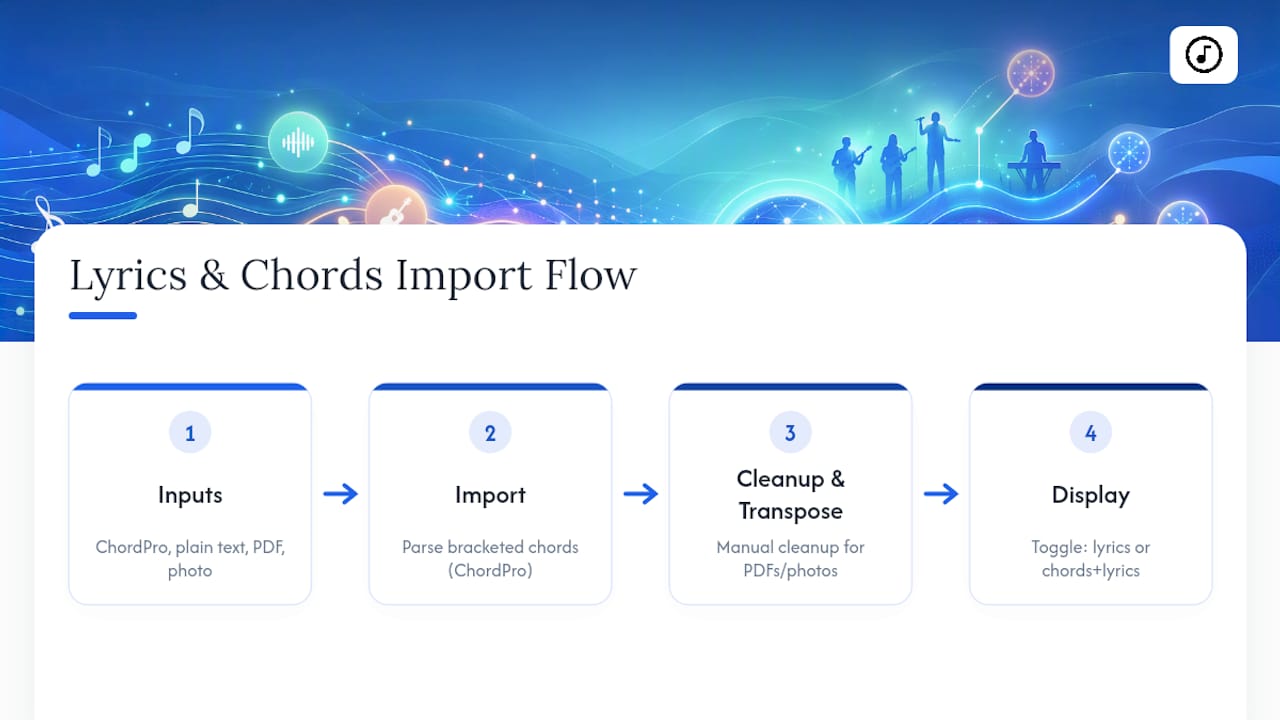
Chord and lyric handling is where most ProPresenter alternatives quietly succeed or fail. ChordPro, the plain-text standard that wraps chords in brackets like [G] or [Am], is the closest thing this space has to a universal format, and most alternatives support it in some form.
OpenLP treats any text between brackets as a chord, which is efficient but strict: charts written with a slightly different bracket convention, or pulled from a PDF with inconsistent spacing, often need a manual cleanup pass before they render correctly on stage. That's a real time cost for a volunteer team on a Wednesday night before rehearsal.
Some platforms accept ChordPro files directly, along with plain text and photos of printed or handwritten charts. This can help with libraries in multiple formats. Converting a scanned PDF or a phone photo into usable, transposable chords is one of the biggest time sinks in music ministry, and it's worth testing your worst-formatted chart before committing to any tool.
The display side matters just as much as the import side. A chord chart that imports cleanly but crowds the stage screen with too much text still fails your guitarist mid-song. Look for tools that let you toggle chords on or off per screen, since your vocalist usually wants lyrics only while your instrumentalists want chords and lyrics together without either competing for space.
What About Streaming, Multi-Output, and Stage Displays?
Most churches now run at least two outputs during a live service: a congregation-facing screen and a stage monitor or confidence screen for the team on stage. Some add a third feed for online streaming.
MediaShout and EasyWorship both handle multi-output setups reliably, a legacy of their desktop, seat-based design built specifically for that kind of stage hardware. Proclaim adds cloud sync on top of its output handling, useful for churches running the same service across multiple campuses at slightly different times. SlideDog's playlist-based structure makes it a solid pick if your service mixes video clips, slide decks, and live camera feeds in one continuous run, though it's built more for hybrid event use than dedicated weekly worship.
For churches livestreaming their services, Switcher Studio and Risen Media both lean into video production and multi-camera switching rather than lyric display, and many teams pair one of them with a dedicated presentation tool instead of expecting a single app to do both jobs well.
Certain tools focus on setlist and chord management rather than full multi-camera streaming switching, aiming to complement existing streaming or stage display setups.
Can You Try These Tools Before Committing?
Every option worth testing offers some way to try before you buy, and skipping that step is the single most common regret teams report after switching software mid-season.
FreeShow and OpenLP are free outright, so there's no financial risk to installing them on a laptop and running a real rehearsal. EasyWorship and MediaShout both offer trial periods on their desktop installs. Proclaim publishes its plan tiers and features on its pricing page, which is worth reading closely since media library inclusions vary by tier.
Some platforms offer free trials that allow worship leaders to build setlists, invite teams, and run rehearsals before committing financially. Comprehensive learning resources including knowledge bases and support documentation are important for volunteer onboarding.
Does the Software Support Your Audio and Video Files?
Compatibility gaps show up at the worst possible moment: five minutes before service, when a video file suddenly won't play. Most modern presentation tools handle common formats like MP4 and MOV for video and MP3 or WAV for audio, but codec support inside those formats can vary more than the file extension suggests.
OpenLP and FreeShow, as open-source and community-maintained projects, sometimes lag slightly behind commercial tools on newer codec support, which is worth checking directly against your church's typical media before a live service, not during one. EasyWorship and MediaShout, as established commercial desktop products, tend to have wider out-of-the-box format support since that's been part of their core offering for years.
Song7's focus stays on lyrics, chords, and setlist display rather than full video and audio media handling, which is worth knowing upfront if your service leans heavily on video clips and backing tracks alongside live music. Teams that need both often run a dedicated media player or streaming tool for video segments and use Song7 for the sung portions of the service, where chord accuracy and setlist sync matter more than codec support.
How Customizable Are the Themes and Layouts?
Volunteer teams often inherit a template built by whoever set up the software five years ago, and changing it later feels riskier than it should. Look for a tool that lets you adjust font size, background, and layout without needing to rebuild every slide from scratch.
WorshipTools and Proclaim both offer template systems built around consistent branding across a congregation's multiple services or campuses. Holyrics keeps its layout options simple and chord-forward, which suits musicians more than production teams chasing a specific visual style. EasyWorship and MediaShout carry over more traditional template libraries from their long history as desktop tools, giving volunteers a lot of pre-built options to start from.
Certain tools keep lyric and chord displays clean and legible by default, focusing on readability under stage lighting rather than extensive visual customization, which can benefit volunteer teams by minimizing setup time.
Is the Support and Community Actually Helpful?
A tool is only as good as the help available when something breaks on a Saturday night. Commercial products like Proclaim and MediaShout typically offer direct support channels since a subscription or license fee funds that infrastructure. Open-source and donation-supported projects like OpenLP and FreeShow rely more heavily on community forums and volunteer contributors, which can mean slower turnaround on obscure bugs but often a genuinely engaged user base solving problems in public where you can search past answers.
Some solutions are built with volunteer teams in mind, aiming to require less ongoing support by providing simpler workflows, fewer configuration decisions, and a focused feature set around setlists and chords.
Will It Hold Up During a Live Service?
Reliability under pressure is the one requirement that overrides every other feature comparison. A tool with a beautiful interface that freezes mid-verse has already failed its most important job.
Desktop-first tools like EasyWorship and MediaShout generally benefit from years of refinement around exactly this scenario, since local software with no dependency on an internet connection tends to be more predictable during a live service. Cloud-based tools like Proclaim and WorshipTools depend on a stable connection, which is worth stress-testing on your actual church Wi-Fi before a live Sunday, not assuming it'll work because it worked at home.
Song7 syncs setlists and chord updates instantly across devices, which is a real advantage for last-minute changes, but any cloud-connected tool benefits from a documented backup plan: a downloaded or offline copy of the setlist in case the connection drops mid-service. Ask any tool's support resources directly how offline access works before you need it in front of a congregation.
Rehearsal-First Thinking Beats Feature Checklists
Most comparisons in this category rank tools by feature count: how many outputs, how many file formats, how many themes. That's the wrong lens for a volunteer-led church. The real test is whether your actual rehearsal workflow gets smoother or gets stuck.
The conventional advice says to pick based on price or platform first. We'd push back on that. A free tool that costs your volunteer team an extra thirty minutes of chord reformatting every week isn't actually free. It's a hidden labor tax paid by the same three people who already do too much. Marketplace roundups reinforce this by handing out labels like "best overall" or "best free plan" that reflect a reviewer's criteria, not your Wednesday night rehearsal.
What should you prioritize first, before price or platform? Chord import fidelity and setlist sync. If your musicians and your slide operator aren't looking at the same version of Sunday's plan by Thursday, everything else about the tool is secondary. Test that one workflow with your messiest real files before you sign up for anything, and let that result, not a features list, make the decision.
— Editorial team
Ready to Simplify Setlists for Your Volunteer Team?
If you've been weighing free tools against desktop licenses and cloud subscriptions, the honest tradeoff usually comes down to this: free and open-source options save money but ask your volunteers to handle chord formatting and troubleshooting themselves, while desktop tools trade flexibility for a steeper per-seat cost as your team grows. Song7 was built to skip that tradeoff entirely for music-focused teams. It combines drag-and-drop setlist building, real-time sync, chord diagrams, instant transposition, and a presentation mode with rehearsal tools like a metronome and tuner, all in one place designed specifically for volunteer-run worship ministries.
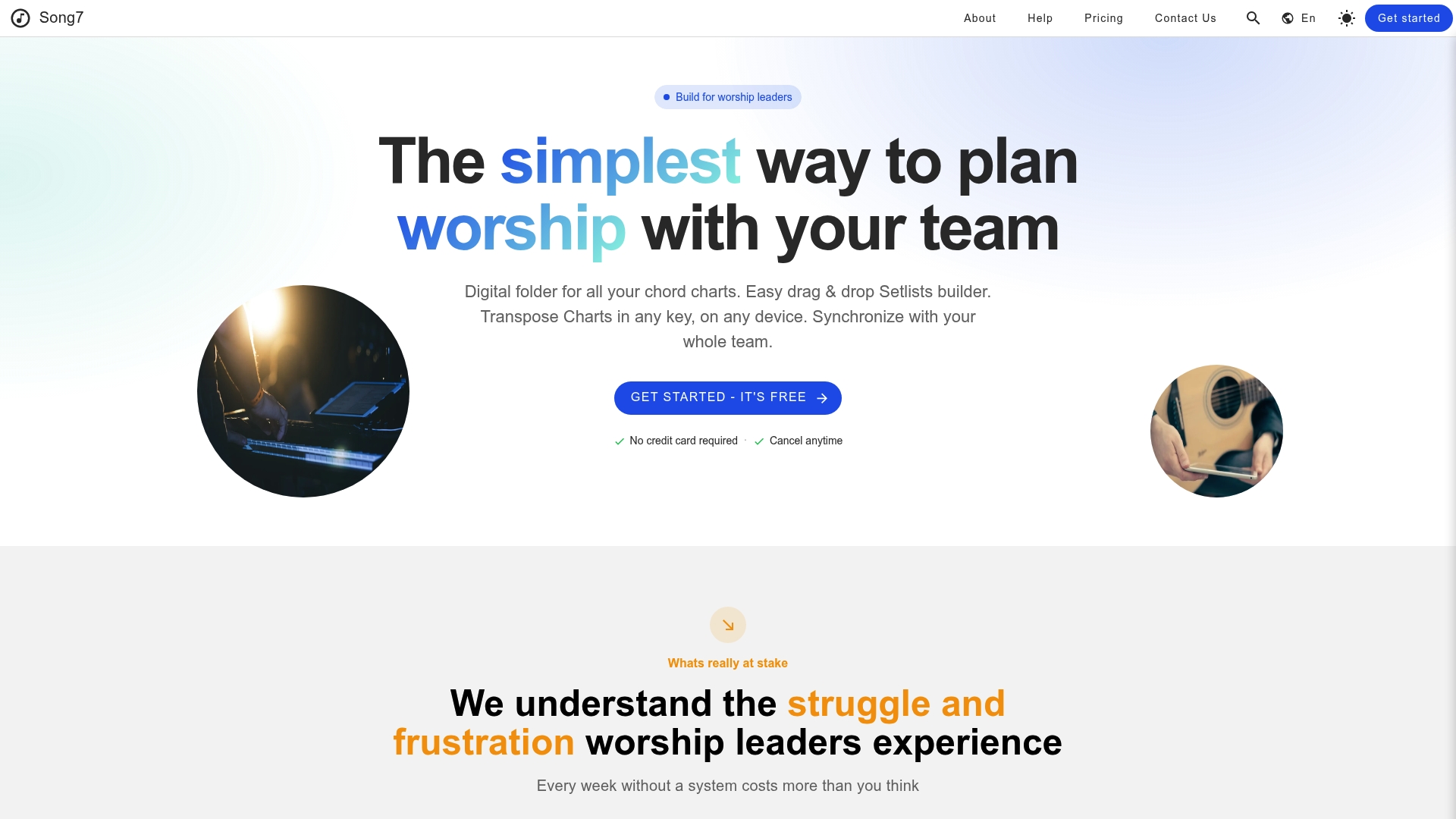
If your team is tired of chasing chord charts across text threads and group chats, start a free trial and build your next setlist directly in Song7 to see how it fits your rehearsal night. You can also explore Song7's setlist and rehearsal tools to see how cloud sync cuts down on last-minute Sunday morning scrambles.
Sources
- ProPresenter Alternatives | Capterra
- FreeShow — A free and open-source presenter
- Configuring OpenLP — OpenLP 3.0 Reference Manual
- Pricing | Proclaim Presentation Software
FAQ
Is ProPresenter or EasyWorship Better for a Volunteer Team?
Neither is universally better. EasyWorship uses a familiar desktop, seat-based license that many longtime volunteers find easier to learn, while ProPresenter offers a deeper feature set built more for production-heavy teams. The right answer depends on whether your team values simplicity or advanced production control.
Is There a Free Version of ProPresenter?
ProPresenter does not offer an ongoing free tier for church use. Teams wanting a genuinely free option typically choose FreeShow or OpenLP instead, both of which are free and open-source.
What Is the Best Free Church Presentation Software?
FreeShow and OpenLP are the two most established free options, both supporting cross-platform installs with no seat fees, according to their own project documentation. FreeShow adds broad import support for formats like PowerPoint and ProPresenter files, while OpenLP offers stronger remote-control features.
How Much Does ProPresenter Cost for Churches?
ProPresenter's costs are typically tied to per-seat licensing plus optional add-ons like its ProContent media library, which can add recurring expense beyond the base license. That seat-based cost structure is a common reason churches start comparing ProPresenter alternatives in the first place.
What Should a Volunteer Team Prioritize When Choosing an Alternative?
Chord import fidelity and setlist sync matter more than a long features list. A tool your team can actually rehearse with cleanly, like Song7 for collaborative setlists and chord display, usually beats a feature-heavy option nobody has time to fully learn.