
For teams running rehearsals and live sets, the best approach is a purpose-built, team-focused chord-chart platform rather than a generic sheet-music reader. iPad tends to offer richer, more mature apps in this category, so test Android parity on your own device before committing. Run a short rehearsal test with your top pick, or start a free trial, and see how it holds up under real conditions before you trust it on stage.
TL;DR:
- Team-focused chord-chart platforms are essential for rehearsals and live sets, especially when real-time updates are needed across multiple devices.
- Android versions of leading apps often have limited features compared to iPad, making platform testing crucial before commitment.
- Compatibility checks should include importing, annotating, and offline use on the actual device model to ensure reliability during performances.
- Features like setlist management, fast transposition, and reliable sync are vital for smooth live rehearsals and quick key changes.
- Volunteer worship teams benefit most from platforms like Song7, which streamline setlist sharing, real-time updates, and easy onboarding of rotating members.
Table of Contents
- What tablet chord chart apps actually do
- Platform compatibility: iPad, Android, and cross-platform realities
- Live performance features that actually matter
- Setting up tablet chord charts for a reliable show
- How Song7 approaches chord chart management for worship teams
- Choosing between a team platform and a solo sheet reader
- Try Song7: what to test in your first rehearsal
- Sources
- FAQ
What tablet chord chart apps actually do
Not every app in this space solves the same problem, and that's where a lot of teams get tripped up. Before you download anything, it helps to know which category you're actually shopping in.
- Sheet-reader apps are built for solo musicians who read standard notation or PDF scores and mainly need page turns and annotation tools.
- Chord-chart managers focus on organizing and formatting text-based charts, often with transposition and chord-diagram support, but limited team features.
- Setlist and team-sync platforms center on getting the whole band or worship team on the same page, literally, with shared libraries and live updates.
- Practice tools lean into metronomes, backing tracks, and tempo trainers, and treat chord display as a secondary feature.
Solo sheet readers work well if you're the only one who needs the chart and you're not coordinating with anyone else mid-rehearsal. Their limitation shows up the moment a second musician needs the same chart with a different key or a different set of annotations. Chord-chart managers solve the formatting and transposition piece nicely for an individual, but most were never designed with shared libraries in mind, so passing updates to bandmates still means a text message or an email attachment.
Practice-focused apps earn their keep in the woodshed, not on stage. A metronome and a slow-down feature are great for learning a new song, but they rarely include the setlist ordering or presentation polish a live set demands.
That leaves team-sync platforms as the natural fit for anyone running rehearsals with other people, especially volunteer teams where turnover is common and nobody wants to relearn a complicated tool every few months. When one person updates a chord chart or swaps a song in the set, everyone else needs to see that change before the next rehearsal, not discover it mid-song on a Sunday morning. That single requirement, real-time visibility across a group, is the dividing line between a decent personal tool and a platform that actually serves a team.
Platform compatibility: iPad, Android, and cross-platform realities
Feature parity between iPad and Android is one of the most common surprises teams run into after they've already picked a favorite app. Practitioners have flagged that advanced features are frequently optimized for iPadOS first, with Android versions arriving later or shipping with a reduced feature set, so checking platform-specific requirements before you commit to a subscription matters more than it might seem, according to a discussion on platform disparity in music apps.
Before you settle on an app, run through this three-step test on your own device:
- Import a real file. Load a chart you already use, whether it's a PDF, a photo, or a ChordPro file, and confirm it renders cleanly with no cut-off margins or garbled chord symbols.
- Annotate it. Try marking up the chart the way you would before a show: highlight a key change, jot a cue, or adjust a chord diagram.
- Check pedal support and offline mode. Connect a Bluetooth foot pedal if you use one, then switch off Wi-Fi and confirm the app still opens your library without a hitch.
File format choices matter just as much as the app itself. ChordPro is worth understanding here, since it's a well-established, device-agnostic chord chart format that keeps your library portable if you ever switch apps or platforms. Favoring ChordPro or a similar text-based format over a proprietary file structure means your years of organized charts survive even if a given app gets discontinued. A practical guide to the ChordPro format walks through why that portability matters for musicians building a long-term library. When an app doesn't support ChordPro directly, a reliable PDF export as a fallback keeps you from being stranded.
Pro Tip: Test the exact tablet model your team will actually use on stage, not a newer or older one you happen to have at home. Screen size and pedal compatibility can behave differently across generations.
Live performance features that actually matter
A chord-chart app can look great in a demo video and still fall apart during a real set. The features below are the ones that separate a smooth Sunday morning from a scramble.
- Setlist management lets you build and reorder your set once, instead of hunting for individual songs mid-performance.
- Transpose on the fly handles a last-minute key change without anyone reaching for a pencil.
- Page-turn options, whether swipe, tap, or pedal, keep both hands free when they need to be.
- Presentation mode displays clean, large-format lyrics or chords for the whole team or congregation to follow.
- Offline access protects you when venue Wi-Fi drops, which happens more often than anyone likes to admit.
- Reliable sync means an update made during rehearsal actually shows up on every device before the next practice.
Picture a vocalist who realizes thirty seconds before the bridge that the key needs to drop a whole step. An app with fast, accurate transpose turns that into a non-event. Now picture a rhythm guitarist who missed Tuesday's rehearsal where the bridge chords changed. A platform with real-time sync means he opens his tablet Sunday morning and sees the update automatically, rather than playing the old version in front of the congregation.
A short in-rehearsal trial is one of the fastest ways to catch these failure points, since sync delays, pedal lag, and unexpected UI quirks tend to surface in a real practice faster than they do in casual browsing before you subscribe. Pay attention to how fast changes propagate across devices, how the app resolves a conflict when two people edit the same chart, and whether offline mode behaves the way you expect when the signal drops.

Setting up tablet chord charts for a reliable show
A tablet rig that works in your living room can still fail on stage if you haven't rehearsed the setup itself. Treat the tablet the same way you'd treat any other piece of gear: test it before it has to perform.
Hardware checklist:
- Choose a tablet size that's readable at arm's length under stage lighting, generally a larger screen size recommended for visibility.
- Use a stable, weighted stand rather than a lightweight clip that can shift when you lean in.
- Plan your power strategy, whether that's a full charge before the show or a portable battery pack for longer services.
- Add a Bluetooth foot pedal or remote page-turner if your hands are occupied with an instrument.
- Keep a backup device, even an older tablet or a phone, loaded with the same set as insurance.
File and library prep: Choose your preferred format ahead of time, whether that's ChordPro, PDF, or a mix, and stick with it so your library stays consistent. Export a backup PDF of your full setlist before every service in case the app itself has an issue. Label charts and setlists with clear, consistent names so nobody's hunting for "Song (2)" thirty seconds before it starts.
Pre-show run-through: Sync your devices one last time before doors open, then test a transpose on a random song to confirm it's working. Verify presentation mode displays correctly on any shared screen, and confirm your pedal advances pages the way you expect. Finally, walk through the full setlist once, page turn by page turn, so muscle memory takes over when the lights come up. Formatting charts well ahead of time, following tips for avoiding mid-phrase page turns, makes this final run smoother.
Pro Tip: Rehearse the page turns themselves, not just the songs. A chart that reads perfectly but turns awkwardly mid-phrase will trip up even a seasoned player.
How Song7 approaches chord chart management for worship teams
Song7 was built around the specific rhythm of volunteer-based worship teams rather than solo performers or professional touring bands, and its feature set lines up closely with the live-performance checklist above.
- Setlist sync keeps every team member's device current the moment a leader updates the set.
- Drag-and-drop setlist building lets a leader reorder songs quickly without digging through menus.
- Instant transposition handles key changes on the spot, whether planned or last minute.
- Presentation mode displays lyrics and chords cleanly for the team or congregation.
- Import options cover ChordPro, plain text, and photos, so existing libraries don't have to be rebuilt from scratch.
- Built-in metronome supports rehearsal timing without a separate app.
The typical scenario where this matters most is a small church with a rotating volunteer band, where the guitarist one week might be on bass the next, and nobody has time to relearn a complicated tool. When a worship leader swaps a bridge chord or adds a last-minute song, the whole team sees it without a group text or a scramble at the sound check. That kind of consistency is what tends to cut down on rehearsal confusion and the small mistakes that come from someone working off an outdated chart.
For teams that want to see the setup steps before diving in, Song7's guidance on syncing setlists covers the practical rehearsal steps worth testing early.
Choosing between a team platform and a solo sheet reader
A team platform gains you shared visibility and fewer stage surprises, at the cost of a bit more setup and, often, a subscription. A solo sheet reader gains you simplicity and zero coordination overhead, but leaves every team update to manual effort. Solo musicians and small bands with a stable set list often do fine with a lighter, single-user app. Volunteer worship teams with rotating members and frequent changes usually get more value from a synced platform, even with the modest learning curve that comes with onboarding new volunteers.
— Editorial team
Try Song7: what to test in your first rehearsal
If your team is weighing whether a synced platform is worth the switch, the fastest way to find out is a short trial run rather than a long research session. Song7 is built specifically for volunteer worship teams, so onboarding is designed to be light: no steep learning curve, no unnecessary settings to configure before your first rehearsal.
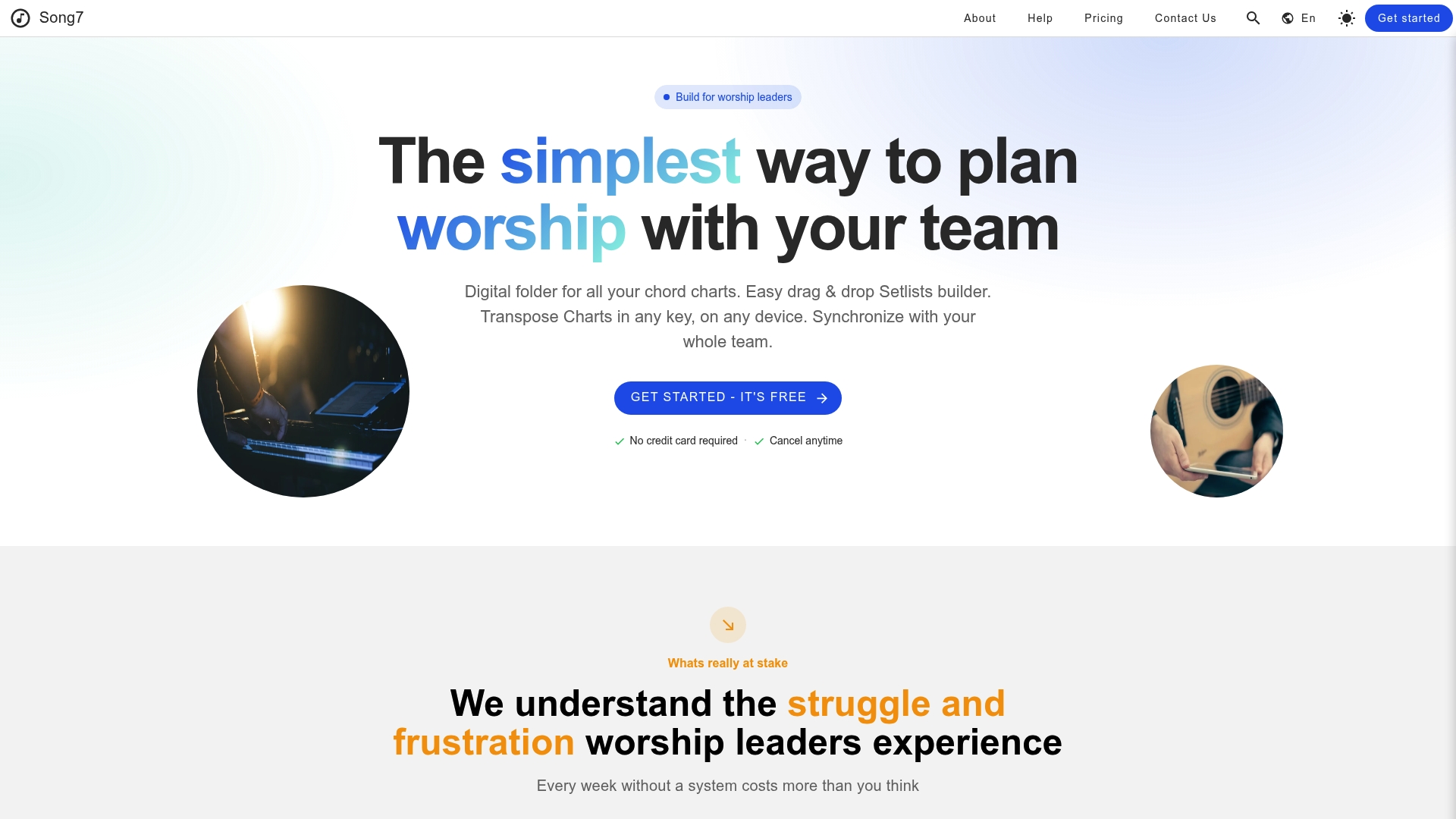
In your first one or two rehearsals with Song7, test the pieces that matter most on stage:
- Sync speed, by updating a chart on one device and checking how quickly it appears on another.
- Transpose, by changing keys on a song your team already knows well.
- Presentation mode, by displaying a chart the way your team or congregation would actually see it.
- Team invite flow, by adding a volunteer and confirming they can access the shared setlist right away.
Start a free trial with Song7 and run it through a real rehearsal before your next service.
Sources
For readers who want to dig deeper into the technical side, the ChordPro format overview explains why a device-agnostic chord format protects your library long term. The discussion on platform-specific feature gaps is worth a read if you're deciding between iPad and Android. Musicians comparing options across devices may also find this comparative look at sheet-music apps per device useful. Readers ready to try a team-focused platform can start with the Song7 product page.
FAQ
What is the best app for finding chords?
There's no single universally best app for finding chords, since it depends on whether you need a chord library, a search tool, or a way to build your own charts from text or photos. Apps that support ChordPro or similar text-based formats tend to make it easier to find, format, and reuse chords across your library, according to ChordPro's documentation.
Is there an Android equivalent to forScore?
There isn't a direct one-to-one Android equivalent, since some of the most established sheet-music and chord-chart apps have historically launched iPad-first, with Android versions arriving later or offering a reduced feature set, according to practitioner discussion on platform disparity. If you're on Android, test import, annotation, and offline behavior on your specific device before subscribing to confirm the app covers what you need.
What is the best app for practicing chords?
The best practice app depends on whether you need a metronome, tempo control, or a synced library you can rehearse from with your team. Apps built specifically for rehearsal, rather than solo sheet reading, tend to combine chord display with practice tools like a metronome so you're not switching between apps.
What is the best chord app for iPad?
iPad tends to have richer, more mature options in this category since many chord and sheet-music apps launched there first, so feature depth is generally stronger than on Android. For teams specifically, rather than solo musicians, a synced platform built for group use, such as Song7, tends to serve rehearsal and live-service needs better than a single-user sheet reader.