
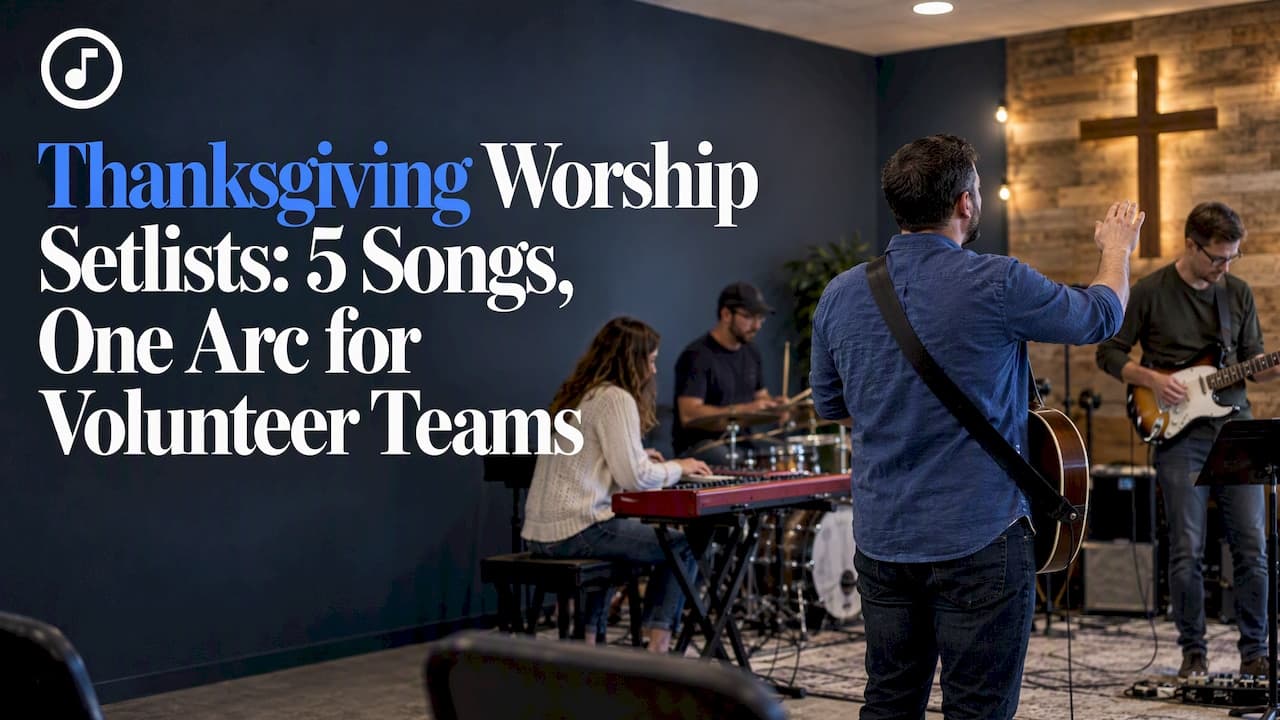
Use one of the three five-song Thanksgiving setlists below (traditional, contemporary or blended) and plan 4–5 songs for a 60–75 minute service. That count leaves room for testimonies and Scripture. The flow follows the three-movement arc: Call to Thanksgiving, Testimony and Remembrance, then Response of Praise.
TL;DR:
- Read Psalm 100 after the opener, Psalm 107 before testimonies, and Colossians 3:15 through 17 before closing praise to anchor each service movement in Scripture.
- Choose singable melodies in comfortable ranges, check every verse for Thanksgiving themes, and move from an energetic opening through reflection to an anthemic finish.
- Small teams can simplify intros, transpose songs into friendlier keys, and use clear endings; assign speaking, prayer, and slide cues before rehearsal.
- Licensing depends on how songs are used, so confirm your church’s current coverage and contact the publisher when an arrangement’s status is unclear.
Table of Contents
- Three copyable setlists for your Thanksgiving service
- How do you pick and order songs that tell one story?
- Where do Scripture, testimonies, and prayer fit?
- What does a 60–75 minute run sheet look like?
- How should your team rehearse and check tech?
- Who built this guide, and what is it based on?
- Shepherding hearts, not performing a set
- Build and run these setlists with Song7
- FAQ
- Sources
Three copyable setlists for your Thanksgiving service
Each list below follows the same arc: gather, remember, respond. Pick the one closest to your congregation, then swap songs freely. Worship Leader Magazine also publishes 25 Thanksgiving song suggestions and three full five-song setlists if you want more options.
Setlist A: Traditional / hymn-led
- "Come, Ye Thankful People, Come": a gathering hymn that names the season right away.
- "For the Beauty of the Earth": a gentle step into gratitude for creation.
- "Great Is Thy Faithfulness": the testimony song, built for remembering what God has done.
- "Now Thank We All Our God": a joyful turn toward response.
- "Doxology": a short, familiar closer everyone can sing from memory.
Setlist B: Contemporary
- "Give Thanks": an easy, upbeat opener.
- "10,000 Reasons (Bless the Lord)": a familiar gathering song that OCP suggests for uniting diverse congregations.
- "Thank You, Lord": a mid-tempo song that gives space for a testimony.
- "Goodness of God": a reflective high point.
- "Good, Good Father": a warm, sing-along close.
Setlist C: Blended / multigenerational
- "Come, Ye Thankful People, Come": open with a hymn to welcome older voices.
- "10,000 Reasons (Bless the Lord)": bridge into a contemporary sound.
- "Goodness of God": hold it for the testimony block.
- "Great Is Thy Faithfulness": let it flow straight in, ending on its last chord.
- "Now Thank We All Our God": a full, joyful finish.
Quick swaps: For a small instrumental team, drop to guitar or piano and keep the verses simple. For a choir-led anthem, this Hal Leonard choral piece offers parts and arrangement notes.
How do you pick and order songs that tell one story?
A setlist works when each song hands the congregation to the next one. Think of it as a short journey, not a playlist.
- Tempo: Open with an energetic song, settle into a reflective pace for testimony, then finish faster or anthemic.
- Singability: Keep melodies in a comfortable range so people can sing out, not just listen.
- Lyrics first: Never choose by title alone. Read every verse and check that the words fit the thanksgiving theme.
- Count: A standard Sunday set uses 4–5 songs, enough for a narrative without rushing anyone. Our guide on how many songs belong in a worship set goes deeper.
If you want to label each slot, our worship song categories map neatly to the three-part arc.
Pro Tip: After each song, ask "What does my heart want to say next?" The answer usually points to your next pick.
Where do Scripture, testimonies, and prayer fit?
Songs land deeper when Scripture and stories surround them. Our Sunday service planning checklist helps you place each element.
- Psalm 100: Read it as the call to thanksgiving, right after the opening song.
- Colossians 3:15–17: Use it to move from reflection to rejoicing, before the closing songs.
- Psalm 107: Read a few verses ahead of the testimony block.
- Testimonies: Schedule brief testimonies between midset songs.
- Communion or prayer: Pair it with the reflective song, or place it just before closing praise.
Some churches use lectionary texts instead, such as Sirach 50:22–24 or Luke 17:11–19.
What does a 60–75 minute run sheet look like?
Copy this timing into your service plan and share it with volunteers.
- Welcome (3–5 minutes): Greet people and name the theme of gratitude.
- Opening songs: Keep them upbeat and familiar.
- Testimony block: Share short stories, with Psalm 107 or a quiet instrumental underneath.
- Midset song (5–6 minutes): A reflective moment that carries the testimonies forward.
- Scripture and sermon tie-in: Connect the message back to the songs.
- Closing songs: Build to a joyful, full-voice finish.
- Benediction: Send people out with thanks.
For smooth transitions, use an instrumental tag, a spoken prayer or a slide change. Cue communion or the offering on a quiet beat. Our transition rehearsal playbook offers ideas for practicing these.
How should your team rehearse and check tech?
Spend some rehearsal time on transitions, key compatibility and endings. Those are where volunteer teams stumble.
- Tech check: Soundcheck, monitor levels, lyric slides, and click or backup tracks if you use them.
- Small teams: Simplify intros, use a capo or transpose to friendlier keys, and end songs on clear, crowd-friendly chords.
- Handoffs: Decide who speaks, who prays and who cues the slides before you play a note.
Pro Tip: Rehearse the gaps, not only the songs. A calm pause often matters more than a perfect verse.
Who built this guide, and what is it based on?
Our editorial team at Song7 assembled this guide from practitioner resources, including Worship Leader Magazine's Thanksgiving planning and setlist features, along with worship-planning experience. Song7 is a platform for worship leaders and church music teams, so the planning tools described here are ones we know well: drag-and-drop setlists, instant transposition, presentation mode and real-time team syncing.
If your church is also coordinating Thanksgiving outreach, Thanksgiving Outreach NYC is one community ministry option to explore.

Shepherding hearts, not performing a set
Sit down with your pastor before you pick a single song. When both of you know the message, the music can serve it instead of competing with it. Remember that Thanksgiving is the congregation's offering, so choose songs people can sing without you. Each year, revisit your list: keep what moved people, retire what felt forced, and add one new song.
— Editorial team
Build and run these setlists with Song7
We built Song7 so small teams can plan faster: drag and drop a setlist, transpose in one tap, show lyrics in presentation mode and keep every volunteer synced in real time. Import one of the lists above and share it with your team today at Song7.
FAQ
How many songs should a Thanksgiving worship service have?
Plan 4–5 songs. That is enough to build a narrative without rushing the congregation, and it leaves room for Scripture and testimonies.
What songs work best for a Thanksgiving worship setlist?
Choose songs whose lyrics focus on gratitude and God's faithfulness, like hymns such as "Great Is Thy Faithfulness" or contemporary songs such as "Goodness of God." Mix tempos so the service moves from gathering to testimony to praise.
What order should Thanksgiving worship songs follow?
Follow the three-part arc: Call to Thanksgiving, Testimony and Remembrance, then Response of Praise. Start with energetic songs, slow down for reflection, and finish with joyful praise.
Can I use hymns and contemporary songs together?
Yes. A blended setlist helps different generations sing together. Open with a hymn, bridge with a familiar modern song, and use transitions so the shift feels natural.
Do I need a license to use songs in a Thanksgiving service?
Licensing requirements can depend on how songs are used. Check your church's current licensing coverage, and ask the publisher if you are unsure about a specific arrangement.