
Plan every transition on your setlist and give it one owner before Sunday. Pick a single musical rule (key relationship, tempo gap, or phrase length) as your default fix, then rehearse the actual handoff, not just the songs. Short spoken scripts and a documented setlist note carry the rest.
TL;DR:
- Planning and rehearsing every transition with a designated owner ensures smooth handoffs and prevents last-minute improvisation during services.
- Using musical decisions like key, tempo, and phrase alignment in advance reduces the need for improvised fixes and creates seamless flow.
- Incorporating rehearsed bridging techniques such as crash-outs, pads, or tags helps address wide key or tempo gaps effectively.
- Between-song comments should be brief, scripture-based, and timed to support the musical tail rather than distract or extend silence unnecessarily.
- Consistent rehearsal, clear cues, and shared setlist tools prevent common issues like timing errors, jarring key changes, and volunteer forgetfulness.
Table of Contents
- Why Worship Transitions Matter More Than the Songs Themselves
- Musical Rules That Remove Most Transition Friction
- Performance Techniques That Bridge Awkward Gaps
- What to Say Between Songs (and When to Say Nothing)
- Rehearsal and Team Communication: Who Owns Each Handoff
- Templates and a One-Page Checklist for Sunday Morning
- How Centralized Setlist Tools Support Smoother Transitions
- Varying Your Transitions So the Set Doesn't Feel Repetitive
- Handling Sound and Lighting Cues During Transitions
- Managing Energy and Congregational Flow Through Transitions
- Common Transition Problems and How to Fix Them
- Coordinating the Worship Leader and Band Through Every Handoff
- Editorial Perspective: Transitions Are Pastoral Work, Not Production
- Sources
- FAQ
Why Worship Transitions Matter More Than the Songs Themselves
You can pick the best five songs in your church's library and still lose the room in the fifteen seconds between them, because worship transitions are the connective tissue of a set. When they're clumsy, the congregation feels the seam, not the Spirit. When they're planned, nobody notices the mechanics at all, which is exactly the point.
Most teams spend hours picking songs and keys and almost no time on what happens between them. That's backwards. Reformed Worship notes that transitions are often the most neglected part of set planning, even though they're the moments most likely to break congregational focus. Treat every handoff between songs, or between a song and a spoken moment, as its own decision, not an afterthought you'll figure out on the fly.
How to plan and map every transition on your setlist
Before rehearsal, count the transitions in your set. A five-song set has four transitions, plus however many spoken moments you add. For each one, decide the type: a musical flow (no gap), a bridge (a deliberate musical device like a vamp or pad), or a spoken reset. Then write that decision down where your team can see it.
A quick planning checklist works better than a vague conversation:
- Key relation: are the two songs in the same key, a relative key, or a jump that needs bridging?
- Tempo gap: is the BPM shift small enough to feel natural, or does it need a ramp?
- Lyrical continuity: does the last line of song one connect thematically to the first line of song two?
- Pastoral intention: does this moment need words, silence, or nothing at all?
Write the answer directly on the setlist next to each song, not in a separate document nobody opens on Sunday morning.
Musical Rules That Remove Most Transition Friction
Most transition problems are solvable with three musical decisions made in advance: key, tempo, and phrase length. Get these right during planning and you'll rarely need an improvised fix mid-service.
Start with keys. Worship Online recommends mapping every key and BPM on the setlist before rehearsal, then avoiding placing two songs in unrelated keys back to back. Relative keys (like C major to A minor) or a simple whole-step transpose almost always sound intentional. A jump from, say, E to B flat with no bridge tends to sound like a mistake, even when it's played correctly.
Tempo works the same way. A shift of 10 to 15 BPM usually reads as energy building or settling. Anything beyond that benefits from a ramp, a slight accelerando or decelerando over the last four bars, so the tempo change feels earned rather than abrupt.
Phrase alignment matters just as much as key or tempo:
- Start the next song on a phrase boundary, typically the top of an 8, 16, or 32 bar section.
- Never launch a new song mid-phrase; it disrupts the internal logic listeners feel even if they can't name it.
- Count off during the last phrase of the previous song so the band lands together.
Pro Tip: If you're unsure whether two songs share a workable key relationship, try playing the last chord of song one and the first chord of song two back to back on a keyboard. Your ear will tell you in about two seconds whether it needs a bridge.
Performance Techniques That Bridge Awkward Gaps
When the key or tempo gap is too wide for a clean cut, you need a bridge technique the band has actually rehearsed, not invented in the moment. A handful of moves handle almost every situation:
- Crash-out and hold. End the song on a sustained chord and let the room breathe. Worship Leader suggests a longer crash-out of several seconds works especially well after an up-tempo song, giving the congregation time to respond before the next song begins.
- A cappella endings. Drop the instruments and let voices carry the last line. This hides an odd key change beautifully because the ear resets to a single melodic line before the band re-enters in the new key.
- Instrumental pads. A held synth or guitar swell under a key change smooths the transition so the shift feels like a wash of sound rather than a jump cut.
- Vamp sections. Loop a short chorus or turnaround phrase while the leader decides, in real time, whether to speak, keep playing, or move on. This buys flexibility without dead air.
- Tags. Repeat a key line from the previous song once more, softly, before launching into the next. It reinforces the lyric and gives multi-generational congregations, especially those still finding the words, a moment to catch up.
What to Say Between Songs (and When to Say Nothing)
Words between songs should support the moment, not compete with it. The timing rule matters most: speak into the musical tail, while pads or a soft chord are still ringing, or right before the final chord resolves. Speaking into total silence forces the congregation to shift gears twice, once for your voice and once for the return to music.
Keep scripts short, Scripture anchored, and free of insider language. A few examples that work across most congregations:
- Invitation: "If you're carrying something heavy this morning, this next song is for you."
- Scripture tie-in: "Psalm 46 says God is our refuge and strength. Let's sing that back to Him."
- Simple continuation: "Let's keep our eyes up as we move into this next song together."
Avoid stacking three sentences of commentary before every song. One sentence, spoken with conviction over the music, does more than a paragraph spoken into silence.
Rehearsal and Team Communication: Who Owns Each Handoff
A transition plan only works if someone owns it. During rehearsal, assign specific roles: one person starts the next song (usually the guitarist or keys player on the downbeat), one player holds the pad or vamp, and one team member watches for the leader's cue to move.
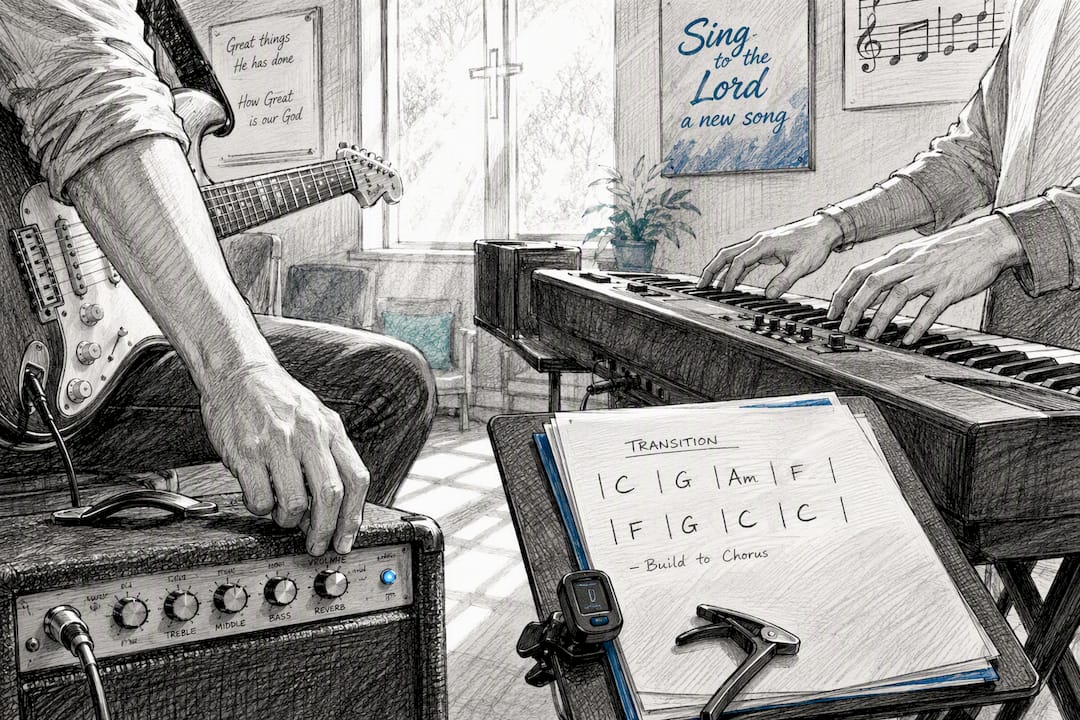
Church Leaders frames this clearly: identify every transition point in the set and rehearse it as part of the regular band rehearsal, not as an afterthought squeezed in at the end.
A simple drill works well for volunteer teams: run the song to the outro, repeat the outro, and perform the chosen transition into the next song twice in a row. Record it on a phone, listen back, and adjust who cues what. This drill, described in detail by Lead Worship Well, takes roughly five to ten minutes per transition when the band already knows both songs.
- Assign a starter, a pad or sustain player, and a cue watcher for every transition.
- Run the transition twice in rehearsal, then once more if anyone hesitates.
- Budget 5 to 10 minutes per transition, not per full song.
Pro Tip: Record every transition rehearsal on your phone. Listening back reveals timing issues your ears miss in the room, especially who came in a half beat late.
Templates and a One-Page Checklist for Sunday Morning
A setlist note only helps if it's specific enough for a volunteer to follow without asking you a question. Each song entry should include: song title, key, BPM, transition type into the next song, who cues the handoff, and any spoken note attached to it.
- Song, key, BPM
- Transition type (flow, bridge, or spoken)
- Who initiates the cue
- Exact spoken line, if any
Before service, run through a short checklist:
| Checklist item | Why it matters |
|---|---|
| Send setlist well ahead | Gives volunteers time to practice at home |
| Confirm keys with each player | Prevents last-minute transposition surprises |
| Rehearse every transition, not just songs | Catches timing issues before Sunday |
| Sound-check pads and sustain tones | Avoids dead air during key changes |
| Sync tempo/metronome settings | Keeps the band locked during tempo ramps |
| Distribute final charts to the team | Everyone plays from the same version |
Compress this into a one-page handout your volunteers can glance at backstage. Nobody reads a three-page rehearsal document thirty seconds before walking on stage.
How Centralized Setlist Tools Support Smoother Transitions
A shared, synced setlist eliminates one of the most common transition failures: someone playing from an outdated chord chart in the wrong key. When updates sync instantly across the team, everyone rehearses and performs from the same version.
Song7 was built around this exact volunteer-team problem. A few features map directly onto the workflow above:
- Drag-and-drop setlist building lets you mark transition type and cue owner right next to each song.
- Instant transpose means a last-minute key change updates for every team member at once, not just the leader's copy.
- Presentation mode and a built-in metronome help the band hold tempo and lyrics together through a live key or tempo shift.
- Real-time sync means your transition notes reach volunteers before rehearsal, not after.
Varying Your Transitions So the Set Doesn't Feel Repetitive
Defaulting to the same transition technique every time, always a crash-out, always a spoken word, trains your congregation to anticipate the pattern instead of staying present in the moment. Church Leaders points out that varying transition styles intentionally keeps a set from sounding formulaic, and it gives you more tools for matching the transition to what the moment actually needs.
Silence deserves a place in that toolkit, and it's the one most worship teams underuse. A few seconds of quiet after a song, with no instruments and no talking, lets the congregation sit with what they just sang instead of being rushed to the next thing. Silence works especially well after a confession-oriented or reflective song, right before communion, or following a moment where the lyrics carried real emotional weight.
Prayer works similarly but adds a spoken anchor. A short, unscripted prayer, ten to fifteen seconds, can bridge two songs that don't share an obvious musical or lyrical connection. It also gives the band a natural window to reset instruments or retune without drawing attention to it.
The rule of thumb: match the transition technique to the emotional temperature of the moment, not to whatever you did last week. A high-energy set benefits from vamps and tags that keep momentum. A reflective set benefits from silence and quiet pads. Rotate deliberately across a month of services and your congregation will feel the variety even if they can't articulate why.
Handling Sound and Lighting Cues During Transitions
Technical cues break down more transitions than bad musicianship does. A pad that comes in a half second late, or stage lighting that snaps to full brightness during a quiet a cappella moment, undoes even a well-rehearsed musical handoff.
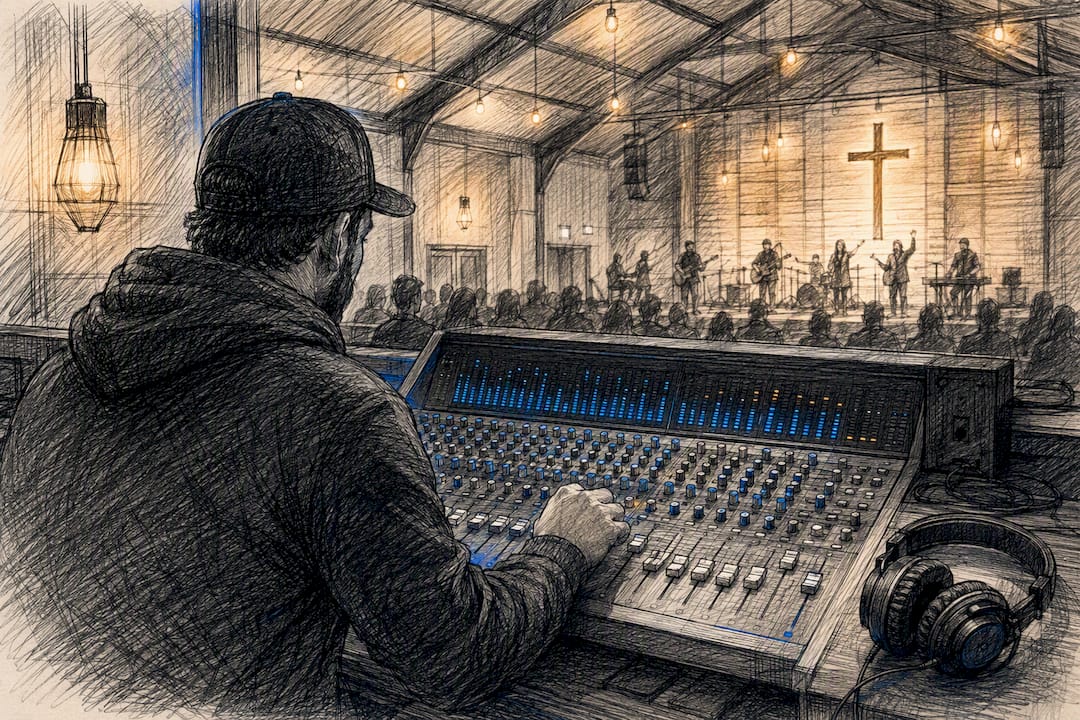
Sound and lighting need the same advance planning as the music itself. Your sound engineer should know, before the service starts, exactly which transitions involve a pad, a vamp, or a key change that affects monitor mixes. If the keyboard player is holding a sustained pad through a transition, the engineer needs to know to keep that channel open and balanced, not buried under a fading vocal mic.
Lighting should shift gradually, not abruptly, during any transition meant to feel continuous. A hard lighting cue in the middle of a musical bridge tells the congregation something changed even when the band intended a seamless flow. Save sharp lighting changes for moments where you want the congregation to notice a shift, like moving from worship into a sermon.
The fix here is simple: include your sound and lighting operators in the same rehearsal run-through as the band. If they only hear the transition once, live, on Sunday, they're guessing. If they've heard it twice in rehearsal, they know exactly when to move a fader or fade a light.
Managing Energy and Congregational Flow Through Transitions
Every transition either builds energy, releases it, or holds it steady, and congregations feel the difference even when they can't name it. A worship set that only ramps upward for thirty straight minutes exhausts people. One that stays low the entire time never lets them engage physically or emotionally.
Think of your set's energy as a shape you're drawing across the service, not a straight line. Transitions are the pivot points on that shape. Moving from an upbeat declaration song into a quieter, more intimate song requires a transition that visibly signals the shift, a tempo pull-back, a softer instrumental texture, maybe a few seconds of silence, so the congregation's energy can follow the music down instead of getting whiplash.
The opposite move, building from something quiet into something bigger, needs the reverse signal: a rising pad, a slight tempo increase, maybe a spoken line that lifts anticipation. WorshipFuel recommends ending sets on vertical, God-focused songs specifically because that upward arc gives the congregation somewhere to land emotionally before the service moves into its next segment.
Watch your congregation during transitions, not just during songs. If heads go down to check phones or bulletins during every transition, that's a signal your transitions are creating disengagement gaps rather than bridges. A well-run transition keeps eyes up and attention held, even during the fifteen seconds when no lyrics are on the screen.
Common Transition Problems and How to Fix Them
A few problems show up in almost every volunteer-led worship team, and most have straightforward fixes once you know what to look for.
The band starts the next song at different times. This almost always traces back to an unclear cue, not a lack of skill. Assign one person, usually whoever starts the song, as the definitive cue and have everyone else watch that person, not the leader's microphone stance.
Key changes sound jarring even when played correctly. The notes might be right, but the transition technique is missing. Add a crash-out, a pad, or an a cappella moment to soften the jump instead of cutting straight from one key to the next.
Spoken words kill the momentum. This usually means the words came during silence instead of over a musical tail, or the script ran too long. Trim it to one sentence and practice speaking it while the pad is still playing.
Volunteers forget the plan mid-service. This is a documentation problem, not a memory problem. If the transition type and cue owner aren't written on the setlist itself, don't expect anyone to remember a verbal instruction from Tuesday's rehearsal.
The set feels the same every week. Rotate your transition techniques on purpose. If you used a crash-out last week, try a vamp or an a cappella ending this week, even between the same two songs.
Most of these trace back to one root cause: the transition wasn't planned and rehearsed with the same care as the songs around it.
Coordinating the Worship Leader and Band Through Every Handoff
The worship leader's job during a transition isn't to play more, it's to communicate clearly with the fewest possible signals. A raised hand, a nod, or eye contact with the cue watcher should carry the same weight as a verbal instruction, because verbal instructions mid-transition usually confuse more than they clarify.
Each band member needs a defined role during every transition, not just during the songs. The drummer often anchors tempo through a fill or count off. The bassist or keys player frequently holds harmonic continuity through a pad or sustained note. The acoustic or electric guitarist might carry the rhythmic pulse that signals the next song's feel before anyone else comes in.
Rehearsal is where this coordination gets built, not Sunday morning. Run the actual transition, not just the songs on either side of it, so the band experiences the handoff exactly as it will happen live. If the drummer only ever practices song one and song two separately, the four bars between them will always be the shakiest part of the set.
The leader also carries responsibility for reading the room in real time. If the congregation is still deeply engaged after a song ends, that's a cue to extend the pad or hold the silence a beat longer than planned. If energy has clearly shifted, moving into the next song a touch faster than rehearsed can keep momentum alive. Rehearsed transitions give you the structure. Reading the congregation gives you the judgment to adjust that structure live.
Editorial Perspective: Transitions Are Pastoral Work, Not Production
Treating transitions as a technical problem misses what they actually do: they protect the congregation's attention on God, not on the mechanics of the set. A church we've studied once fixed a chronically clunky set by doing nothing more than adding four seconds of silence after its most emotionally weighted song. Attendance didn't change. Engagement did.
That's the real argument for rehearsing transitions with the same seriousness as the songs themselves. The small, repeatable practices, mapping keys, assigning a cue owner, running the handoff twice in rehearsal, aren't production polish. They're what let a congregation stop noticing the band and start noticing the moment.
— Editorial team
Sources
- Those treacherous transitions — Worship Leader
- Worship teams guide: transitions — Church Leaders
- How to plan a worship setlist that flows — Worship Online
- How to create a seamless worship set — WorshipFuel (CCLI)
FAQ
What Should You Say During a Worship Transition?
Keep it to one sentence, spoken over the musical tail rather than into silence, and anchor it to Scripture or a simple continuation phrase like "let's keep our eyes up as we move into this next song."
What Are the 5 C's of Worship?
Definitions of the "5 C's" vary across different ministries and resources, so there's no single agreed-upon framework worth stating as fact here; focus instead on the concrete transition practices covered above, like planning, key mapping, and rehearsal.
What Are Examples of Transitions in the Bible?
Scripture contains numerous shifts between lament and praise, most visibly in the Psalms, where a psalm often moves from crying out to declaring trust within the same passage, a pattern many worship leaders mirror when building a set's emotional arc.
What Are the Four Stages of Worship?
Many worship teams organize a set around an arc of engagement, exaltation, intimacy, and response, though specific labels vary by tradition; the transitions between these stages are exactly where planning, key relationships, and pacing matter most.
How Long Should a Worship Transition Take to Rehearse?
Most transitions take 5 to 10 minutes to rehearse properly, using a drill of running the outro, repeating it, and performing the handoff into the next song twice in a row.