
Song7 stands out as the strongest alternative to WorshipTools for volunteer-led worship teams, thanks to its focus on fast setlist syncing, simple transposition, and a presentation mode that does not require technical training. Other options like EasyWorship, ProPresenter, and OpenLP each serve a different slice of the market, from large production venues to free open-source setups. The right pick depends on your team's size, tech comfort, and how much time you have to train volunteers before Sunday.
TL;DR:
- Song7 offers instant setlist synchronization, simple drag-and-drop building, and live transposition, making it ideal for volunteer-led small to mid-sized churches.
- It focuses on real-time updates and minimal training, whereas tools like ProPresenter are more suited for large venues with complex staging and trained operators.
- Most competing platforms support importing common file formats and have varying levels of media control, but ease of use for volunteers often hinges on offline accessibility and quick setup.
- Larger production tools tend to be more complex and less practical for volunteer teams, which prioritize fast onboarding and reliable live updates on all devices.
- Testing software by running a full rehearsal with real imports and live sync is crucial before committing, as ease of adoption predicts ongoing usability more than feature count.
Table of Contents
- Which worship software alternatives are worth considering?
- How do these tools actually compare on the things that matter?
- How should you choose the right worship software for your team?
- Where Song7 fits for worship teams like yours
- What we think most churches get wrong when choosing software
- Try Song7 with your team this week
- FAQ
- Sources
Which worship software alternatives are worth considering?
If you are outgrowing WorshipTools or just started shopping around, you have landed in a crowded field. We have pulled together the names that show up most often in side-by-side comparisons and alternative listings, starting with the option built specifically for volunteer teams.
Song7 was designed around one problem: volunteer-led worship teams need their setlists, chords, and lyrics synced instantly, without a learning curve that eats into rehearsal time. It offers a drag-and-drop setlist builder, instant transposition, a presentation mode for live display, and rehearsal tools like a metronome and tuner, which integrate well with weekly studio loop tools for music teachers. Syncing means when a worship leader swaps a song order an hour before service, team members' devices update automatically. That combination of simplicity and dependability is what makes it a fit for small and mid-size churches running on volunteer hours rather than paid tech staff.
Here is how the rest of the field breaks down:
- EasyWorship gives churches a familiar desktop workflow with strong media playback, a good match for teams that want on-premise control rather than a cloud-based tool.
- ProPresenter is built for large venues and events that need multi-layered visuals and complex staging, which is powerful, but often more than a volunteer team needs to manage.
- OpenLP is a free, open-source presentation platform that covers the basics of lyric and media display for churches on a tight budget.
- VideoPsalm offers free Bible and lyrics presentation with simple import options, aimed squarely at smaller congregations.
- Faithlife Proclaim connects presentation slides to a cloud media library, useful for churches already using the Faithlife ecosystem.
- MediaShout has a long history in church media with detailed timeline and playback controls for teams that want granular control.
- ChMeetings, Worship Him, Sunday Worship, WorshipCenter Pro, Worship Assistant, Presentation Manager, Worship LIVE!, Ministry Assistant, Risen Media, Worship Extra, KerkBeamer, Altar Live, Quelea, QuickWorship, Song of Songs, TheOpenPresenter, Proclaim by Logos, MindMyMinistry, ShareFaith, Fly Worship, LiveControl, ChurchStreaming.tv, ChurchPlan, Church 15, SermonCast, Connection Card Pro, One Church, Praisenter, SeekerWorks, Tithe.ly, Ad-Din, StreamingChurch.tv, and Subsplash round out the broader landscape. Several of these lean toward church management, streaming infrastructure, or giving tools rather than live lyric presentation, so they are worth a look if your need extends beyond the worship set itself, but they rarely compete head to head with Song7, EasyWorship, or ProPresenter on day-to-day setlist and presentation work.
SourceForge's alternatives directory lists many of these same names, confirming that this is a stable, well-covered market rather than a niche with only one or two real options.
| Tool | Best for | Standout capability |
|---|---|---|
| Song7 | Volunteer-led small to mid-size teams | Instant setlist sync, drag-and-drop builder, transpose, rehearsal metronome and tuner |
| EasyWorship | Desktop-first churches wanting on-premise control | Robust desktop workflow and media playback |
| ProPresenter | Large venues with dedicated tech teams | Advanced multi-layer and multi-screen control |
| OpenLP | Budget-conscious churches | Free, open-source core presentation features |
| VideoPsalm | Small congregations needing simple scripture display | Free lyric and Bible presentation tooling |
| Faithlife Proclaim | Churches already using Faithlife tools | Cloud slide libraries tied to church media |
| MediaShout | Teams needing granular media timing | Detailed timeline and playback control |
Each of these names shows up repeatedly across comparison pages for worship software, which is one reason we treat them as the core shortlist rather than a long, undifferentiated list.
How do these tools actually compare on the things that matter?
A feature list only tells half the story. What decides whether a tool survives its first few Sundays is how it handles the day-to-day friction points: syncing changes, training a rotating volunteer roster, and keeping the budget predictable.
| Best for | Deployment | Presentation power | Setlist & library | Team sync | Pricing shape | Ease for volunteers |
|---|---|---|---|---|---|---|
| Song7: volunteer teams | Web-based | Lyrics, chords, simple live display | Drag-and-drop builder, transpose, tagging | Real-time sync across devices | Subscription with free trial | Built for low-training volunteer use |
| EasyWorship: desktop control | Desktop | Strong media and video playback | Library management within app | Manual or local network sync | Perpetual license | Moderate, familiar desktop pattern |
| ProPresenter: large production | Desktop (with companion apps) | Multi-layer, multi-screen staging | Advanced playlist and media management | Networked sync across stations | Subscription or one-time purchase tiers | Steeper, suited to trained operators |
| OpenLP: free entry point | Desktop | Basic lyric and media display | Simple library and service plans | Local, not cloud-based | Free | Workable but less polished |
G2's comparison of EasyWorship and ProPresenter shows the same handful of names surfacing again and again across pairings, which tells us the market has settled around a known set of contenders rather than constant new entrants. G2's comparison of MediaShout and ProPresenter also notes that production-heavy platforms add real technical complexity, a tradeoff worth weighing carefully before committing a volunteer team to one.
A few things worth testing before you decide:
- Ask whether a song edit mid-rehearsal updates on every connected device, not just the leader's screen.
- Check how long it takes a brand-new volunteer to build their first setlist without help.
- Confirm whether the tool works offline if your venue has unreliable Wi-Fi during service.
The tradeoff running through all of this is straightforward: production-grade tools like ProPresenter buy you layered visuals and multi-screen staging, but that power comes with a setup and training cost that volunteer teams often cannot absorb. Lightweight tools built for volunteers sacrifice some visual complexity in exchange for something more valuable to a small team: everyone can actually use it by Sunday morning.
How should you choose the right worship software for your team?
Before you sign up for anything, run through a short checklist that matches the tool to how your team actually operates, not how a sales page describes it.
- Does it support offline mode for venues with spotty internet during service?
- Can it import your existing files, whether that is ChordPro, plain text, or scanned photos of handwritten charts?
- Does it offer role-based permissions so volunteers can edit their own parts without touching the whole service plan?
- Does it handle multi-screen output if your stage has both a confidence monitor and a congregation-facing screen?
- How fast does a change sync across every device on the team, not just the one making the edit?
- What does the free trial actually include, and does it expire before you have run a full rehearsal cycle?
When you get on a demo call, these questions tend to separate the tools that were built for volunteers from the tools that were built for professional tech directors:
- What happens when two volunteers edit the same setlist at once?
- How long does onboarding take for someone who has never used presentation software?
- Can a song be transposed on the spot during rehearsal without breaking the slide layout?
- What file formats can you import and export, and does that include ChordPro?
- Is there a hard limit on songs, setlists, or team members on the entry-level plan?
- What happens to your library if you cancel? Can you export everything?
Pro Tip: Run one full rehearsal inside the trial before you commit. A single live test, importing a song, transposing it, syncing to a volunteer's phone, and presenting it, exposes more real problems than an hour of reading feature lists.
Watch for a few red flags during that trial: pricing pages that hide the real cost until checkout, feature lists so long they bury the basics, and no clear path for onboarding a volunteer who has never touched the software before. If a tool needs a manual before a volunteer can build a setlist, that is a sign it was not built with your team in mind.
For a deeper walkthrough of this kind of hands-on test, our guide to testing church presentation software in one rehearsal covers the exact steps worth running before you decide. If you are weighing web versus desktop specifically, our breakdown of web versus desktop worship software walks through the tradeoffs in more depth.
Where Song7 fits for worship teams like yours
We built Song7 around a simple observation: most worship software is designed for the biggest church in the room, not the volunteer team running sound, slides, and setlists on a Tuesday night rehearsal. Our feature set reflects that choice.
- Instant setlist sync keeps every team member's device current the moment a leader changes the song order.
- Drag-and-drop setlist building lets a volunteer assemble a full service without reading a manual first.
- One-tap transposition adjusts chord charts on the spot during rehearsal, no retyping required.
- Presentation mode displays lyrics live without the layered complexity of production-focused tools.
- Built-in metronome and tuner support rehearsal prep without needing a separate app.
Our fit is clearest for volunteer-led small to mid-size churches that need their team synced and prepared without hiring a dedicated tech director. That is the gap we built for, and it shapes every decision in how the interface works: fewer menus, fewer settings, more of what a Sunday team actually touches week to week.
Among the sourced comparisons we reviewed, G2's library of worship software comparisons consistently places production-focused platforms as valuable for large venues but notes added complexity for smaller teams, which lines up with why we kept Song7's feature set intentionally narrow.
For more on how Song7 compares specifically against established desktop tools, our EasyWorship alternatives guide and our ProPresenter alternatives guide go through the setlist-syncing differences in more detail.
What we think most churches get wrong when choosing software
Most churches shop for worship software the same way they shop for a sound system: more features, more sliders, more control. That instinct backfires for volunteer teams. The tool that wins the feature comparison on paper is often the tool that sits unused by week three, because nobody had time to train a rotating group of volunteers on a dozen menus.

The conventional advice, "pick the most powerful platform you can afford," gets the priority backwards. Power only matters if your team can reach it under Sunday morning pressure. What actually predicts whether a tool sticks is how fast a brand-new volunteer can build a setlist alone, and how reliably a last-minute change reaches every device before doors open.
If you take one thing from this comparison, test for speed of adoption before you test for feature depth. A tool with fewer options that your whole team uses confidently beats a tool with more options that only one trained person can run.
— Editorial team
Try Song7 with your team this week
If your worship team is tired of chasing down the latest setlist version or re-explaining software to a new volunteer every month, this is the problem we built Song7 to solve. Our platform keeps everyone synced in real time, so the song order your leader finalizes on Thursday is exactly what shows up on every phone and screen on Sunday, no group text required.
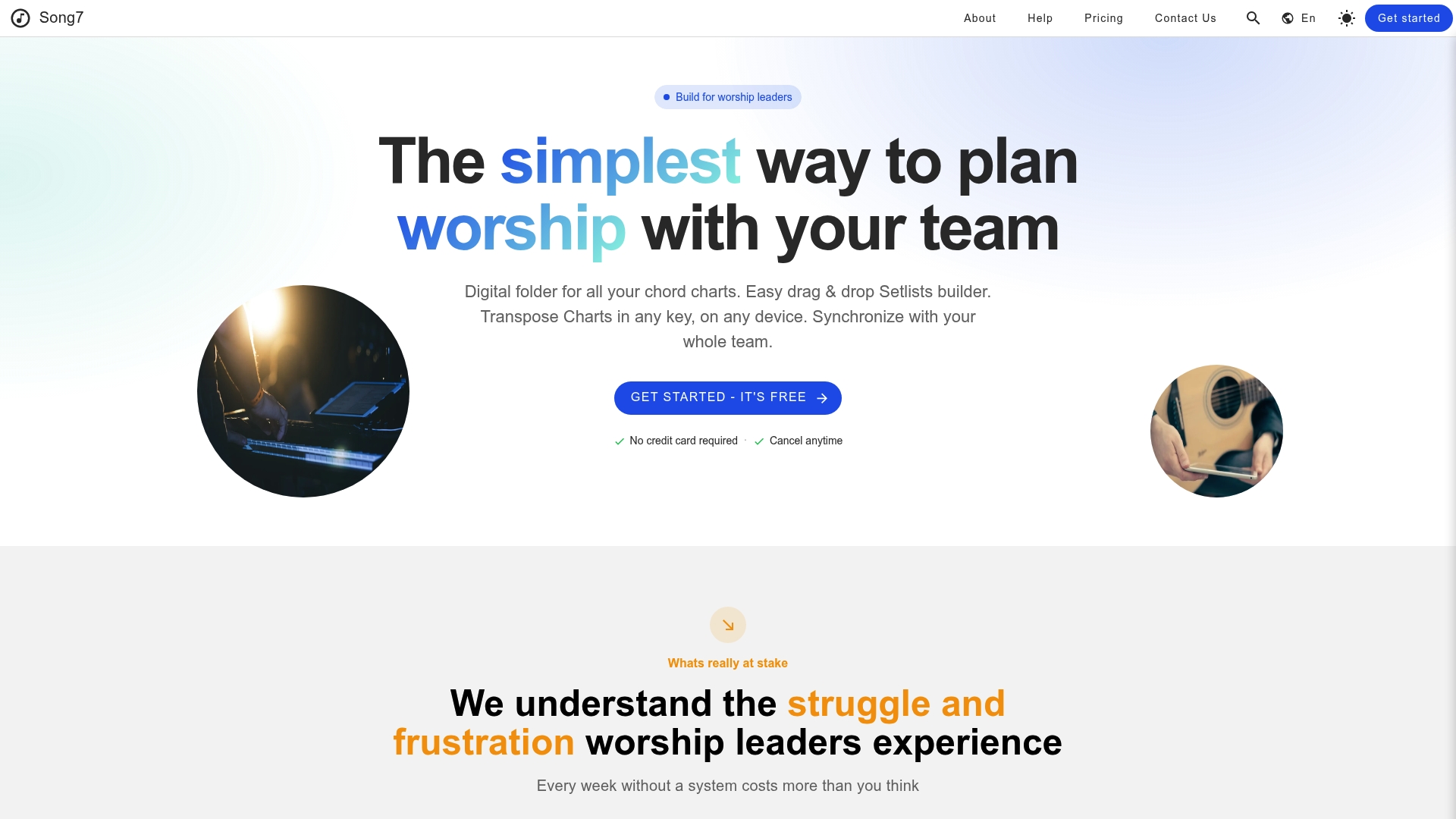
Getting started takes less than one rehearsal cycle:
- Start a free trial at Song7.
- Import one song from ChordPro, text, or a photo of a chord chart.
- Build your first setlist using the drag-and-drop builder.
- Sync with your team and watch changes update live across every device.
Ready to see it in action with your own team? Visit Song7 and start your trial today.
FAQ
How hard is it to migrate from WorshipTools to another tool?
Migration usually means re-importing your song library and chord charts into the new platform, which most tools support through ChordPro, text, or file uploads. Expect to spend one or two rehearsal sessions rebuilding your core setlists and training your team on the new interface.
Can volunteer teams use these tools without technical training?
Tools built specifically for volunteer workflows, like Song7, prioritize drag-and-drop setlist building and simple presentation modes that do not require a manual to operate. Production-focused platforms with multi-layer visuals typically need more hands-on training before a volunteer feels confident running them live.
Does Song7 work offline during a service?
Song7's presentation mode is designed to keep your current setlist and chord charts accessible on your device, which helps during brief connectivity drops common in church buildings. Check current offline behavior directly with Song7 support, since coverage can depend on your specific plan and device.
What should I ask a vendor during a free trial?
Ask how fast a change syncs across every team member's device, what file formats you can import and export, and whether there are hard limits on songs or team members at the entry level. Also ask what happens to your library if you cancel, since export options vary widely between platforms.
Are free tools like OpenLP or VideoPsalm good enough for a small church?
Free, open-source tools like OpenLP and VideoPsalm cover core lyric and scripture presentation well, which makes them workable for very small congregations on a tight budget. They typically offer less polish and fewer team-syncing features than paid, volunteer-focused platforms built around real-time collaboration.