
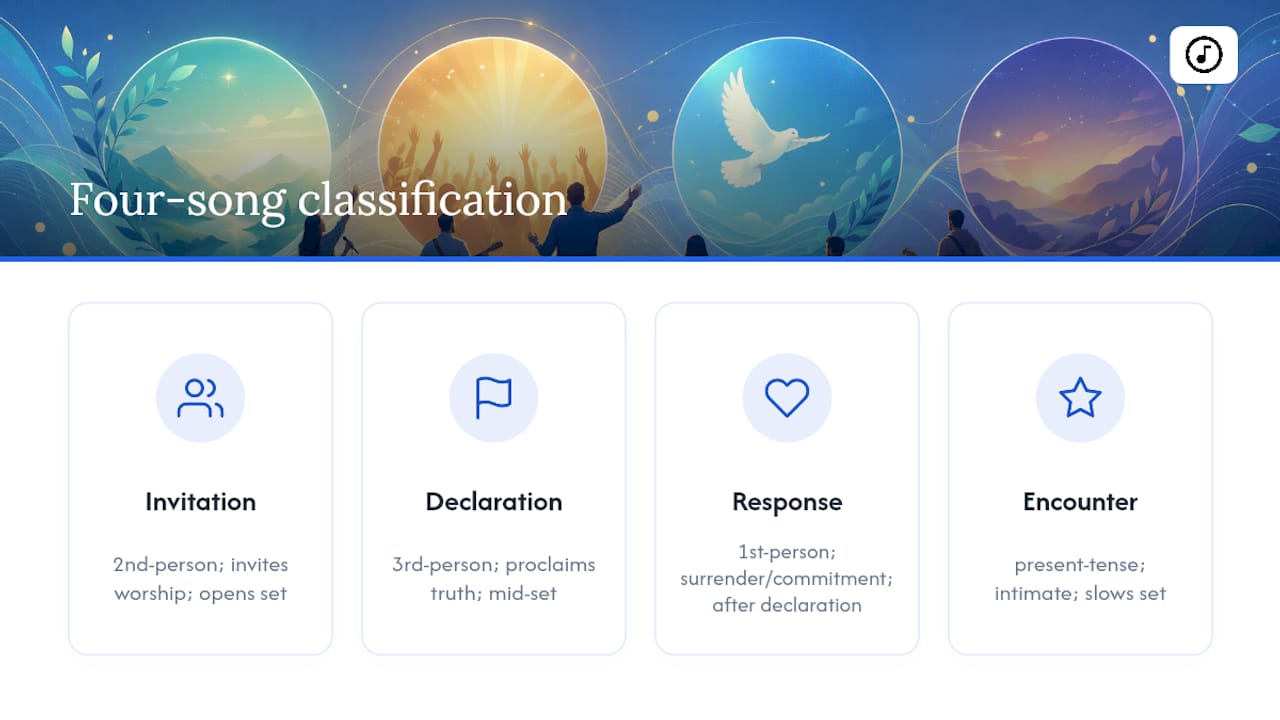
Worship song categories are purpose-driven labels, not tempo labels. They classify a song by what it does spiritually, not by how fast it plays. The most practical starting point is a four-category model: Invitation songs draw people in, Declaration songs proclaim truth about God, Response songs answer what's been declared, and Encounter songs create space for intimacy with God. Getting this right matters because a set built on tempo alone can feel emotionally flat even when every song is technically "good."
TL;DR:
- Most worship songs fit clearly into one of four categories based on their lyrical emphasis, with the chorus being the key tie-breaker if it spans multiple themes.
- Building a setlist with a progression from invitation to declaration to response creates a spiritual flow that guides congregational participation.
- Tagging every song with minimal metadata, including category, key, and tempo, streamlines rehearsal and transitions, especially when using tools like Song7.
- Liturgical traditions assign songs to fixed service moments, while contemporary churches prefer flexible categories that adapt to sermon themes and church seasons.
- Proper classification avoids mistaking tempo for function, ensuring a balanced set that fosters engagement and theological depth during worship.
Table of Contents
- What Are Worship Song Categories, Really?
- How to Classify a Song in Under a Minute
- Building a Setlist Around Categories
- Tagging, Mashups, and Making Categories Stick in Rehearsal
- How Song7 Turns Categories Into a Repeatable Workflow
- Where Worship Song Categories Came From
- How Categories Differ Across Denominations and Traditions
- Why Categories Change How a Congregation Sings
- Common Mistakes Worship Leaders Make With Categories
- Sources
- FAQ
What Are Worship Song Categories, Really?
Most worship leaders start with tempo. Fast opener, slower bridge, big finish. It's an easy system, and it's also the wrong lens for building a set that actually shepherds a congregation somewhere.
Worship song categories group songs by their spiritual function inside a service: invitation, declaration, response, encounter, confession, thanksgiving, and so on. A song's tempo tells you almost nothing about whether it belongs at the start of a set or right before communion. A slow song can be a bold declaration of God's power. A fast song can be a response of surrender.
Two taxonomies dominate the worship-planning world right now:
- The four-category model (Invitation, Declaration/Proclamation, Response, Encounter), which favors flexibility and works well for contemporary, non-liturgical services.
- The liturgical-elements approach, which maps songs to fixed service moments like call to worship, confession, communion, and benediction, common in traditions with a set order of service.
A related four-part scheme, Praise/Thanksgiving, Prophetic/Declarative, Worship/Intimacy, and Petition/Prayer, classifies most contemporary congregational songs accurately without leaning on tempo at all. Whichever labels you use, the classifier that matters is the dominant theme of the chorus, not the click track.
How to Classify a Song in Under a Minute
Once you've picked a taxonomy, classification comes down to two questions: who is the song talking to, and what is the chorus actually saying? Here's a fast-reference breakdown using the four-category model.
Invitation songs call people into worship. They tend to use second-person or corporate language ("Come," "Let us"), sit in a comfortable vocal range, and work well as openers. Think of songs built around gathering language, like an opener that repeats "come and worship" or "let everything that has breath."
Declaration/Proclamation songs announce something true about God, usually in third person ("He is," "God is"). These carry the theological weight of a set, often build to a bold, anthemic chorus, and work well mid-set once the room is warmed up. A chorus repeating "our God is greater" or "great is Thy faithfulness" is doing declaration work.
Response songs answer what's been declared, usually in first person ("I will," "I surrender"). They're the surrender-and-commitment songs, often softer musically even at moderate tempo, and they work well after a strong declaration or right before a sermon transition. A lyric like "I give You my heart, I give You my soul" is textbook response.
Encounter songs create space for intimacy, using intimate, present-tense language ("You are here," "Holy Spirit"). These are usually the slowest, most spacious arrangements in a set, with room for pauses, and they're the songs that "bring people down from high" energy into stillness. A repeated line like "Spirit, lead me where my trust is without borders" fits here.
Pro Tip: When a song's verses feel like one category but the chorus feels like another, classify by the chorus. It's the section people remember and sing back, and it's what a taxonomy built around dominant-classifier logic recommends as the tie-breaker.
Roughly four out of five contemporary worship songs fit cleanly into one of these categories once you isolate the chorus. The rest are genuine hybrids, and that's fine. A hybrid song can still anchor a set transition if you know which half you're leaning on that Sunday.
Building a Setlist Around Categories
A setlist built from categories reads like a story instead of a random string of songs. The order isn't arbitrary. It's meant to move a congregation from gathering to declaring to responding to resting, the same emotional and spiritual arc a good sermon follows.
Here are three templates you can adapt this week:
- The 3-song set: Invitation, Declaration, Response. Simple, tight, and works well for early services or midweek gatherings.
- The 5-song set: Invitation, Declaration, Declaration, Response, Encounter. This is the standard Sunday morning shape, giving the room two chances to proclaim before it responds.
- The extended worship set: Invitation, Declaration, Response, Encounter, Response (reprise). Useful for retreats or nights built specifically around ministry time.
Practitioners who track song placement around the sermon consistently recommend including songs of Invitation, Acknowledgement, and Relationship in every service, arguing that skipping a category isn't just a musical gap. It's a pastoral one. A set with only Declaration songs can leave a congregation informed but never invited to respond. A set with only Encounter songs can feel emotionally rich but theologically thin.
Pro Tip: Label each slot in your setlist with its category, not just its title. When you glance at a lineup that reads "Invitation, Declaration, Declaration, Response, Encounter," you'll catch a lopsided set before rehearsal instead of during it.
Tagging, Mashups, and Making Categories Stick in Rehearsal
Categories only help if your team can find and use them fast, which means metadata. At minimum, tag every song in your library with: category, theme, key, tempo, scripture reference, and any arrangement notes. A workable schema doesn't need to be exhaustive. Three required fields (category, key, lead vocal range) plus two optional ones (theme or scripture, arrangement notes) balance speed with usefulness for most volunteer teams.
Tags and mashups extend a theme across songs without an awkward stop. Before combining two songs, check that the key and time signature align, or transpose one to match. A mismatched key is the fastest way to kill momentum mid-set.
For rehearsal, keep transitions simple:
- Agree on a one-word cue phrase for each transition point.
- Run the transition itself, not just the full songs, two or three times.
- Keep the metronome or click running through transitions so tempo doesn't drift.
Pro Tip: A five to ten minute transition-only rehearsal right before service catches more problems than a full run-through the night before.
How Song7 Turns Categories Into a Repeatable Workflow
Categories are only useful if your whole team can see and act on them, which is where the tag → setlist → rehearse workflow comes in. Song7 supports each step:
- Tagging: Attach category, key, tempo, and scripture reference directly to each song in your library.
- Drag-and-drop setlist builder: Arrange songs by category to check your set's shape at a glance.
- Instant transposing: Match keys quickly when building a mashup or tag.
- Presentation mode and real-time team sync: Keep everyone, from vocalists to the tech booth, working off the same categorized setlist.
If you want a deeper walkthrough of the tagging side, organizing your song library effectively covers metadata schemas in more detail, and Sunday service planning walks through building the set itself.
Where Worship Song Categories Came From
The impulse to sort songs by function isn't new. It goes back to the Psalms themselves, which ancient Jewish worship already grouped by purpose: psalms of lament, psalms of thanksgiving, psalms of ascent sung on pilgrimage, royal psalms declaring God's kingship. That's a category system roughly three thousand years old, and it maps surprisingly well onto modern Declaration and Response labels.
Liturgical traditions formalized this further over centuries, building fixed service structures where hymns were assigned to specific moments: introits, offertories, communion hymns, recessionals. The Reformation era added a wave of congregational hymnody meant to teach doctrine through Declaration-style lyrics people could memorize.
The contemporary four-category model is a much newer development, shaped by the rise of the modern worship band in the late 20th century. As services moved away from fixed liturgical orders toward flexible, band-led sets, leaders needed a simpler classification system that didn't depend on a printed order of service. The result borrowed the emotional logic of older liturgical categories (gathering, confessing, proclaiming, responding) but compressed it into labels flexible enough to work in a non-liturgical format.
What hasn't changed across three thousand years is the underlying instinct: a service works better when it moves somewhere, and that movement needs songs built for different jobs along the way.
How Categories Differ Across Denominations and Traditions
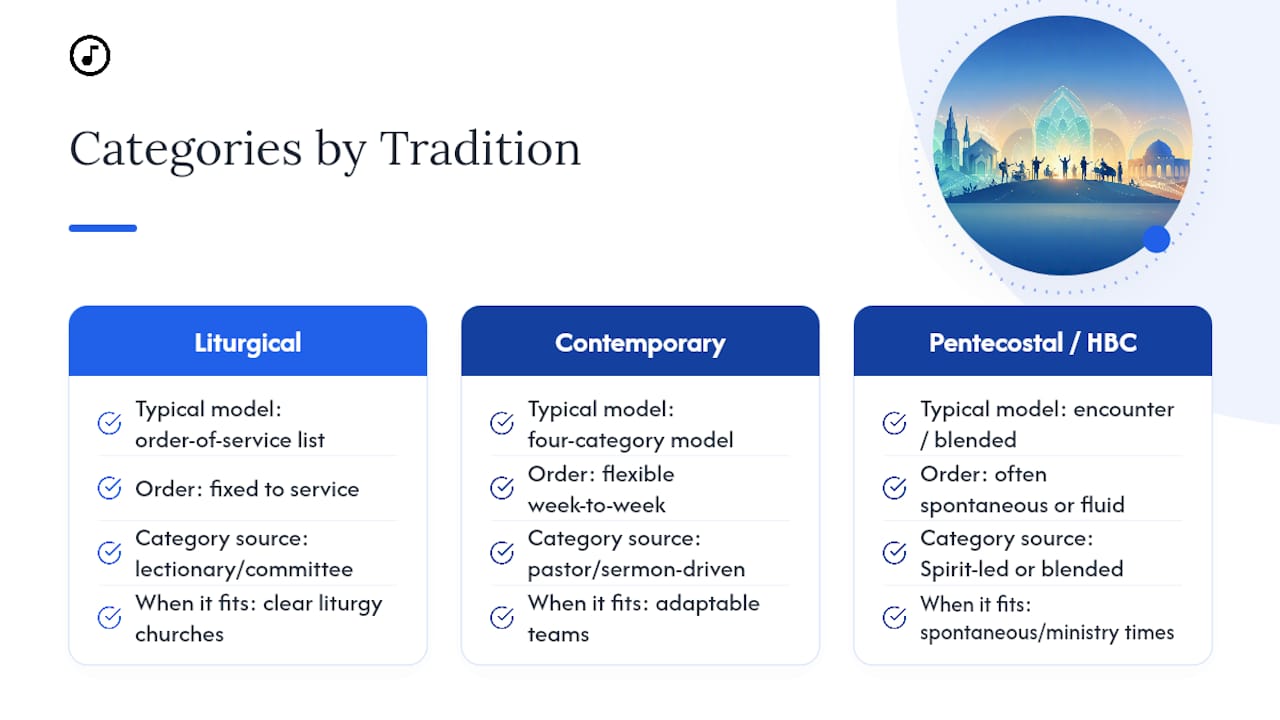
Liturgical churches (Catholic, Episcopal, many Lutheran and Presbyterian congregations) tend to organize songs strictly around the order of service: call to worship, confession, assurance of pardon, communion, benediction. In these traditions, a song's category isn't really up for debate. It's assigned by its slot in a service that's often set months in advance by a lectionary or worship committee.
Contemporary evangelical and non-denominational churches lean toward the four-category model precisely because their services are less fixed. A worship pastor building a set week to week needs categories flexible enough to respond to a sermon topic or a season in the church's life, not locked to a printed liturgy.
Pentecostal and charismatic traditions often add a category liturgical lists don't emphasize as heavily: extended Encounter or "ministry time" songs, sometimes without fixed structure at all, built to sustain a spontaneous, Spirit-led moment. Historically Black church traditions frequently blend Declaration and Response into a single continuous, call-and-response form where the line between proclaiming truth and answering it musically blurs on purpose.
None of these approaches is more "correct" than another. Liturgical element lists work best for churches with a clear order of service, while the four-category model suits teams that need week-to-week flexibility. What matters is that your team agrees on one system and applies it consistently, rather than mixing frameworks and creating confusion about what a "Response song" even means in your context.
Why Categories Change How a Congregation Sings
A congregation participates more when a set has emotional and spiritual logic, not just a string of good songs. Skip straight from an Invitation opener to an Encounter song, and you'll often see people disengage. There hasn't been enough Declaration in between to give them something to respond to.
This is where the pastoral argument for categories becomes practical rather than academic. Including representation from Invitation, Declaration, and Response songs each service isn't a stylistic preference. It's a way of making sure the congregation is actually guided through an arc, not just present for one.
Encounter songs carry their own risk if overused. A set with three Encounter-style songs back to back can feel emotionally heavy without ever grounding people in the truth that justifies that emotion. Congregants sing along with Declaration choruses because the lyrics hand them something concrete to affirm. They often go quiet during Encounter songs that lack that anchor, not because they're disengaged, but because there's nothing specific to sing back yet.
The fix isn't complicated: alternate. Give people something to declare before you ask them to simply be still.
Common Mistakes Worship Leaders Make With Categories
The biggest mistake is treating tempo as a stand-in for category. A slow song isn't automatically an Encounter song, and a fast one isn't automatically Declaration. Sort by lyrical function first, tempo second.
The second mistake is over-tagging. Piling on ten metadata fields per song guarantees your team stops filling them in accurately within a month. Stick to a short list: category, key, tempo, and maybe one more.
The third is inconsistent metadata across team members, where one volunteer calls a song "Praise" and another calls the same song "Declaration." Standardize your labels in writing, run a quarterly library review, and pick one small change to test this month. Ask your team what actually felt different.
— Editorial team
Sources
For the four-category taxonomy and classification logic, see Crucis. For liturgical element mapping, see Sovereign Grace Music. For tag and mashup technique, see Worship Ministry Training.
Ready to put these categories into practice without juggling spreadsheets? Song7 lets your team tag songs by category, build setlists by drag and drop, transpose on the fly, and stay synced in real time, so your whole volunteer team is working from the same plan every Sunday. If you're mapping Petition or Prayer songs to scripture, this collection of prayer-focused Bible verses is a useful reference for picking supporting readings.
- The Four Song Categories in Worship — Crucis
- Songs by Liturgical Categories — Sovereign Grace Music
- Worship Planning // Song Types — The Church Collective
- My 15 favorite mashups & tags for worship — Worship Ministry Training
FAQ
What are the seven levels of worship mentioned in some teachings?
Various teachers describe a "levels of worship" progression (often citing stages like entering with thanksgiving and moving toward deeper intimacy), but this isn't a standardized taxonomy used across worship-planning literature. It's best treated as one devotional framework among several, not a fixed industry standard like the four-category model.
What are common themes in worship songs?
Common themes include God's faithfulness, surrender, gratitude, God's power and majesty, intimacy with the Holy Spirit, and petitions for help or healing. These themes map closely onto the Declaration, Response, Encounter, and Petition/Prayer categories.
What are the main types of worship song categories?
The most widely used practical model has four types: Invitation, Declaration/Proclamation, Response, and Encounter, though liturgical churches often use elements like call to worship, confession, communion, and benediction instead.
Are there lists of 100 popular worship songs organized by category?
Curated song lists exist across many worship resources, but song popularity shifts constantly and specific rankings aren't something this article tracks. A more durable approach is tagging your own church's library by category using the classification cues covered above, so your list stays current regardless of what's trending.
How do I handle a song that fits two categories at once?
Classify by the chorus, since it's the part congregants repeat and remember most. If the chorus still splits evenly between two functions, pick the category that matches where you plan to place the song in your set.