
Some setlist apps deliver reliable real-time syncing, simple drag-and-drop setlist building, and presentation-ready lyric display with minimal training, designed for volunteer-led worship teams. Small and medium churches gain the most: rehearsals start on time, key changes stop causing panic, and Sunday mornings run without the last-minute scramble for the right charts.
TL;DR:
- Most volunteer teams benefit from quick, reliable mobile sync and drag-and-drop setlist building, which prevents last-minute confusion before services.
- Instant transposition and clear, presentation-friendly output help team members of varying tech skills adapt quickly and reduce errors.
- A one-week rollout, focusing on importing a small song list, testing transposition, and rehearsing with the app, can establish an effective workflow in time for Sunday.
- Reliable real-time updates and a single point of accountability for setlist edits minimize Sunday morning chaos caused by outdated charts or conflicting changes.
- Simplicity and consistency in use matter more than extensive features, making initial setup and adoption smoother and more sustainable long-term.
Table of Contents
- Why Volunteer Teams Need a Worship-Focused Setlist App
- What to Look For in a Worship Setlist App
- How Song7 Covers the Worship Setlist Checklist
- Roll Out a Working Setlist in One Week
- Editorial Take: Prioritize Reliability, Not Feature Count
- Start Your Song7 Trial This Week
- Sources
- FAQ
Why Volunteer Teams Need a Worship-Focused Setlist App
Most worship teams don't struggle because they lack talent. They struggle because their tools weren't built for how a volunteer team actually works. Someone prints a chord chart Thursday night, the key changes Sunday morning, and now half the band is playing in the wrong key while the other half is squinting at a phone screenshot.
A general-purpose notes app or a shared folder can't fix that. Worship-specific software solves a different problem: it keeps everyone, from your most seasoned guitarist to the teenager running slides for the first time, looking at the same current version of the same song.
Here's what actually matters for a volunteer context:
- Paper charts go stale fast — one edit on Saturday night means someone's holding an outdated copy Sunday.
- Uneven tech comfort across the team means the app has to work for your least tech-savvy volunteer, not your most.
- Last-minute key changes are common when a vocalist is out and a substitute needs a different range.
Worship-focused features like presentation integration, built-in transposition, and CCLI-aware song libraries exist because generic tools never had to solve these exact headaches. Reliability and simplicity beat a long feature list every time in this setting.
What to Look For in a Worship Setlist App
Before you commit to any platform, run it against a short checklist. Skip this step and you'll find out the hard way, three weeks in, that it can't do the one thing you needed most.
- Setlist building and ordering. Can you drag songs into place, reorder on the fly, and export or print a clean chart without fighting the interface?
- Transposition. A worship leader who needs to drop a song a whole step for a guest vocalist should be able to do it in seconds, not by rewriting a chart from scratch.
- Team syncing and mobile reliability. When you update a setlist, does every team member's phone or tablet reflect that change instantly, or does someone have to refresh and hope?
- Roles and permissions. Can you control who edits versus who just views, so your rookie volunteer can't accidentally delete Sunday's set?
- Presentation output and integrations. Does the app connect cleanly to whatever you project lyrics on, and can it work alongside tools like ProPresenter or EasyWorship if your church already uses one?
- Library import options. Can you bring in songs from ChordPro files, plain text, or even a photo of a handwritten chart, instead of retyping your entire catalog?
- Rehearsal tools. A built-in metronome or click track, plus the ability to attach notes or audio references, turns a rehearsal from guesswork into practice.
- Licensing support. Does the app respect CCLI or SongSelect workflows so you're not managing compliance in a separate spreadsheet?
- Pricing model. Is it a flat team subscription, or does cost scale awkwardly as your volunteer roster grows?
Pro Tip: Test transposition and mobile sync before anything else during a trial. Those two features cause the most Sunday-morning friction when they're missing, and reviewers consistently flag mobile accessibility as the deciding factor in whether volunteers actually adopt a tool.
Free tools like OpenLP or OpenSong can handle lyrics and projection, but they typically lack built-in scheduling and CCLI workflow, which means small churches often end up stitching together a projection tool, a group chat, and a shared document just to cover the gaps.
How Song7 Covers the Worship Setlist Checklist
Run Song7 against that same list and the fit for volunteer-led teams becomes clear. The platform builds setlists through a drag-and-drop interface, so ordering songs or swapping one out mid-rehearsal takes seconds rather than a rebuild.

Transposition is instant. Chord diagrams display alongside lyrics, so a volunteer who reads charts differently than your worship leader still sees something usable. A built-in metronome keeps rehearsal tempo honest without anyone pulling out a separate app, and syncing happens in real time across every team member's device the moment a change is made.
That last point solves the exact problem most volunteer teams complain about. Song7's own workflow examples show a team can sync an updated setlist in about five minutes, and sharing a public setlist link lets musicians check Sunday's plan from their phone without logging into anything, which cuts down on the Saturday-night group text spiral.
Here's where Song7 fits best against the checklist:
- Small to medium churches with volunteer rotations, where nobody has time to learn complicated software between a day job and Sunday service.
- Teams juggling inconsistent tech skill levels, since the interface stays simple enough for a first-time volunteer.
- Leaders tired of chasing people down for chart updates, thanks to instant syncing instead of manual re-sending.
Song7 offers a free trial, so you can run your own team through a real rehearsal before committing. The product's design philosophy leans deliberately toward fewer features done reliably, rather than a long menu of tools most volunteer teams will never touch.
Roll Out a Working Setlist in One Week
You don't need a semester-long onboarding plan. A focused week gets your team from zero to a functioning setlist workflow, and the discipline of testing early is worth the effort.
- Day 0 to 1: Sign up and import your core songs, whether from ChordPro files, plain text, or photos of existing charts. Start with just five to ten songs rather than your whole catalog. Common rollout guidance recommends proving the workflow on a small song set before scaling up.
- Day 2 to 3: Invite your team members, confirm everyone can access setlists from their phones, and test transposition on at least one song.
- Day 4 to 5: Run an actual rehearsal using the app's metronome and any attached notes or references. Adjust charts based on what didn't work.
- Day 6 to 7: Share the public setlist link with the full team and confirm everyone knows Sunday's plan before they walk in the door.
Pro Tip: Assign one volunteer as the "content owner" for those first two weeks. A single point of accountability for edits prevents the confusion of three people updating the same setlist at once, and requiring mobile confirmation by Thursday heads off last-minute changes before they become a crisis.
If something breaks mid-week, the fix is usually simple: check that everyone's on the latest app version, confirm the setlist was actually saved (not just edited locally), and re-share the link if anyone's view looks outdated.
Editorial Take: Prioritize Reliability, Not Feature Count
We've watched too many worship teams pick software the way they'd pick a phone, chasing the longest spec sheet, only to abandon it after a month because volunteers never opened it. Reliability beats features here, every time. A setlist tool your team actually uses on Sunday morning is worth more than one packed with functions nobody touches.
Our rule of thumb: pick the tool your volunteers will use without being reminded twice. If you're evaluating options, run the one-week checklist above with Song7's free trial and judge it on that standard alone.
— Editorial team
Start Your Song7 Trial This Week
Song7 gives you a straightforward alternative to juggling paper charts, group texts, and mismatched apps just to keep a volunteer team on the same page. The trial lets you import your existing songs, whether from ChordPro files, plain text, or a photo of a handwritten chart, and build your first setlist with the drag-and-drop editor in minutes.
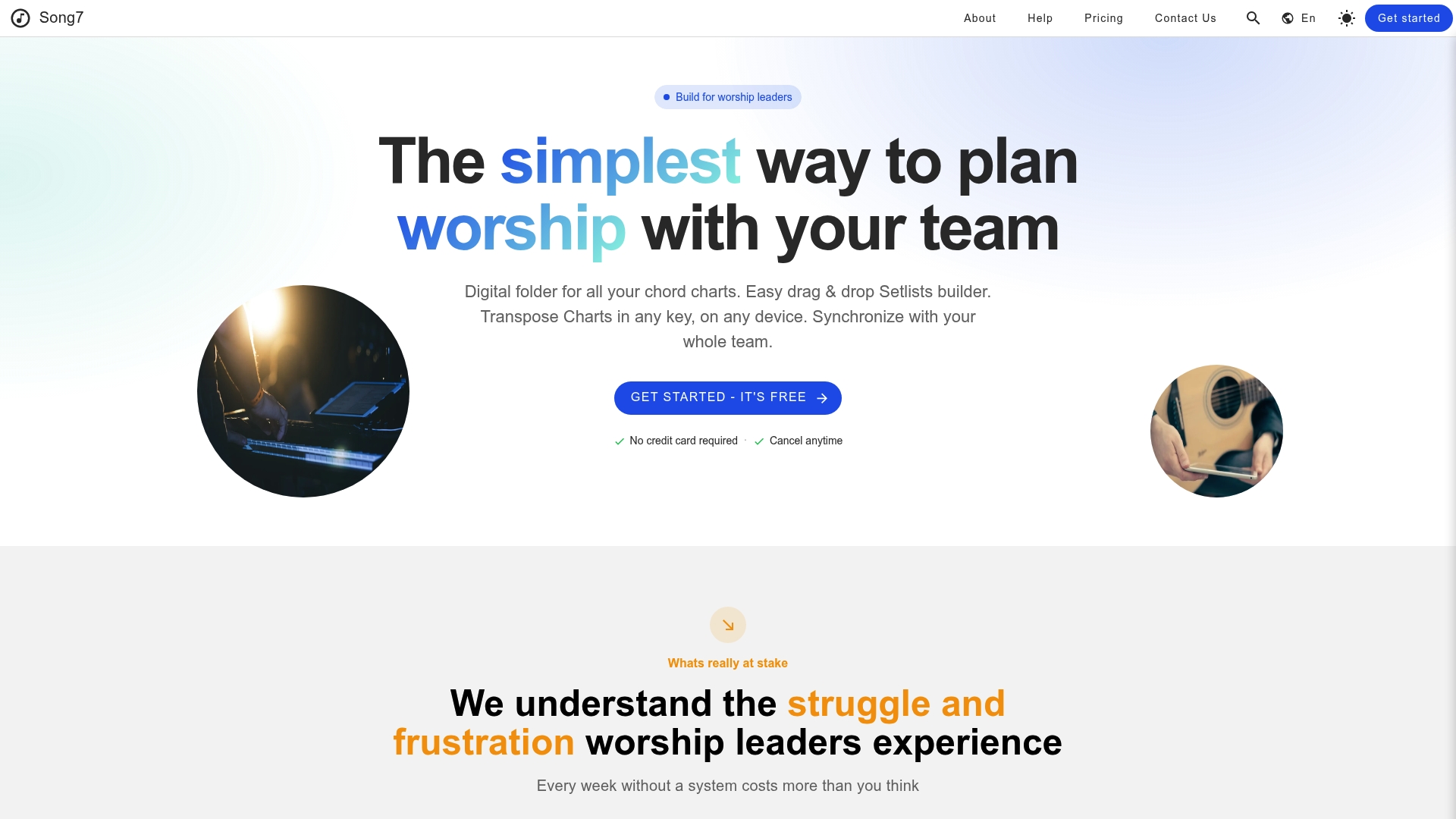
Use the one-week checklist from earlier in this guide during your trial. By day seven, you'll know whether Song7 fits your team's rhythm, from transposition speed to how quickly your volunteers pick up mobile access. Teams migrating from another planning tool can also move their song library over in about fifteen minutes.
Head to Song7's homepage to start your trial, or visit the Song7 setlist builder page to see the tools built specifically for church music stands and worship teams. Import your core songs today and have a working setlist ready before your next rehearsal.
Sources
For broader context beyond this guide, see this category roundup of worship planning software, this review of Planning Center Services as the long-standing scheduling standard, and this breakdown of mobile-first worship tools.
- Best Worship Planning Software in 2026: Tools for Every Church Size
FAQ
What Makes an App the Best Setlist App for Churches?
The best setlist app for churches combines reliable real-time syncing, simple drag-and-drop building, instant transposition, and presentation-ready lyric display, all without requiring heavy training. Song7 was built around exactly those priorities for volunteer-led teams.
How Long Does It Take to Set Up a Worship Setlist App?
Most churches can get a working setlist system running in about a week: importing songs, inviting the team, running one test rehearsal, and sharing the final setlist before Sunday. Starting with a small rotation of five to ten songs speeds up that first week considerably.
Does Song7 Work Offline During Service?
Most worship planning tools, Song7 included, are cloud-based and depend on an internet connection for full functionality, which is common across the category. If your venue has unreliable Wi-Fi, download or print charts as a backup before service starts.
Can Song7 Integrate With ProPresenter or EasyWorship?
Song7 is designed to work alongside common worship presentation setups, letting teams keep lyric display and chord charts synced while projecting through the software they already use. Check current integration details on Song7's site before switching your presentation workflow.
How Much Does Song7 Cost?
Song7 offers a free trial so teams can test the platform before committing. Current pricing details are available directly on the Song7 website.