
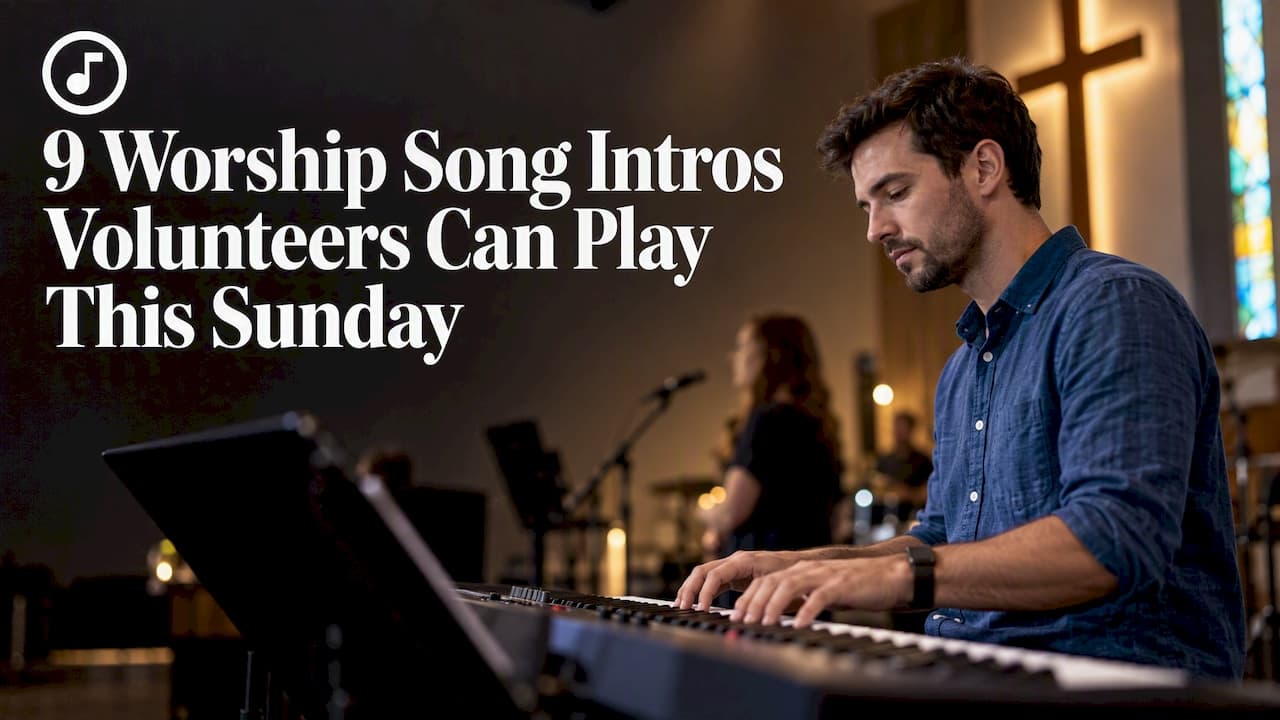
For song intros worship teams can use this Sunday, start with a tonic groove, an arpeggiated V chord, a melodic motive, or a cycle-of-fifths walk-up. Pick one for your next song, then rehearse it once with your drummer giving a count-in and the intro looped until everyone lands together. Send the reference recording ahead, and keep the plan in Song7 so nobody guesses.
TL;DR:
- Loop I, IV, and V for upbeat songs; use an arpeggiated V chord to build toward a chorus, and rehearse its landing on the tonic.
- Send every musician an MP3 and a written cue before rehearsal, then spend 30–45 seconds explaining the intro and loop it until everyone starts together.
- Overlap song intros only when keys connect; use a short gap for different keys or feels, and keep a continuous beat only at matching tempos.
- Have the drummer count in, use a click when tempos drift, and confirm the time signature before vamping so the band avoids meter clashes.
Table of Contents
- 1. Musical intro ideas your team can play this week
- 2. Rehearsal prep: what to send and how to run it
- 3. How to link songs: intro overlap, short gap, or no break
- 4. Count-ins, click, and vamping: tech tips that keep intros tight
- 5. What can you say and play to bring people in on cue?
- 6. Why one intro a week beats a fancy arrangement
- 7. How Song7 keeps your intro plans in one place
- FAQ
- Sources
1. Musical intro ideas your team can play this week
Good intros are rarely complicated. Improvising around the tonic chord, arpeggiating the V chord, using cycle-of-fifths progressions, or highlighting a melodic motive already in the song all produce professional-sounding introductions. Here is how each one sounds and how to rehearse it.
- Tonic groove or vamp: Loop I–IV–V or I–vi–IV–V until the band is ready to move on. Best for upbeat songs. Rehearse it with the drummer until the loop feels relaxed. The leader decides when to release into the verse.
- Arpeggiated V: Roll through the V chord to build tension, then land on the tonic. It works well when you want to build toward a chorus. Practice the landing note, since that is where it tends to wobble.
- Melodic motive: Play or harmonize a short melody from the song. It cues the congregation to the tune before they sing a word. A lead guitar or keys usually carries it.
- Cycle-of-fifths walk-up: Walk the chords up into the tonic. It suits key changes or a dramatic entry. Write the chord path on the chart so no one improvises it live.
- Pedal point or ambient pad: Hold one low note under a soft pad. Great for slow songs. Keys or an acoustic guitar leads.
- Rhythmic drum intro: Two bars of groove from the drummer set the tempo for everyone. The drummer leads.
- Single-instrument lead-in: Piano or guitar alone plays the first phrase. Keep it simple and steady.
- Stripped harmonic intro: Only the main chords, no fills. This is the safest option for newer volunteers.
- Cue-to-sing: A short spoken cue plus one instrument holding the key chord. The leader leads it.
2. Rehearsal prep: what to send and how to run it
Rehearsal for an intro starts before the team meets. Every member should have an MP3 or reference recording so everyone shares one picture of the song's texture and tempo. Then spend 30–45 seconds of rehearsal giving clear instruction on the intro before you play it.
Our guide to sending rehearsal notes three days early shows how to package this. Use this checklist:
- Attach the MP3 and a short written cue to the song.
- Set a target intro length that fits the song.
- Assign the count-in, ideally to the drummer.
- Loop the intro until it is solid.
- Confirm monitor and AV needs, like click in the in-ears or a pad on the keys.
Pro Tip: Loop the intro until everyone can start confidently on the same beat, then play it again.
If your rehearsal window is tight, our 90-minute rehearsal plan shows where to fit intro practice.
3. How to link songs: intro overlap, short gap, or no break
Linking songs musically gives a set a sense of journey. There are three common methods, and each one needs rehearsal around key and tempo.
- Intro overlap: Start the next song's intro as the last note of the previous one fades. Works best when the keys are close enough to connect smoothly.
- Short gap: Leave a brief moment to clear the air, then begin. This suits songs with different feels or keys that do not connect easily.
- No break: Keep a constant beat running between songs. This needs matching tempos, so test it with the click.
Pick one drill and repeat it: play the end of song A into the start of song B repeatedly. If the keys fight, transpose one song rather than forcing a clumsy bridge. Our five-to-ten-minute transitions playbook walks through quick versions for volunteer teams.
4. Count-ins, click, and vamping: tech tips that keep intros tight

Let the drummer take the count-in so you can focus on the congregation while the band locks in. When tempos drift, a click or a tap-tempo metronome app keeps everyone honest.
Vamping, repeating a simple chord or progression, is useful when you cannot predict the intro's length. Confirm the time signature first, or a 3/4 song and a 4/4 vamp will collide.
- Mistake: starting the opening chord while the leader begins singing. Fix: let the chord ring first, then sing. Intros should be rehearsed and staged so the congregation knows when to join.
- Mistake: unclear cues. Fix: agree on one nod or one spoken word.
- Mistake: mismatched meters. Fix: write the time signature at the top of the chart.
Share recordings early and loop the intro until it is solid: the rehearsal habit worship leaders are encouraged to build before the team ever meets.
For service-flow ideas beyond the music, practical tips for church service leaders add a helpful volunteer-management view.
5. What can you say and play to bring people in on cue?
Keep spoken cues short and calm. Try these:
- "Stand with us as we sing," said over a held chord.
- "Here we go, four bars," so the band and the room both know the length.
- Count-ins: a loop, a pickup, or an immediate downbeat.
For a simple vamp, loop I–IV–V–I until the room is ready, then release into the first line. Let the leader's breath be the signal.
6. Why one intro a week beats a fancy arrangement
Our view is simple: volunteer teams do not need more complicated intros, they need more repeatable ones. A service tends to drift when every song starts a different way. Standardizing the count-in and sending the recording early takes away most of the guessing, and the sound gets steadier because people stop worrying about their entrance and start listening to each other. Practice an intro type regularly and keep arrangements plain. Confidence grows faster than difficulty, and the congregation follows confidence.
— Editorial team
7. How Song7 keeps your intro plans in one place

We built Song7 so intro plans stop living in text threads and crumpled notes. With Song7 you can:
-
Add intro notes and cues right on the song in your setlist
-
Use a built-in metronome for the count
-
Sync every update to the whole team instantly, so Sunday matches rehearsal
Start a free trial at Song7, build one setlist, and see how much easier the next rehearsal feels.
FAQ
What is a good simple intro for a worship song?
Loop the tonic chord, or I–IV–V, until the band is ready to move on. It is easy to learn and easy to cue. Pick it when your team is new or short on rehearsal time.
Who should count in the band?
The drummer should usually count in, so the leader can focus on the congregation. Agree on the length of the count before rehearsal and keep it the same every week.
How long should a worship song intro be?
A short intro is a practical default for many songs. If the length may change on Sunday, vamp the chords and let the leader release into the first line.
How do I start a song if I am not sure of the timing?
Confirm the time signature with the band first, then vamp a simple progression. This keeps the intro flexible without a collision between 3/4 and 4/4.
Sources
- 4 Tips for Great Worship Song Intros
- Worshipinfo
- Providing Seamless Transitions Between Songs in Your Worship Set - Renewing Worship
- Practical Music Theory Tips #6 – Chord Progressions and Vamping | I am an Offering