
For most volunteer-led worship teams, the best church music app is one that syncs setlists instantly and keeps chord charts simple to read on stage. Song7 does exactly that, built specifically for small and mid-size teams without a paid tech staff. Bigger production churches running full livestream studios or backing tracks may need to add a streaming or stems tool alongside it, but they rarely need to replace it.
TL;DR:
- Most volunteer worship teams benefit from using a simple app like Song7 that offers instant synchronization, easy setlist building, and straightforward transposition features.
- Small and mid-size churches should layer Song7 with licensing or stems tools, rather than seek all-in-one solutions, to address specific needs like licensed charts or rehearsal tracks.
- When choosing a worship app, prioritize reliable sync, ease of onboarding, offline access, and seamless stage presentation, testing these features during rehearsals first.
- Browser-based streaming solutions like StreamYard are ideal for volunteer teams due to ease of use, while desktop encoders require dedicated tech volunteers and advanced setup.
- Setting up a basic workflow with a single person in one weekend and practicing a simple, repeatable process ensures reliable service without complex features that volunteers won’t use actively.
Table of Contents
- What Makes an App One of the Best Church Music Apps?
- Which App Category Do You Actually Need?
- Presentation, Livestream, and Licensing: What to Test First
- How Do You Choose the Right Worship App?
- Your Weekend Setup Checklist
- Why Simplicity Wins for Most Worship Teams
- Try Song7 Without Reworking Your Whole Workflow
- Sources
- FAQ
What Makes an App One of the Best Church Music Apps?
You've probably tried at least one worship app that promised everything and delivered a headache. The apps worth your time do a small number of things reliably, not a long list of things poorly. That's the real test behind any "best church music apps" comparison.
Some apps were built around that idea. They focus on the core job: managing your worship song library, building setlists your whole team can see, and getting everyone on the same page (literally) before Sunday morning. Here's what that looks like in practice.
- Instant synchronization — when you update a chord or change the key, every team member's screen updates automatically, no group texts required.
- Drag-and-drop setlists — build your worship set in minutes and reorder songs without retyping anything.
- One-tap transposition — move a song from the original key to whatever your vocalist can actually hit that week.
- Presentation mode — display lyrics and chords cleanly for stage screens or a phone propped on a music stand.
- Chord diagrams — helpful for newer guitarists who haven't memorized every shape yet.
- Built-in metronome — keep rehearsal tempo consistent without a separate click app.
Each of these solves a specific Sunday-morning problem: the last-minute key change, the volunteer who missed rehearsal, the printed chart that's two versions out of date. A church running multiple services or multiple campuses benefits even more, since one setlist update pushes out to every team member instead of getting retyped for each service. Rotating volunteers matter here too. A drummer who fills in once a month doesn't need training. They open the app and see the same setlist everyone else sees.
Pro Tip: Build next Sunday's setlist right after this Sunday's service while the songs are still fresh in your head. Song7's drag-and-drop setlist builder makes this a five-minute task instead of a Thursday-night scramble.
If you want a deeper look at how team handoffs work in practice, Song7's guide on sharing setlists with your worship team walks through a typical week.
Which App Category Do You Actually Need?
Not every worship app solves the same problem, and that's where a lot of teams waste money. Before you compare specific products, sort out which category you're actually shopping in.
- Setlist and team collaboration apps (like Song7) manage your song library, build sets, and sync updates across your whole team in real time. Best fit: any volunteer-run team, regardless of size.
- Chord chart and licensing apps like SongSelect provide official lead sheets and one-click usage reporting tied to your CCLI license. Many churches already have SongSelect access bundled into a license they're already paying for.
- Rehearsal and stems players isolate instrument tracks so a bassist can practice their part without the full mix. These matter most for bands that rehearse separately before Sunday.
- Presentation controllers run the lyric and chord display on stage screens, sometimes as a standalone app and sometimes built into your setlist tool.
- Streaming studios like StreamYard handle your livestream, multistreaming, and recording, entirely separate from song management.
Most small and mid-size churches do best layering two tools rather than hunting for one app that does everything: a setlist and collaboration app as the daily driver, plus SongSelect or a stems player for the pieces Song7 doesn't try to replace. Integrated suites like WorshipTools bundle several of these categories into one subscription, which can simplify billing but sometimes means fewer options in each individual area. The right mix depends on whether your bottleneck is chart quality, rehearsal prep, or the livestream itself.
Presentation, Livestream, and Licensing: What to Test First
The features that look great in a demo aren't always the ones that matter on service day. Presentation output is one of them. Before committing to any app, connect it to your actual stage display or projector during a rehearsal, not for the first time five minutes before the service starts. Font size, screen orientation, and how the app handles a sudden key change all show their weaknesses under real conditions.

Streaming is where volunteer teams tend to overbuild. Browser-based studios minimize training and remove encoder setup entirely, since a guest or host joins with a link and multistreaming happens in the cloud. Desktop encoders like OBS are free and more customizable, but they expect a dedicated volunteer with the technical patience to configure scenes and hardware. Start browser-based. Add a desktop encoder only once you have someone who actually wants to own that complexity.
CCLI reporting deserves the same attention. Practitioners generally recommend keeping reporting inside your planning workflow rather than treating it as a manual task after the fact, since that's where songs get forgotten and reports go missing. During any trial, test these specifically:
- Transposing a song mid-setlist
- Offline access when Wi-Fi drops
- Recording and playback for rehearsal
- Exporting or importing existing charts
One data point worth knowing: SongSelect comes bundled with many churches' existing CCLI licenses, so check what you already have access to before paying for a second charting tool.
How Do You Choose the Right Worship App?
Here's a framework you can run through in about ten minutes, whether you're comparing two apps or five.
- Ease of onboarding — can a volunteer who's never used the app find their part in under two minutes?
- Sync reliability — do updates reach every device instantly, or does someone need to refresh manually?
- Transpose and chord features — is changing keys a single tap, or a multi-step workaround?
- Offline mode — does the app still work when your building's Wi-Fi acts up mid-service?
- CCLI and reporting support — does it connect to your license, or leave reporting as a separate chore?
- Presentation output — does it drive your stage screens cleanly, or require a third app in between?
- Pricing model — is there a real free tier or trial, or do you have to commit blind?
Run every finalist through a short trial checklist before you decide anything permanent. Time how long it takes to onboard one volunteer from scratch. Check device compatibility across whatever phones and tablets your team actually owns, not just the newest model. Confirm role permissions work the way you expect, so a guest musician can view a setlist without editing it. Test importing your existing charts to make sure you're not retyping your whole library by hand.
Watch for a few red flags. If an app has no licensing or reporting features at all, you'll end up doing that work manually anyway. If it's installer-only and blocks volunteers from accessing it on personal devices, it fights against the exact people who need it most. And if there's no trial and pricing is vague, that's usually a sign the product isn't built with small teams in mind.
Pro Tip: Ask a volunteer, not yourself, to run the onboarding test. What feels intuitive to a worship leader who's used ten apps often isn't intuitive to a volunteer using their first one.
Your Weekend Setup Checklist
You can get a basic workflow running in a single weekend. Here's the order that works.
- Before you start: confirm your CCLI license is active, pick one person to own the app setup, and take stock of the songs your team plays regularly.
- Set up your team: create your team in the app, import existing charts (or link SongSelect if it's available), build your first setlist, turn on presentation mode, and test transposing a song.
- Rehearse and go live: run a full dry run with your actual team, confirm your livestream audio routes correctly if you're streaming, and record one sample run for reference.
That's it. No months-long rollout, no training manual. For a fuller walk-through of weekly planning once you're past setup, Song7's guide to Sunday service planning covers the recurring rhythm.
Why Simplicity Wins for Most Worship Teams
The instinct to chase every feature is understandable, but power and simplicity trade off against each other constantly. A volunteer team doesn't need forty settings; it needs three that work every single week. Complexity earns its place only once you have a dedicated tech volunteer who wants to own it. Until then, pick one workflow, practice it twice, and let it become boring. Boring is what reliable looks like on a Sunday morning.
— Editorial team
Try Song7 Without Reworking Your Whole Workflow
Some worship apps give your team one place to manage songs, sync setlists, and transpose on the fly, without the setup overhead that comes with bigger production suites. If your Sunday mornings currently run on group texts and outdated PDFs, that's the exact gap it closes.
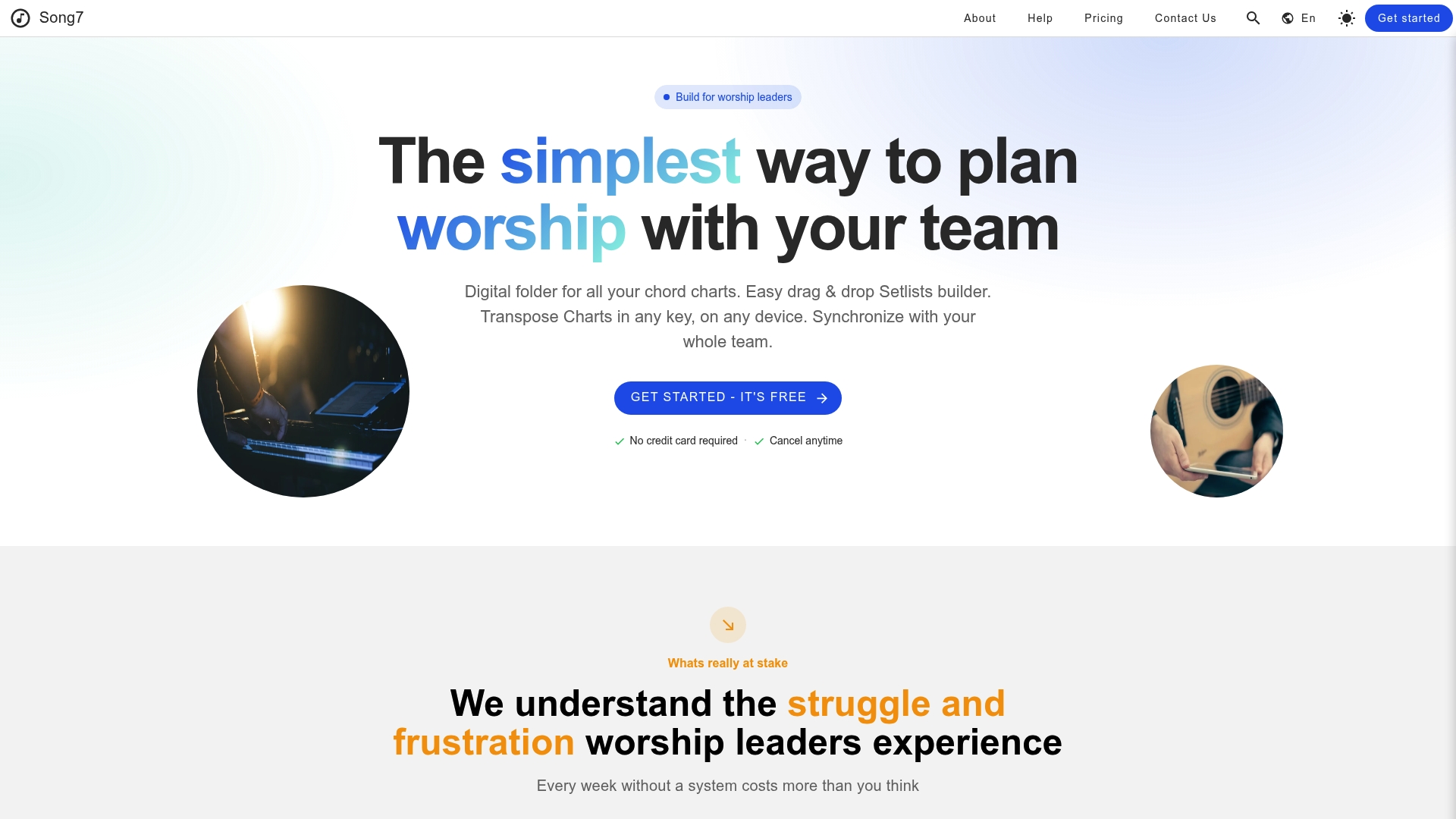
You can start a trial directly at Song7 and have your first setlist built before your next rehearsal. If your team also needs presentation hardware or a signage consult for stage displays, nonprofit-focused digital signage solutions are worth a look alongside your software setup. And if your church needs broader IT support on a tight budget, nonprofit IT services can help fill that gap too. Pick one Sunday, load your setlist into Song7, and see how much shorter your prep time gets.
Sources
- Church streaming software: best practices and options — StreamYard blog
- CCLI SongSelect Review 2026: Still the Worship Team Standard?
- WorshipTools Reviews, Pricing & Alternatives (2026)
FAQ
What Is the Best Church Music App?
For volunteer-led teams, Song7 is the strongest daily driver because it centers on instant setlist sync, transposition, and presentation mode without extra complexity. Larger production churches sometimes pair it with a separate streaming or stems tool for the pieces outside its focus.
Is There a Free Church Music App?
Several worship apps offer free tiers, though they typically cap features like multi-site sync or extended recording. WorshipTools, for instance, offers a generous free tier suited to smaller churches before scaling into paid features.
What Is the Best Live Streaming App for Churches?
Browser-based studios like StreamYard are the easiest starting point for volunteer teams, since hosts and guests join through a link with no software install. Desktop encoders like OBS offer more control but require a dedicated tech volunteer comfortable configuring scenes.
What Are the Top Music Apps for Worship Teams?
The strongest options split by job: Song7 for setlists and team sync, SongSelect for licensed charts and CCLI reporting, and a stems or rehearsal player for musicians practicing individual parts. Most teams get further layering two focused tools than searching for one app that does everything.
Does Song7 Handle CCLI Reporting?
Song7 focuses on setlist building, syncing, transposition, and presentation rather than licensing reporting itself. Pair it with your existing CCLI license and SongSelect access for the reporting side of your workflow.