
A church service run sheet is the minute-by-minute document that lines up time, action, owner, and technical cue for every part of your Sunday gathering, so nobody is guessing what happens next. It keeps musicians, tech volunteers, and the platform team synchronized while you focus on leading rather than managing logistics. Copy the template below, drop in today's service order, and hand it to your team before rehearsal starts.
TL;DR:
- A well-structured run sheet ensures clear ownership of each service segment, with assigned roles and precise timing to prevent last-minute chaos.
- Keeping each service segment within recommended durations—such as 20 to 35 minutes for worship sets—maintains engagement and manages Overruns, especially in multi-service gatherings.
- Incorporating a buffer into timers and writing fallback plans directly into the run sheet allows smooth adjustments without public disruptions or confusion.
- Using a shared, editable digital document helps teams rehearse transitions and adapt plans in real-time, reducing nerves and last-minute improvisations.
- Adopting a dedicated app like Song7 can streamline the process, synchronize updates instantly, and make live adjustments more efficient during the service.
Table of Contents
- What Goes Into a Church Service Run Sheet Template?
- How Long Should Each Part of a Church Service Run?
- How Do You Build a Worship Set That Flows Into the Run Sheet?
- What's the Best Way to Keep a Service on Time?
- Why Run Sheets Change What Sunday Actually Feels Like
- Let Song7 Turn Your Run Sheet Into a Live, Synced Workflow
- Where to Go Deeper on Timing and Run Sheets
- Sources
- FAQ
What Goes Into a Church Service Run Sheet Template?
A run of show names who leads each moment, what happens on stage, and what technical action fires next. That's the whole job of a run sheet, and it works because every row answers the same five questions: when, what, who, what cue, and what else you need to know.
Here's the canonical structure, with a sample row filled in:
| Time | Segment | Action | Owner | Tech Cue | Notes |
|---|---|---|---|---|---|
| — | Worship Set 1 | Band plays "Great Are You Lord" | Worship Leader | Lyrics slide 1, stage lights up | Key of D, count in |
Contemporary service (75 minutes): welcome and announcements (5 min, host), worship set of four songs (25 min, worship leader and band), offering and transition video (5 min, tech), sermon (35 min, pastor), closing song and prayer (5 min, worship leader).
Traditional liturgical order (60 minutes): processional and call to worship (5 min, liturgist), hymns and responsive reading (15 min, choir director), Scripture reading (5 min, reader), sermon (25 min, pastor), communion (8 min, elders), benediction (2 min, pastor).
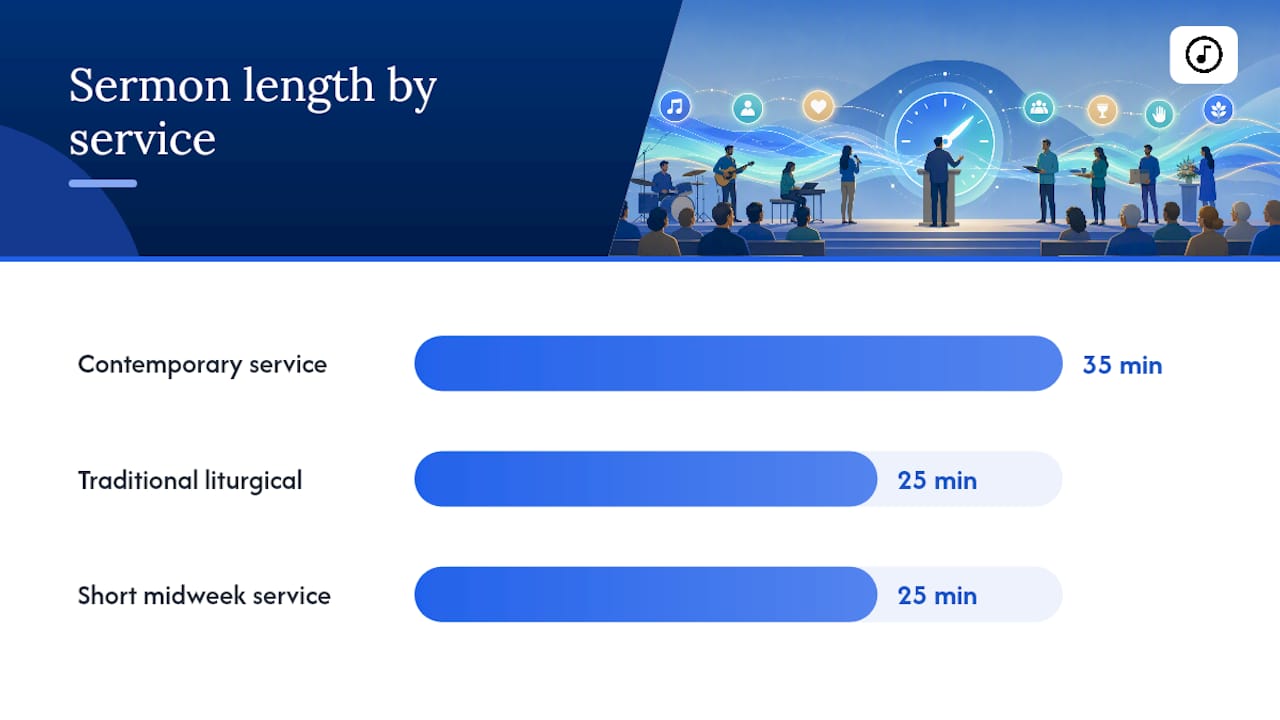
Short midweek service (45 minutes): welcome (2 min), two-song worship set (10 min), teaching (25 min), closing prayer (3 min), dismissal (5 min).
To put this to work:
- Copy the table into Google Sheets or Word so every column stays editable.
- Fill in real times working backward from your service start, not forward from guesses.
- Assign one owner per row, even for small tasks like "start the countdown video."
- Share it as a live link with your team, and print a backup copy for the tech booth in case Wi-Fi drops.
Small church teams don't need software to start. A shared spreadsheet with those six columns beats a mental checklist every time, because ownership and backups only stick when they're written down somewhere everyone can see.
How Long Should Each Part of a Church Service Run?
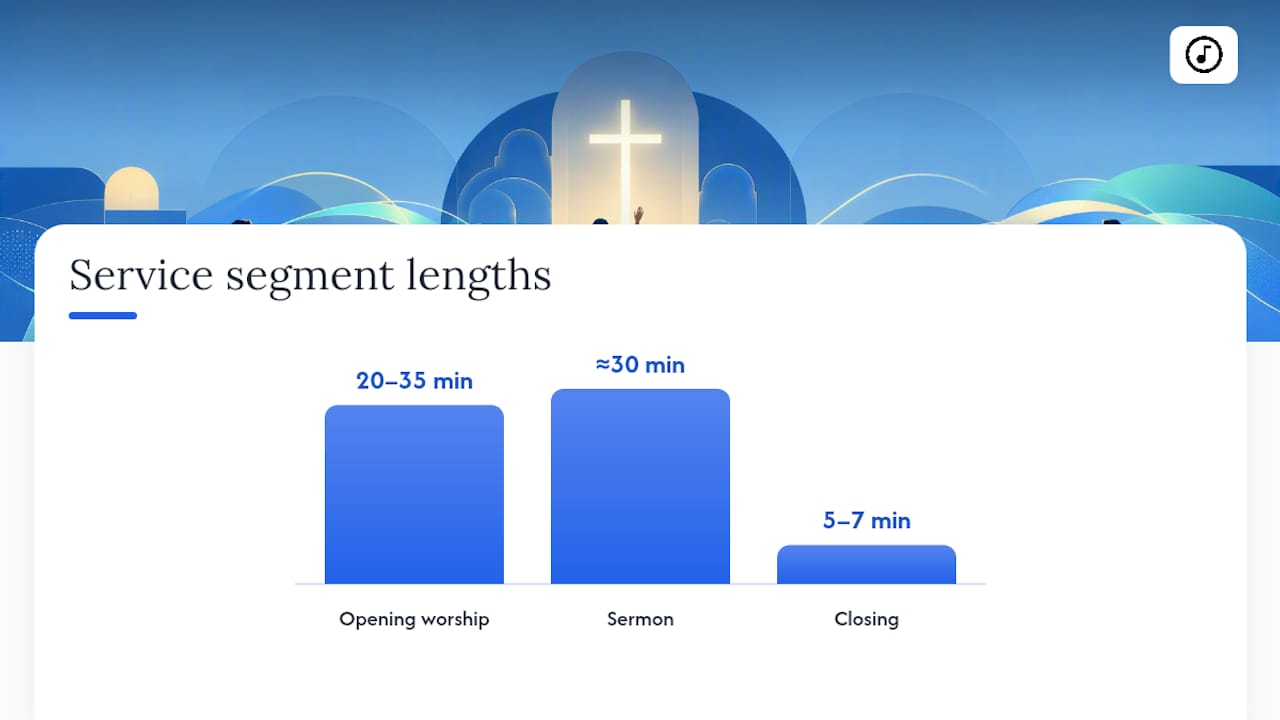
Most well-paced services land between 60 and 90 minutes, and the breakdown that produces that range looks like this:
- Welcome and announcements: a few minutes
- Opening worship: a quarter of the service time
- Offering: a few minutes
- Sermon: about a half hour
- Communion or altar response: several minutes
- Closing: 5 to 7 minutes
Worship sets typically run 20 to 35 minutes and carry 3 to 5 songs. A 20-minute block usually fits three to four songs, while a 30-minute block stretches to four or five, depending on tempo and how many transitions you build in. That range isn't arbitrary. It's long enough to build a real arc but short enough that the congregation stays engaged rather than watching the clock, and it's the number most worship leaders converge on when they plan sets that actually work.
Multi-service churches usually trim two to three minutes off transitions and hold sermons to the tighter end of the range, since a five-minute overrun compounds fast across three back-to-back services. Single-service churches have more flexibility, and holidays like Easter or Christmas Eve often justify a longer worship set or an added special number. Whatever you land on, write the exact minute count into the run sheet rather than leaving segments open-ended. A number on paper is much easier to defend under pressure than a feeling.
How Do You Build a Worship Set That Flows Into the Run Sheet?
A worship set that moves people usually follows a five-part arc: opener, builder, turn, response, and send. The opener gathers attention, the builder raises energy, the turn shifts focus toward reflection, the response gives space for the congregation to engage personally, and the send closes the moment and hands off cleanly to what's next. Map that arc onto your three to five songs, and the timing from the section above falls into place naturally.
Before adding any song to the plan, run it through five quick questions:
- Is it biblically sound?
- Is the message clear?
- Is it singable for a congregation, not just a soloist?
- Is it necessary here, or does it repeat what another song already does?
- Does it fit today's theme?
Once your set is chosen, the run sheet needs more than song titles. Add the key, BPM, arrangement notes (full band vs. stripped-down bridge), and the transition type between each song, whether that's a straight segue, a spoken moment, or a full stop. Tag who calls each transition, the worship leader verbally or the tech operator on a cue light, so nobody is left staring at each other on stage.
Pro Tip: During rehearsal, loop the outro of one song straight into the intro of the next several times in a row. That repetition builds the muscle memory your band and tech team need to nail the handoff live, instead of fumbling it the one time it counts.
What's the Best Way to Keep a Service on Time?
Timers work best as a safety net, not a stopwatch breathing down the preacher's neck. The trick is building a buffer zone into the timer itself rather than into the schedule.
Set the visible sermon timer a few minutes shorter than the actual slot. If the sermon has 30 minutes, set the countdown to 25. That gap gives your tech lead an early, private signal (often just the timer glowing yellow) before the real deadline hits, so adjustments happen quietly instead of as a public interruption.
Where you put that timer matters:
- A confidence monitor on stage for the speaker or worship leader to glance at without breaking eye contact with the room.
- A stage tablet for the platform team.
- A second screen in the tech booth, watched by whoever owns the run sheet that day.
Write your fallback plan directly into the run sheet, not just in your head. Something like "If sermon runs past 35 minutes, cut the announcements slot and drop the bridge on the closing song" works because it names the cut and the person who makes the call. Pro Tip: Rehearse with the timer visible every single time, not just on game day. Teams that practice against the clock stop fearing it and start using it.
Why Run Sheets Change What Sunday Actually Feels Like
We've seen a shared, live run sheet turn a chaotic five-minute scramble into a non-event. One team we talked with had a soloist no-show ten minutes before the set; because the fallback plan was already written into the sheet, the backup vocalist stepped in without a single whispered negotiation on stage.
That's the real payoff. Teams using synced digital run sheets report fewer last-minute phone calls and steadier volunteer retention, because nobody feels like they're improvising their role from memory. A cloud-based shared plan does for a volunteer team what a rehearsal does for a band: it turns nerves into readiness.
— Editorial team
Let Song7 Turn Your Run Sheet Into a Live, Synced Workflow
Song7 is built to operationalize everything above, so the run sheet you just built doesn't stay a static document nobody opens again after Thursday's rehearsal.
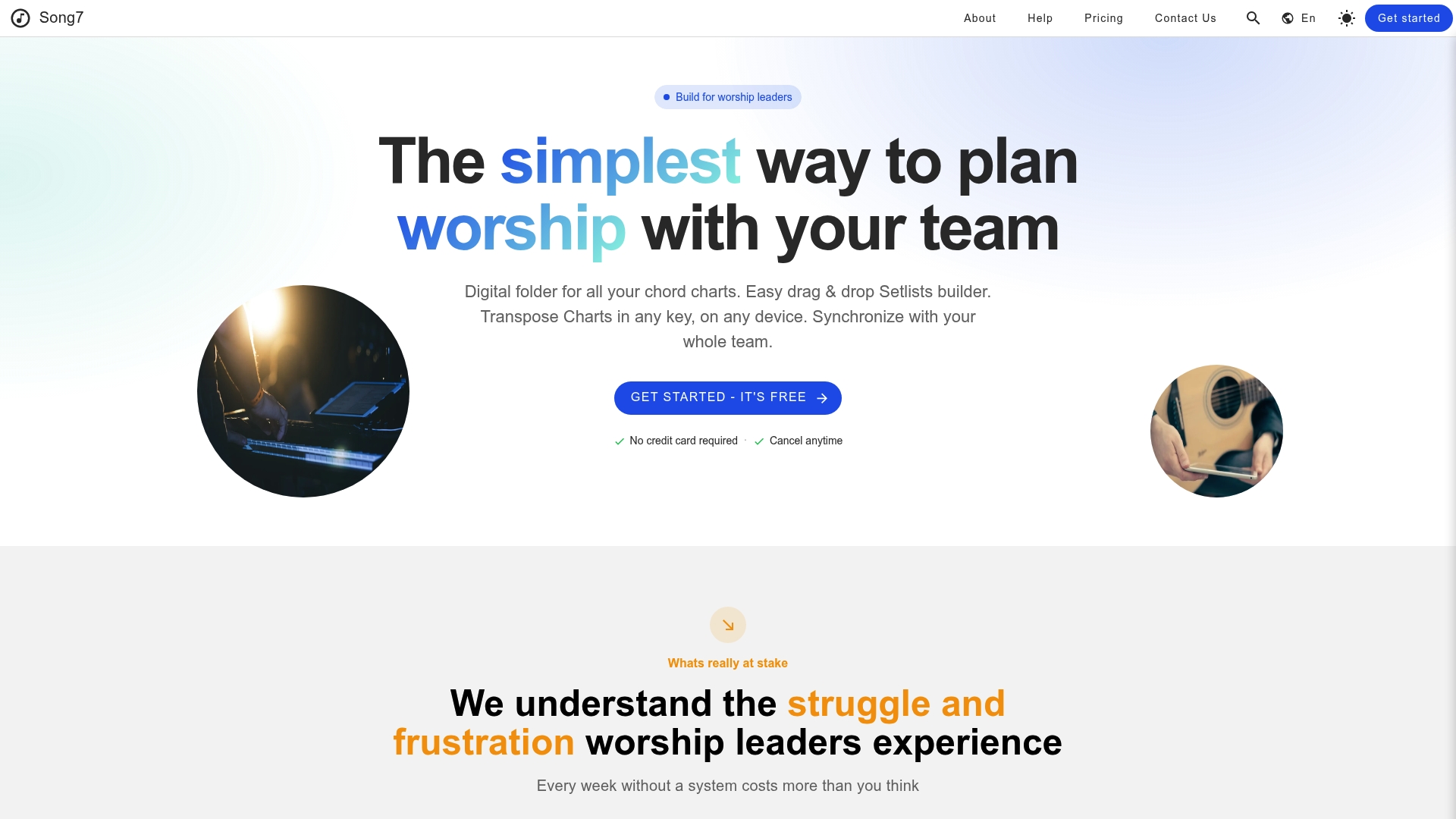
The setlist builder maps directly onto your run sheet's segment and time columns, drag and drop songs into the exact order you planned. Every song carries its key, BPM, and chord chart, so the "tech cue" and "notes" columns you filled in by hand now live inside the app your whole team already has open. Real-time sync means when the worship leader swaps a bridge or drops a verse the night before, every band member and the tech operator sees it instantly, no group text required. Presentation mode puts lyrics on screen without a separate slide deck, and the built-in metronome and transpose tools cover rehearsal the same way your buffer-zone timer covers the live moment.
Try it with your next service plan by importing this week's run sheet into Song7 and see how quickly your team gets on the same page.
Where to Go Deeper on Timing and Run Sheets
For more on set length and pacing, ChurchLeaders' breakdown of worship set timing is a solid reference. For the full mechanics of building a production-grade run sheet, Holy Jot's guide to run of show covers the column-by-column logic in more depth.
Sources
FAQ
How Do You Run a Church Service Smoothly?
Build a run sheet with time, segment, action, owner, and tech cue for every part of the service, assign a backup for each role, and rehearse transitions with a visible timer so the team internalizes the pacing before Sunday.
Is There a Free Church Program Template in Word?
You can build one in minutes by copying the six-column table (time, segment, action, owner, tech cue, notes) from this guide into a Word document or Google Sheet and adjusting it to your service length.
Where Can I Find Opening Prayer Points for a Church Service?
This guide focuses on timing and run-sheet structure rather than prayer content, but your welcome segment (typically 3 to 5 minutes) is the natural slot to schedule an opening prayer within the run sheet.
What Is the Typical Order of a Church Service?
Most services follow welcome, worship set, offering, sermon, communion or response, and closing, totaling 60 to 90 minutes with worship sets running 20 to 35 minutes.
How Many Songs Should Be in a Worship Set?
Most worship sets include three to five songs, with a 20-minute block fitting three to four and a 30-minute block fitting four to five depending on arrangement and transitions.