
A chord diagrams app for worship teams displays transposable chord diagrams that sync with setlists and presentation mode, so volunteer musicians can rehearse and lead services without paper chaos. It cuts down on last-minute scrambling and mid-service mistakes, which matters most when your team runs on volunteers, not full-time staff. Song7 is one purpose-built option that brings these pieces together in a single, focused tool.
TL;DR:
- Accurate transposition and diagram rendering depend on the app’s ability to handle custom chords, capos, and unusual voicings reliably in ChordPro files.
- Reliable team synchronization requires changes made during the week to instantly update on all volunteers’ devices, preventing outdated charts at services.
- The app should support importing and exporting multiple formats, including ChordPro and PDFs, with regular backup options to safeguard the music library.
- Simplified user interfaces with consistent layout across devices help volunteers quickly navigate chords and lyrics without a steep learning curve.
- Testing the app with your actual, heavily edited charts, and in a rehearsal workflow, reveals whether it reduces last-minute errors and fits your team’s routine.
Table of Contents
- 1. What a chord diagrams app actually does for worship teams
- 2. Essential features to prioritize when evaluating an app
- 3. Why ChordPro compatibility matters and what to test in a demo
- 4. Practical workflows: prepare, rehearse, and present using a chord-diagrams app
- 5. User interface and ease of use considerations
- 6. Comparison of popular chord diagrams apps including pros and cons
- 7. How to customize chord diagrams (different chord styles, fingerings)
- 8. Backup and data export/import options
- 9. Collaboration features beyond basic team sync
- Why simplicity wins for volunteer teams
- How Song7 matches this checklist and how to try it
- Sources
- FAQ
1. What a chord diagrams app actually does for worship teams
Think of this software as your entire song binder, chord book, and music stand rolled into one screen. It holds your song library, chord charts, and lyrics, plus useful metadata like key, tempo, and tags such as "Christmas" or "communion." That alone replaces the shoebox of printed charts most churches have been dragging around for years.
The chord diagram piece is the real workhorse. A good app shows diagrams inline with the lyrics or as a separate grid, lets you add your own chord shapes for unusual voicings, and hides trivial or repeated chords so the screen doesn't turn into visual noise. Transposition should update both the chord letters and the diagrams together. Change the key from D to E, and the fingerings shift right along with it.
Beyond diagrams, the features that make a real difference week to week include:
- Drag-and-drop setlist building that lets you reorder songs in seconds during a Thursday rehearsal.
- Presentation mode built for a projector or stage monitor, not a cramped phone screen.
- Team roles and real-time syncing so a chord change on Tuesday shows up on every volunteer's device by Wednesday.
- Rehearsal tools like a built-in metronome to keep the band locked in before doors open.
- Offline access for the Sunday morning when the church Wi-Fi decides not to cooperate.
2. Essential features to prioritize when evaluating an app
Before you sit through a demo, it helps to know what actually separates a tool that saves your team time from one that just adds another app to juggle. Here's a checklist worth bringing into any evaluation:
- Accurate chord diagrams with the ability to add your own custom shapes for capo positions or alternate tunings.
- Reliable transposition that reflows both lyrics and diagrams, not just the chord letters on top.
- ChordPro import and export, including sensible handling when the software hits a chord it doesn't recognize.
- Presentation features built for full-screen projection, with remote advance so whoever is running slides isn't glued to a laptop.
- Team sync, roles, offline access, and rehearsal tools like a metronome or tuner.
- Import flexibility, covering ChordPro files, plain text, and photos or PDFs of old paper charts.
- A trial period so your team can test the workflow before committing to a subscription.
Pricing usually follows a team-based subscription model, often with a free tier for limited users and a paid plan for the leader or team managing the library; current prices are available on the provider's pricing page. That structure tends to fit church budgets better than a per-seat licensing model built for corporate teams.
Pro Tip: Bring your messiest, most heavily edited chord chart to the demo. If the app handles that one cleanly, it will handle everything else you throw at it.
3. Why ChordPro compatibility matters and what to test in a demo
ChordPro is the closest thing worship software has to a shared language. It's a plain-text format that stores lyrics and chord metadata separately, which is exactly why apps built on it can generate chord diagrams and transpose songs reliably. Instead of chords being locked into a fixed position in a PDF, they're tagged data the software can move, resize, and redraw whenever the key changes.
Most ChordPro formatters build diagrams from a known chord list, and they also support user-defined chords for anything outside the standard set. That matters for worship music specifically, since a lot of contemporary arrangements use capo shapes, slash chords, or altered voicings that a generic chord library won't recognize on its own.
A tool built on the ChordPro standard stores chord data as structured metadata rather than fixed text, which is what makes accurate transposition possible in the first place.
When you're testing an app, run through this short list:
- Import a real ChordPro file from your own library, not a demo sample.
- Check whether the chord diagrams render correctly on the first try.
- Transpose the song two or three keys in either direction and watch what happens to the diagrams.
- Look at how the app handles diagram properties like frets and finger positions.
- Test any "suppress" or "diagram visibility" settings to see how much control you have over screen clutter.
How an app handles an unfamiliar chord, whether it flags it, guesses, or lets you define it manually, tells you a lot about how it will behave live, when there's no time to troubleshoot.
4. Practical workflows: prepare, rehearse, and present using a chord-diagrams app
The real test of any app is whether it fits the actual rhythm of a worship week. Here's how that typically breaks down:
- Pre-service prep. Import your songs, ideally from ChordPro files, verify that chord diagrams rendered correctly, set the key for each song, and build the setlist for the week.
- Rehearsal. Transpose songs to match your singers' ranges, push the updated charts to the whole team at once, and lean on built-in tools like a metronome or tuner to tighten the sound before doors open.
- Live service. Switch to presentation mode, hand off slide control to your tech volunteer with a remote clicker, and keep a PDF export on hand as a fallback if the app or Wi-Fi hiccups mid-set.
- After the service. Jot down what worked, adjust any chart that caused confusion, and sync those changes so next week's rehearsal starts from a cleaner version.
That loop, importing correctly the first time, transposing without breaking formatting, and avoiding awkward page turns, is where most of the friction in a volunteer-run team either disappears or gets worse.
Pro Tip: Run this exact workflow with one song at your next rehearsal before rolling it out to your whole set list. Small tests catch formatting problems before they show up on a Sunday.
5. User interface and ease of use considerations
Volunteers don't want a learning curve, they want something that works the way a phone app is supposed to work. The best chord diagram software feels obvious within the first few minutes: songs are easy to find, chord charts are readable without pinching and zooming, and the buttons a musician needs during a live set are large enough to hit under stage lighting.
Clutter is the enemy here. A screen packed with menus, settings, and rarely used features slows everyone down, especially a volunteer guitarist glancing at a tablet between verses. Look for adjustable font sizes, a clean chord diagram layout, and a presentation view that strips away anything that isn't the lyric or the chord in front of it.
Consistency matters just as much as simplicity. If the interface looks and behaves the same on a phone, tablet, and laptop, new volunteers ramp up faster because they're not relearning the layout every time they switch devices. That consistency, more than any single feature, is usually what determines whether a team actually adopts an app or quietly goes back to printed binders after two weeks.
6. Comparison of popular chord diagrams apps including pros and cons
Chord diagram software for worship teams generally falls into a few categories, each with real tradeoffs.
Entry-level song sheet apps are lightweight and cheap, often free, but tend to treat chord diagrams as an afterthought and lack real team syncing.
Feature-heavy production suites built for larger production teams offer deep customization and advanced presentation options, but the learning curve and price tag can be more than a small volunteer team needs.
Focused worship-team platforms, built specifically around setlists, chord charts, and live presentation, sit in the middle: enough features to run a full service, without the bloat of an enterprise tool.
The right fit depends less on which app has the longest feature list and more on which one your specific volunteers will actually use every week without a training session. A tool that a guitarist can open cold on a Sunday morning and understand immediately beats one with more settings buried three menus deep.
7. How to customize chord diagrams (different chord styles, fingerings)
Not every chord looks the same twice, and a good app should let you say so. Most chord diagram tools generate their grids from a standard chord library, but the useful ones also let you define your own shapes when a song calls for something unusual, a capo position, a drop-D tuning, or a jazz voicing a worship band leader prefers over the textbook version.
Customization typically covers a few areas: which fret the diagram starts on, which fingers go where, and whether the diagram shows a barre across multiple strings. Some tools also let you choose between a compact inline diagram next to the lyric line or a larger grid view for teaching a new guitarist the shape before rehearsal.

The ChordPro standard supports this directly through directives that define diagram properties like frets and finger positions, which formatters read to build the diagram exactly as specified rather than guessing from a generic chord table. For a volunteer team, that flexibility is what keeps a chart accurate when the acoustic guitarist and the electric guitarist are playing the same song two different ways.
8. Backup and data export/import options
A church's song library represents years of work: charts built up, keys adjusted, and formatting fixed after some Sunday went sideways. Losing that to a crashed app or a canceled subscription is a real risk, so export options matter more than they might seem to at first glance.
Look for an app that lets you export charts as ChordPro files, plain text, or PDF, so your library isn't locked permanently inside one piece of software. On the import side, the same flexibility should apply in reverse. Teams switching from paper binders or an old PDF collection need a way to bring that material in without retyping every chart by hand, whether that's a direct ChordPro import or a PDF conversion process that pulls chords and lyrics out automatically.
Regular backups, whether automatic cloud syncing or a manual export you run monthly, protect against the worst-case scenario: a worship leader's device dies the week before Easter and nobody can find last year's arrangement.
9. Collaboration features beyond basic team sync
Syncing a chart to everyone's device solves one problem. Deciding who can actually change that chart solves another. Team-based apps usually offer role permissions that separate who can edit a song library from who simply views it. A worship leader or admin might have full editing rights, while a guest musician can see the setlist and chord charts without accidentally changing the key for everyone else.
Shared editing works best when changes are visible in real time, so if the leader adjusts a key on Thursday night, the whole team sees the updated chart without needing a fresh export or a group text. Some platforms also support comments or notes attached to a specific song, useful for flagging "watch the bridge, we're cutting a verse" without cluttering the chord chart itself.
For a small church running on two or three regular volunteers, this might sound like overkill. For a team juggling multiple services, rotating musicians, or a second campus, it's the difference between everyone playing from the same version and someone showing up Sunday with last month's key.
Why simplicity wins for volunteer teams
Most volunteer teams don't fail because they picked the wrong chords. They fail because someone transposed a song too late, or a page turn landed mid-phrase and threw off the whole band for four bars. A chord diagram app earns its place by removing those specific failure points, not by adding more menus to get lost in.
Feature-heavy software impresses in a demo and frustrates in practice when a guitarist just needs to see the right shape at the right moment. Simplicity and reliability matter more here than a long feature list ever will. Try one workflow, importing a single ChordPro file and running it through a rehearsal, before you roll anything out to the full team.
— Editorial team
How Song7 matches this checklist and how to try it
Song7 was built around the exact list above rather than trying to be everything to every team. It handles setlist building with a drag-and-drop interface, displays chord diagrams alongside lyrics, imports ChordPro files directly, transposes songs while keeping diagrams accurate, and runs a presentation mode designed for a projector rather than a laptop screen.
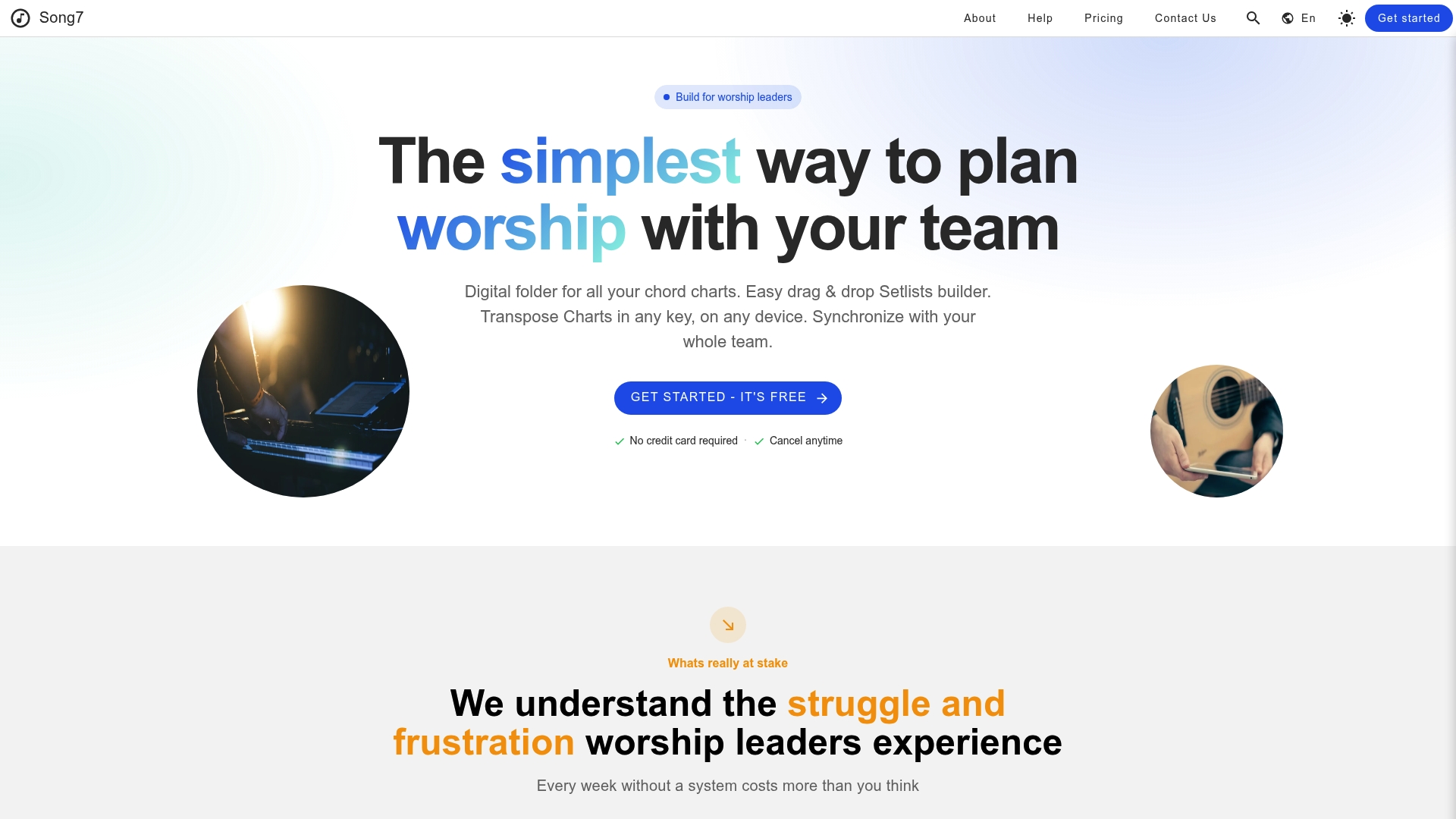
Team syncing means a chord change made Tuesday night is already on every volunteer's phone by Wednesday's rehearsal, which is the kind of detail that quietly prevents a rough Sunday morning. For a team that wants fewer mid-service surprises and less prep time spent formatting charts, that combination covers most of what a volunteer band actually needs:
- A song library with chord charts, lyrics, and metadata in one place.
- Chord diagrams that update automatically when you transpose a song.
- Real-time team syncing so nobody shows up with an outdated chart.
Visit Song7 to see the setlist builder and chord diagram tools in action, or check out the Church Music Stand setlist app for a closer look at how the presentation mode runs during a live service. Starting a trial takes a few minutes and gives your team a chance to test one full rehearsal before deciding whether it fits.
Sources
For the technical side, the ChordPro project documents how the format handles directives and diagram data, which is worth a look if you want to understand what happens under the hood when you import a file. On the practical side, Song7's guides on transposing chord charts and formatting charts to avoid page turns walk through the exact problems most teams run into during their first few weeks. If your team is coordinating rehearsal schedules alongside chart prep, Allegro's weekly practice loop guidance offers a useful structure for keeping rehearsals consistent.
- ChordPro
FAQ
What does a chord diagrams app do for a worship team?
It displays chord diagrams that stay linked to your lyrics and setlist, updating automatically when you transpose a song into a new key. This replaces manually redrawing chord charts every time a singer needs a different range.
Does ChordPro support custom chord fingerings?
Yes. ChordPro formatters typically build diagrams from a known chord list but also let you define your own chord shapes for capo positions or unusual voicings.
Can I import old PDF chord charts into a chord diagrams app?
Many platforms support converting PDF or scanned charts into an editable digital format, which saves retyping years of accumulated arrangements. Song7's guide on converting PDF chord charts walks through one practical method.
How do I stop chord charts from having awkward page turns during a service?
Formatting choices like adjustable font size, line spacing, and where a song naturally breaks make the biggest difference. Song7's post on avoiding mid-song fumbles covers specific formatting adjustments that reduce this problem.
Is there a free option to try a chord diagrams app before committing?
Most team-based platforms, including Song7, offer a trial period or a limited free tier so a worship leader can test the workflow before purchasing a subscription. Pricing details and plan options are available directly on the Song7 site.