
The best worship lyrics app for small, volunteer-led churches is a team-focused planning and presentation platform, not a standalone lyric database, and Song7 fits that job well. We built it around three things your team actually needs every week: simple drag-and-drop setlists, a presentation mode that just works on game day, and real-time sync so nobody shows up with the wrong chart. Try a free trial to see how it works in your next rehearsal.
TL;DR:
- Most volunteer-led churches benefit from a worship app with real-time sync, offline support, and role-based permissions rather than a feature-heavy platform.
- Import options like ChordPro and photo uploads streamline integrating existing song libraries without manual retyping.
- Reliability during live services, quick support, and simple onboarding are more critical than extensive customization or advanced features.
- Testing the app with your team over a full service cycle reveals whether it can handle key changes mid-rehearsal and maintain consistent sync.
- Starting with a short trial and a small setlist helps identify if the app meets your volunteers' comfort level and service planning needs.
Table of Contents
- What to look for in a worship lyrics app
- Feature map: verify these capabilities in demos and trials
- Run a short trial with your volunteers and decide by outcome
- How Song7 matches the checklist and reduces volunteer workload
- How much worship music is already available to work with
- How it fits with the rest of your worship planning setup
- Making lyrics display fit your stage and your team
- What other worship teams say about the apps they use
- What to expect from updates and ongoing support
- Why the "more features" advice misses the point
- Start your free trial and see it in your next rehearsal
- FAQ
What to look for in a worship lyrics app
A worship lyrics app lives or dies on Sunday morning, so the features that matter are the ones your volunteers actually touch during rehearsal and the live service. Before you compare options, filter out the essentials.
- Presentation mode: clean, readable lyrics that format correctly on a projector, confidence monitor, or stage display.
- Setlist builder: drag-and-drop ordering so you can reshuffle a worship set in seconds, not minutes.
- Instant transposition: change keys on the fly without retyping a chart.
- Chord diagrams: visual chord shapes that help newer guitarists and keyboard players follow along.
- Import formats: ChordPro, plain text, or photo import so you're not re-typing years of charts.
Beyond features, run a few operational filters. Does the app work offline when your church Wi-Fi drops mid-rehearsal? Is it built for iOS, Android, and desktop, since your team probably mixes devices? Can a volunteer who barely uses apps still figure it out in ten minutes? And how does it handle lyric licensing responsibilities, since that's a real obligation for churches projecting lyrics publicly.
Team workflow matters just as much as any single feature. Look for role-based permissions so a vocalist can view but not edit, real-time updates so a last-minute key change reaches every phone at once, and rehearsal helpers like a built-in metronome or practice loops that let musicians drill a tricky bridge on their own time.
Pricing shape is worth understanding early too. Some worship apps price per team rather than per user, which matters for a volunteer roster that might change size depending on the season. A free trial lets you test real services before committing.
Pro Tip: Test the app with your worst Wi-Fi scenario first. If it survives a spotty connection during a Wednesday rehearsal, it will survive a packed Sunday.
Feature map: verify these capabilities in demos and trials
Once you've narrowed your options, don't take feature lists at face value. Run an actual demo and check each capability against a real task your team performs.
- Setlist features: drag-and-drop reordering, saved templates for recurring service formats, and a notes field per song for cues like "modulate up a step before the bridge."
- Lyrics presentation: formatting that holds up on a projector and a separate confidence monitor, with font size and cue control you can adjust without leaving the stage view.
- Chord and chart management: ChordPro import and export, clean chord diagrams, and transposition that updates the whole chart instantly.
- Team sync and access: changes pushed to every device the moment you make them, plus role-based access so volunteers see only what they need.
- Rehearsal tools and offline access: a metronome, loop or part isolation for tricky sections, and offline file availability for rehearsal spaces with weak signal.
- Import, export, and licensing: text, photo, and ChordPro import options, with lyric licensing handled transparently rather than buried in fine print.
Rehearsal-specific features deserve special attention during a demo. Breaking songs into parts and offering rehearsal loops helps volunteers learn material earlier, which worship leaders have found improves how prepared a team feels walking into a live service. If an app treats rehearsal as an afterthought, that's a real gap for a volunteer roster that practices on their own time between weekly rehearsals.
Run a short trial with your volunteers and decide by outcome
Reading feature lists only gets you so far. The real test is putting an app in front of your actual team for two weeks and watching what happens.
- Pick three upcoming services and commit to running the full planning process through the new app, not a mix of old and new tools.
- Import or rebuild your setlists for those three services, including any photo or ChordPro charts you already have on file.
- Invite your volunteers as team members so you can test real-time syncing and role permissions, not just your own admin view.
- Run one full rehearsal using the app for charts, lyrics, and any rehearsal tools like a metronome or part loops.
- Use presentation mode live at least once, ideally on the actual projector or screen your congregation sees.
While you test, track specifics: how long setup actually took, whether volunteers felt confident navigating it without you hovering, whether sync held up when someone changed a key mid-rehearsal, and whether the app saved real admin time compared to your old spreadsheet-and-group-text system.
Before you commit, ask any vendor directly about lyric licensing support, whether you own and can export your data if you ever switch platforms, how fast support responds when something breaks on a Saturday night, and which devices and operating systems it supports.
Pro Tip: Give the trial to your least tech-confident volunteer first. If they can build a setlist without texting you for help, the app will work for your whole team.

How Song7 matches the checklist and reduces volunteer workload
We designed Song7 to answer the checklist above directly, feature by feature, rather than bundling in extras that most small teams never touch.
- Drag-and-drop setlists that let you reorder a worship set in seconds, with notes attached to individual songs.
- Presentation mode built for live services, formatted to stay readable on a projector or stage display.
- Instant transposition so a key change takes one tap instead of a rewritten chart.
- ChordPro import alongside text and photo import, so existing charts transfer over instead of getting retyped from scratch.
- Chord diagrams that help less experienced musicians follow along in real time.
- Real-time team sync with role-based sharing, so volunteers see exactly what they need without full admin access.
- Offline support and a built-in metronome, so rehearsal doesn't stop when Wi-Fi does.
For a small team, onboarding is meant to be a first-week task, not a project. We recommend starting with three services, importing one real setlist, and inviting volunteers with limited roles rather than handing out admin access to everyone.
| Checklist item | How it can be addressed |
|---|---|
| Setlist building | Drag-and-drop builder with per-song notes |
| Lyrics presentation | Presentation mode designed for live services |
| Chord management | Support for ChordPro import, chord diagrams, and transposition |
| Team collaboration | Real-time sync with role-based access |
| Rehearsal support | Metronome and offline access |
For setup help, our guide to Sunday service planning and our walkthrough on displaying chords with lyrics both cover the first steps most teams take.
How much worship music is already available to work with
Most teams don't start from zero. You already have years of charts, whether they're in a binder, a shared folder, or scattered across individual musicians' phones. A good worship lyrics app should make it fast to bring that existing library in, through ChordPro files, plain text, or even photos of handwritten charts, rather than forcing you to rebuild everything manually.

What matters more than a built-in song count is how easily your own library transfers and how well the app organizes what you already own. Tagging by theme, key, or season helps a worship leader pull together a cohesive set without digging through a messy folder structure. If you lead around the church calendar, being able to tag songs for Advent, Easter, or communion services saves real planning time later.
Variety also shows up in format flexibility. A team that mixes hymns, contemporary worship, and original songs needs an app that treats all three the same way, rather than one assuming everything fits a single chord-chart template. The practical question to ask during a trial isn't "how many songs come preloaded," it's "how fast can I get my own fifty most-used songs in and organized."
How it fits with the rest of your worship planning setup
A lyrics app rarely works alone. Most teams already use some combination of a service planning tool, a backing track system, and a shared calendar, and the lyrics app needs to slot into that stack rather than compete with it.
The most useful connection point is service planning. If your setlist building happens in the same place where you plan the rest of the service, timing, announcements, offering, you cut out a step where details get lost between tools. Our post on Sunday service planning walks through how a setlist feeds into the broader order of service, and our guide to worship team scheduling covers how to sync setlists with who's actually playing that week.
Backing tracks are a separate consideration. Some teams run tracks from a dedicated playback app or a tablet running a DAW, and the worship lyrics app simply needs to stay out of the way, loading lyrics and charts without conflicting with whatever is driving audio. The practical test during a demo is whether you can have both running on the same device without one crashing the other, or whether you're comfortable splitting lyrics and tracks across two devices.
Making lyrics display fit your stage and your team
Every stage looks different, and every team has a different comfort level with screens, so customization matters more than it might seem at first glance. Font size and spacing are the most immediate concern: a confidence monitor six feet from a vocalist needs different formatting than a projector screen forty feet from the back row.
Color and theme choices matter too, both for legibility and for matching the feel of your service. A high-contrast light-on-dark theme tends to read better under stage lighting, while a simpler light theme might suit a smaller room with house lights up. Being able to adjust these without digging through a settings menu mid-rehearsal is worth testing directly.
Cue control is the other piece worth checking. Can you highlight the current line, dim upcoming verses, or adjust how far ahead the display scrolls? These small details affect how smoothly a vocalist or presenter follows along live, and they're easy to overlook until you're standing in front of the congregation realizing the text is too small to read from the stage.
What other worship teams say about the apps they use
Reviews from other worship leaders are worth reading, but read them with your own team's situation in mind. A five-star review from a large church with a dedicated media volunteer doesn't tell you much about how an app performs for a team of three who each have other jobs.
Look specifically for feedback that mentions volunteer onboarding, reliability during live services, and how support responded when something went wrong. Those are the moments that actually matter for a small, volunteer-led team, far more than a long feature list praised in the abstract. A review that says "my vocalist figured it out without asking me anything" tells you more than one that just says "great app."
It's also worth noting that review quality varies a lot across app store listings and software directories. Weigh patterns across multiple reviews rather than any single glowing or scathing post, and pay closer attention to reviews from churches similar in size and structure to your own.
What to expect from updates and ongoing support
A worship lyrics app isn't a one-time purchase you set and forget. Your team will hit questions during setup, run into an edge case during a live service, or want a new feature as your ministry grows, so ongoing support and development matter as much as the initial feature set.
Before committing, it's reasonable to ask how often an app ships updates and what kind of support is available when something breaks on a Saturday night before Sunday service. A responsive support channel, even a simple email or chat option, matters more to a volunteer team than a long list of planned features that haven't shipped yet.
Regular updates also signal that a platform is actively maintained rather than coasting on its original release. That matters for a tool your whole ministry depends on every week. If you're evaluating multiple apps, ask each one directly about support response times and update frequency rather than assuming based on polish alone.
Why the "more features" advice misses the point
Most advice on choosing a worship lyrics app pushes you toward the option with the longest feature list, as if more capability automatically means a better fit. That advice works for a large church with a dedicated production team. It works against a volunteer-led team where every extra menu, setting, or toggle is one more thing a tired volunteer has to learn on a Tuesday night.
The judgment we'd actually stand behind: pick the app your least technical volunteer can run without asking for help, not the one with the most boxes checked on a comparison chart. A setlist builder that takes thirty seconds to use beats one with twelve customization options nobody on your team will ever touch. Reliability during the live moment matters more than any feature you'll use twice a year.
Prioritize offline access and presentation reliability first. Everything else, themes, advanced chord tools, integrations, is worth having but shouldn't be the deciding factor for a team running on volunteer hours and Sunday morning adrenaline.
— Editorial team
Start your free trial and see it in your next rehearsal
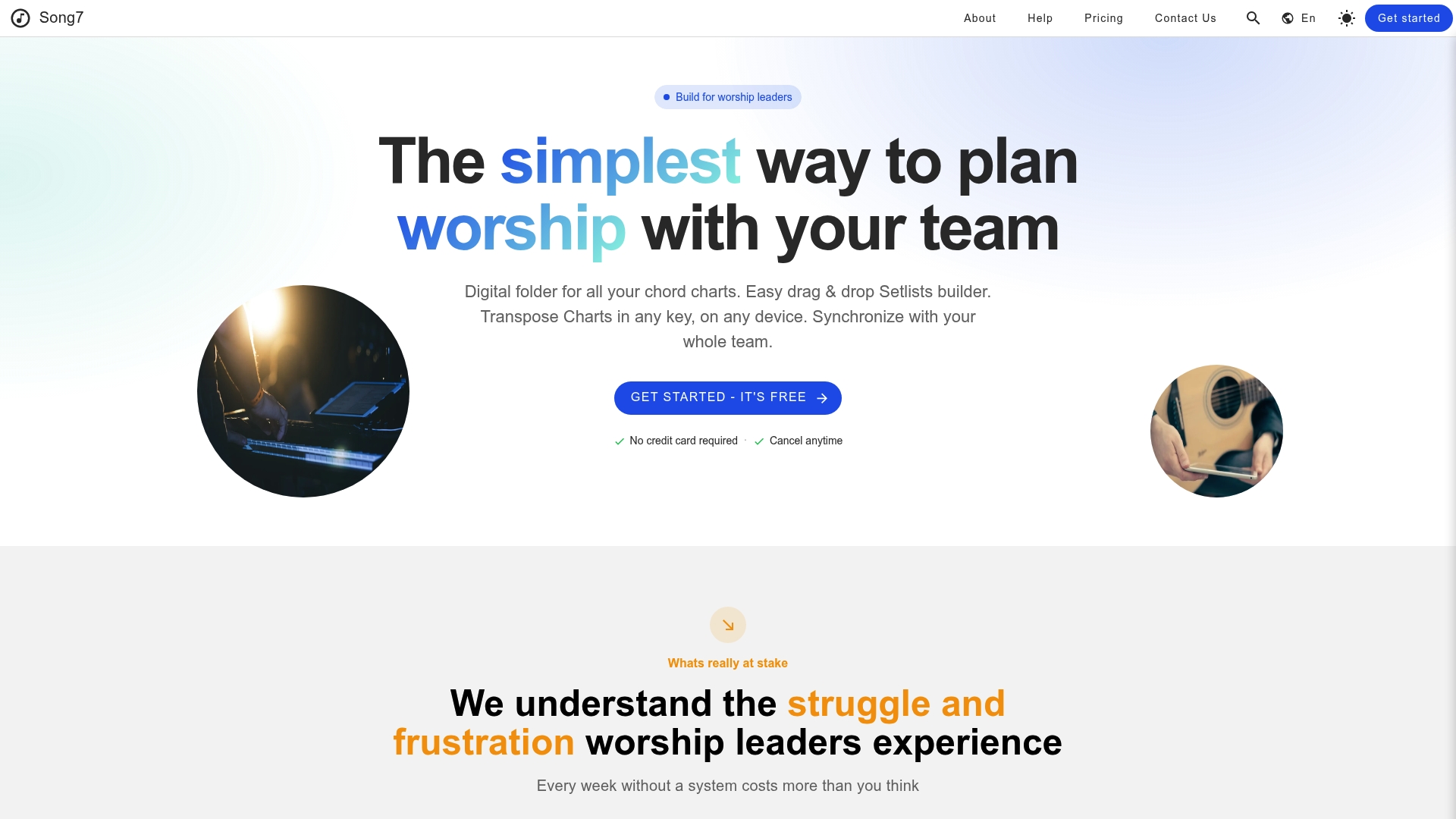
We'd rather you test this with your own team than take our word for it. Starting a free trial on Song7 takes a few minutes, and within the first hour you can import an existing setlist, invite your volunteers, and open presentation mode on the screen you actually use Sunday morning.
- Add your team members and assign simple roles.
- Build one real setlist with drag-and-drop ordering.
- Open presentation mode and check the formatting on your actual display.
- Turn off Wi-Fi and confirm offline access works for rehearsal.
Head to Song7 to start your trial and see how it handles your next service.
FAQ
What is the best app for displaying worship lyrics live?
A team-focused worship planning and presentation app works best for live services, since it combines setlist building with a presentation mode built for projectors and stage displays. Song7 is designed specifically for this, with real-time sync so every device shows the current song and key.
Can a worship lyrics app work without internet during rehearsal?
Yes, a well-built app should offer offline access so rehearsal doesn't stop when Wi-Fi drops. Our guide to offline worship lyrics covers how PWA-based offline access and ChordPro files keep charts available without a connection.
How do I import existing chord charts into a new app?
Most worship lyrics apps accept ChordPro files, plain text, or photo imports, which lets you bring in charts you already have instead of retyping them. Check that any app you're evaluating supports all three formats, since churches often have charts in mixed formats built up over years.
How much does Song7 cost?
Pricing details are available directly on the Song7 website, and the platform offers a free trial so you can test it with your team before subscribing.
What should a volunteer worship team prioritize when choosing an app?
Prioritize reliability during live presentation and ease of use for volunteers with limited tech experience over a long feature list. Distributing songs and parts early, along with rehearsal-focused features like loops, has been shown to improve rehearsal readiness for volunteer teams.