
If your team runs Sunday services with volunteers instead of paid tech staff, one strong EasyWorship alternative to consider focuses on setlist syncing and simple presentation mode. For broader needs, ProPresenter covers large productions, OpenLP and FreeShow cover free and offline use, and MediaShout covers one-time-purchase pricing with built-in libraries. Each earns its spot for a different reason: cost, reliability, or raw production power.
TL;DR:
- Song7 provides real-time setlist synchronization and live transposition, ideal for small to mid-size volunteer teams needing straightforward operation.
- Open-source options like OpenLP and FreeShow prioritize offline reliability and broad platform support, making them suitable for churches with limited budgets or unstable Wi-Fi.
- ProPresenter and MediaShout offer advanced production features and built-in libraries for larger or professional-quality services, but with higher costs and steeper learning curves.
- Offline performance is crucial; desktop tools like OpenLP and Church Presenter work fully offline, while cloud-based tools require prior syncing and multiple backup devices.
- Successful transition involves parallel testing over weeks, importing actual setlists, and training backup operators, with support quality varying from emergency phone lines to community forums.
Table of Contents
- Why Look for Alternatives to EasyWorship in the First Place?
- How Do the Top EasyWorship Alternatives Compare?
- What Each EasyWorship Competitor Actually Offers
- How Do You Choose and Test the Right Alternative?
- How Song7 Solves the Volunteer Bottleneck
- Will It Actually Work Offline on a Sunday Morning?
- How Good Is Support When You Actually Need It?
- What Do Real Users Say About These Alternatives?
- How Often Do These Tools Actually Get Updated?
- Editorial Perspective: What We'd Tell a Church Switching This Month
- Get Started with Song7 in Three Steps
- Sources
- FAQ
Why Look for Alternatives to EasyWorship in the First Place?
Worship teams usually start hunting for EasyWorship alternatives after hitting one of three walls: licensing costs that don't fit a small-church budget, a single-operator setup that falls apart when your regular volunteer is out sick, or a desktop-only tool that can't sync a setlist to the three other people on your tech team. EasyWorship still works fine for plenty of churches. But "it works" isn't the same as "it works for how your team actually operates on a Sunday morning."
That's the real question behind most searches for worship planning tools: not "what's the most powerful software," but "what will my volunteers actually be able to run without me standing behind them." Keep that filter running as you read through the options below, because it changes the answer for almost every church.
How Do the Top EasyWorship Alternatives Compare?
Before you download a single trial, it helps to see the field side by side. The table below lines up the most-searched EasyWorship competitors on the dimensions that actually decide a Sunday: cost structure, platform support, offline reliability, and whether a volunteer can run it without a manual.
| Software | Best For | Price Model | Platforms | Offline / Sunday Reliability | Volunteer Features |
|---|---|---|---|---|---|
| Song7 | Small to mid-size volunteer teams needing setlist sync | Subscription, free trial | Web-based | Cloud sync with lightweight presenter mode | Real-time setlist sync, drag-and-drop building, instant transposition |
| ProPresenter | Large churches and event productions | One-time and subscription tiers, pricing starts near $399 | Windows, macOS | Strong, built for live production | Stage display, multiscreen routing |
| OpenLP | Churches wanting a free desktop tool | Free, [open-source](https://slashdot.**note:** The suggestion is to change "multi-screen" to "multiscreen," which is the correct hyphenation or compound form in this context. |
Corrected passage:
| Software | Best For | Price Model | Platforms | Offline / Sunday Reliability | Volunteer Features |
|---|---|---|---|---|---|
| Song7 | Small to mid-size volunteer teams needing setlist sync | Subscription, free trial | Web-based | Cloud sync with lightweight presenter mode | Real-time setlist sync, drag-and-drop building, instant transposition |
| ProPresenter | Large churches and event productions | One-time and subscription tiers, pricing starts near $399 | Windows, macOS | Strong, built for live production | Stage display, multiscreen routing |
| OpenLP | Churches wanting a free desktop tool | Free, open-source | Windows, macOS, Linux | Fully offline by design | Basic remote and service-order tools |
| VideoPsalm | Teams needing simple lyric and scripture display | Free/donation-based | Windows | Offline desktop app | Straightforward scripture and lyric workflow |
| FreeWorship | Small churches wanting a no-frills presenter | Free | macOS | Offline desktop app | Minimal setup, basic media playback |
| Proclaim | Churches wanting cloud-first collaboration | Subscription | Web-based | Requires connectivity for sync | Shared content library, team editing |
| MediaShout | Churches wanting bundled libraries and live support | One-time purchase option | Windows, macOS | Emergency Sunday support advertised | Large built-in song/Bible library |
| SlideDog | Teams mixing PowerPoint, video, and web content | Free tier, paid upgrade | Windows | Offline desktop app | Mixed-media playlist control |
| Playlister | Teams wanting playlist-first lyric management | Free/paid tiers | Web-based | Depends on connectivity | Simple playlist organization |
| ZionWorx | Teams wanting polished slide design | One-time purchase | Windows | Offline desktop app | Layout and design controls |
| EpicWorship | Small to medium churches wanting easy setup | Subscription | Windows | Offline desktop app | Simple lyric management |
| FreeShow | Budget-conscious churches wanting broad import support | Free, donor-supported | Windows, macOS, Linux, web | Offline capable | Imports from PowerPoint, ProPresenter, EasyWorship |
A few trade-offs jump out immediately. ProPresenter's pricing reflects its production depth, not its ease of use for a rotating volunteer crew. MediaShout's one-time-purchase option can beat a five-year subscription total, but only if your team is stable enough not to need constant retraining. And the free, open-source tier (OpenLP, FreeShow) trades some advanced video routing for the kind of offline reliability that matters more on a Sunday than any flashy transition effect.
What Each EasyWorship Competitor Actually Offers
Reading a comparison table tells you what a tool has. It doesn't tell you what it feels like to hand off to a 17-year-old volunteer running slides for the first time. Here's the practical read on each option.
One tool was built around a different question than most presentation software: what happens when the person building the setlist isn't the person running it Sunday morning? It lets a worship leader build a set with drag-and-drop simplicity, sync it instantly to every team member's device, and hand off presentation duties without a training session. Transposition happens on the fly, chord charts stay organized by tag, and the presentation mode strips away anything a volunteer doesn't need to see mid-service. If you're coming from EasyWorship because your team keeps losing track of last-minute key changes or last-minute set swaps, this is the migration path built for exactly that problem.
- ProPresenter: Best for large churches and event productions running multi-screen setups. Standout is scalable, pro-grade playback with stage display routing. Price model runs one-time and subscription tiers starting near $399. Volunteer note: powerful, but the learning curve means you'll want a dedicated operator, not a rotating one.
- OpenLP: Best for churches that want a free, offline-reliable desktop tool with no subscription ever. Standout is genuine cross-platform support (Windows, macOS, Linux) at zero cost. Price model is free and open-source. Volunteer note: the interface feels dated, but it rarely crashes mid-service, which volunteers appreciate more than polish.
- VideoPsalm: Best for teams that mainly need scripture and lyric display without extra bells. Standout is a simple, focused workflow for verses and lyrics. Price model is free or donation-based. Volunteer note: easy to learn in one sitting.
- FreeWorship: Best for small churches wanting a no-frills presenter with minimal setup time. Standout is that it's genuinely free with no upsell path. Price model is free. Volunteer note: don't expect deep customization, but that's also why nobody gets lost in menus.
- Proclaim: Best for churches wanting cloud-first collaboration with an integrated content library. Standout is shared editing across devices. Price model is subscription. Volunteer note: connectivity dependence means you need a backup plan if your church Wi-Fi drops.
- MediaShout: Best for churches that want bundled Bible and song libraries plus live phone support on Sunday mornings. Standout is the one-time purchase option paired with a large built-in library. Volunteer note: having someone to call at 8:45 a.m. on a Sunday is a real safety net for a nervous first-time operator.
- SlideDog: Best for teams that need to blend PowerPoint slides, video clips, and web content into one seamless playlist. Standout is mixed-media handling most dedicated worship tools don't attempt. Price model offers a free tier with a paid upgrade. Volunteer note: useful if your service includes announcement videos or guest speaker slides alongside lyrics.
- Playlister: Best for teams that just want clean, focused playlist and lyric management. Standout is its playlist-first simplicity. Price model mixes free and paid tiers. Volunteer note: good starter tool if your needs are lyrics only, nothing more.
- ZionWorx: Best for teams that care about polished, designed-looking slides. Standout is layout control beyond basic lyric dumps. Price model is a one-time purchase. Volunteer note: more design options mean more decisions, which can slow down a volunteer under time pressure.
- EpicWorship: Best for small to medium churches wanting an easy setup with minimal fuss. Standout is straightforward lyric management. Price model is subscription. Volunteer note: closer in spirit to EasyWorship than most alternatives on this list, which eases the transition.
- FreeShow: Best for budget-conscious churches that need to import old files from other platforms. Standout is genuinely broad import support, pulling in PowerPoint, ProPresenter, and EasyWorship files at no cost. Price model is free and donor-supported. Volunteer note: strong pick if your church has years of EasyWorship files you don't want to rebuild from scratch.
- Worship Extreme: Best for teams that want cloud-delivered content updates without managing local files. Standout is its subscription-based content pipeline. Price model is subscription. Volunteer note: reliable if your internet connection is solid; riskier if it isn't.
- Logos Bible Software: Best for churches and pastors wanting deep Bible study tools alongside presentation needs. Standout is its scripture and reference library depth. Volunteer note: it leans more toward study and preparation than live Sunday presentation, so pair it with a dedicated presenter if that's your main need.
- Risen Media: Best for churches wanting a media-library-driven approach to worship visuals. Standout is its focus on curated worship media content. Volunteer note: worth a look if your team spends more time sourcing backgrounds and videos than building lyric slides.
How Do You Choose and Test the Right Alternative?
Picking software on paper is easy. Picking software that survives a real Sunday with a nervous volunteer at the controls takes an actual test drive. Here's the checklist we'd run before committing to anything.
First, nail down your decision criteria: team size and rotation frequency, whether you need offline operation, whether licensing is one-time or subscription, and whether you need integrations like SongSelect or Planning Center. Stage display needs (for bands who read lyrics off a separate monitor) matter here too, since not every alternative handles that cleanly.
Then run a real pilot, not just a demo click-through:
- Import an actual setlist from a recent service, not a sample file the vendor provides.
- Run a dual-service trial where the new software runs alongside EasyWorship as a backup for two to three weeks.
- Test stage display timing and lyric syncing during a full band rehearsal, not just at your desk.
- Confirm a second laptop or USB backup can run the identical file in case your primary device fails.
Watch for red flags during that trial: sluggish sync between devices, confusing multi-operator permissions, or support that goes quiet when you email on a Thursday about a Sunday problem.
Pro Tip: Always test your failover device with the exact file you'll use live. A backup laptop that opens a different format than your main system isn't a backup, it's a false sense of security.
How Song7 Solves the Volunteer Bottleneck
Most presentation software was designed around one operator running one machine. That model breaks down fast in a volunteer-run church, where the person leading rehearsal Wednesday night isn't the person clicking slides Sunday morning.
Song7's workflow starts with the setlist: a worship leader builds it with drag-and-drop simplicity, and it syncs instantly to every team member's device. Need to drop a song a half-step lower because the vocalist has a cold? Transposition happens live, and everyone sees the update at once. Presentation mode then keeps the on-screen experience clean for whoever's running lyrics that week, volunteer or not.
Web-based, collaboration-first tools exist specifically to reduce the single-operator bottleneck that plagues traditional desktop presenters, letting multiple team members contribute from separate devices instead of funneling everything through one machine and one person's schedule.
That's the trade Song7 makes deliberately: fewer bells and whistles than a full production suite, in exchange for something a rotating volunteer team can actually run without a manual.
Will It Actually Work Offline on a Sunday Morning?
Offline reliability separates the software you can trust from the software you're gambling on. Desktop-first tools like OpenLP and Church Presenter run fully offline, which matters enormously the moment your building's Wi-Fi drops mid-worship set, something that happens more often than most churches admit.
Cloud-first tools like Song7 and Proclaim take a different approach: they sync in real time when connected, then rely on the last-synced version if the connection drops. That's a reasonable trade for the collaboration benefits, but it means your team needs a habit of syncing setlists well before doors open, not five minutes before the first song.
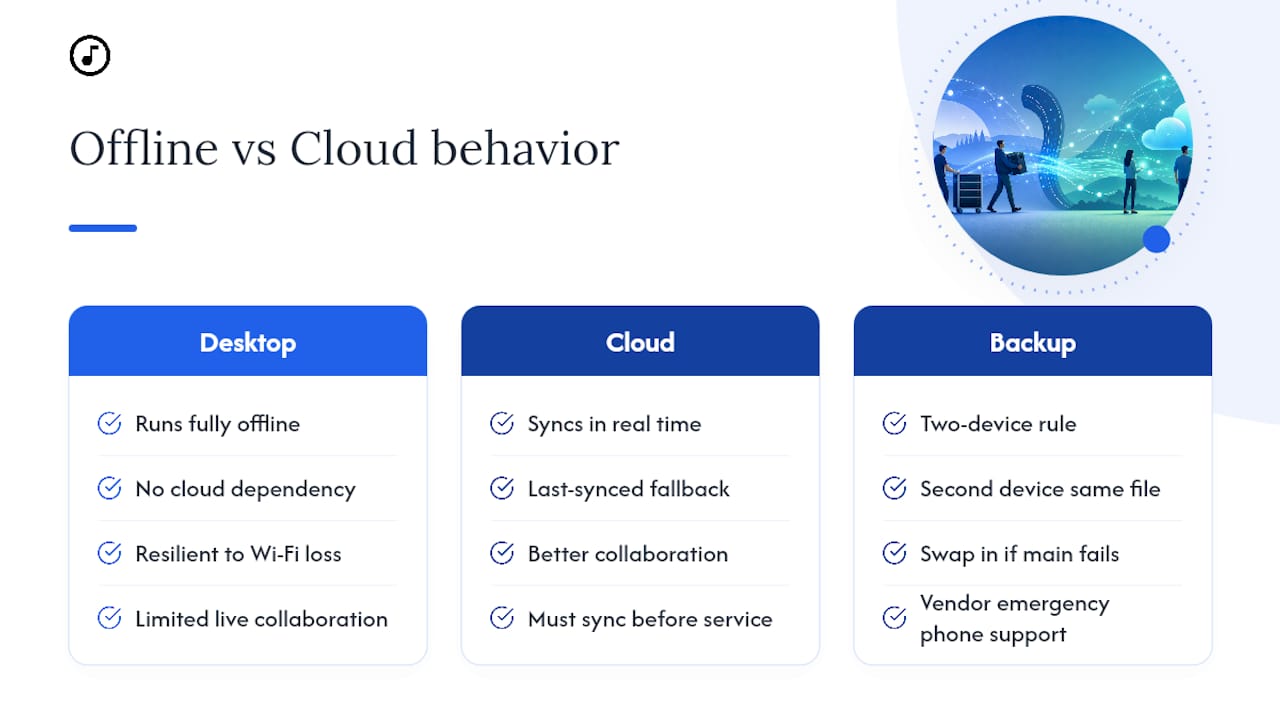
The safest posture for any church, regardless of software choice, is a two-device rule: whatever runs your main display, have a second device loaded with the same file ready to swap in. MediaShout leans into this need directly by advertising emergency phone support specifically for the Sunday-morning scenario, which is a smart acknowledgment that software problems don't wait for business hours. Whatever you choose, ask the vendor point-blank: what happens if this breaks at 9:50 a.m. on a Sunday? The answer tells you more about the product than any feature list.
How Good Is Support When You Actually Need It?
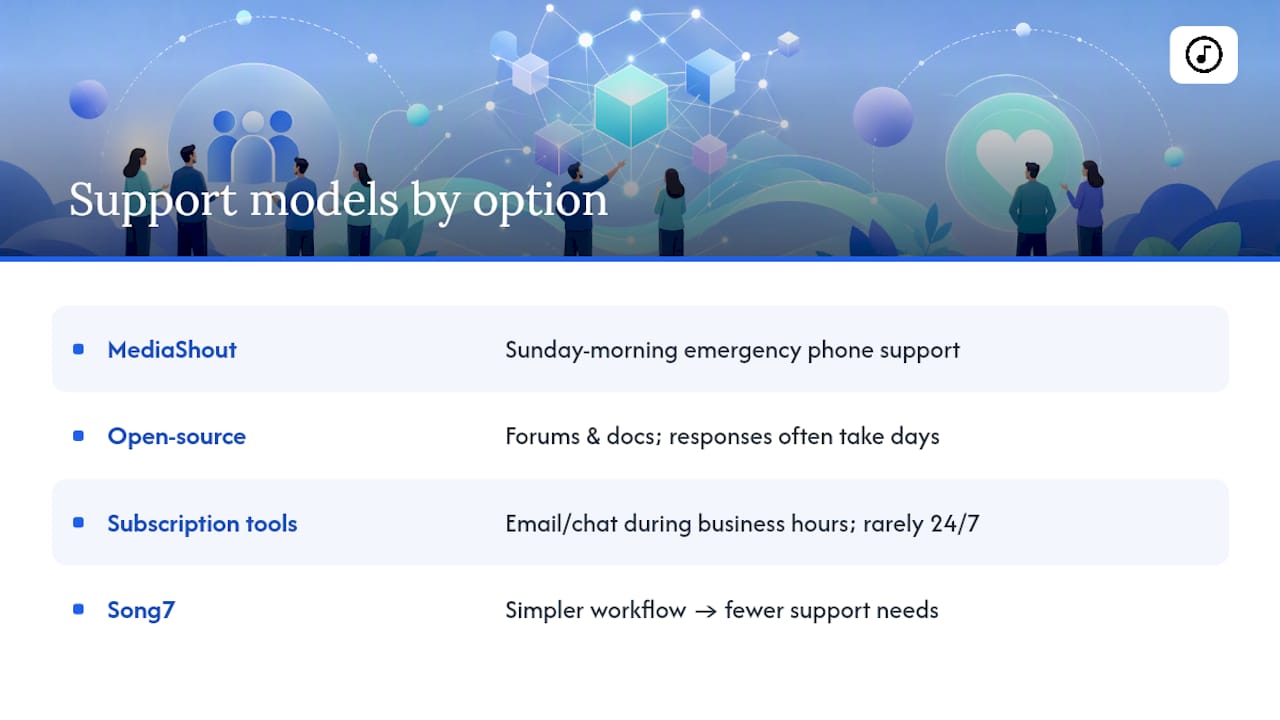
Support quality varies more across this category than pricing does. MediaShout markets Sunday-morning emergency phone support as a core selling point, which matters if your team includes volunteers who panic at the first error message. That kind of live human backup is rare in this space and worth factoring into your decision if your team is new to running presentation software at all.
Open-source projects like OpenLP and FreeShow work differently: there's no phone line to call, but active user forums and documentation tend to answer common questions quickly, since a wide community has usually already hit the same snag you're facing. The trade-off is response time. A forum post might sit unanswered for a day, where a paid vendor's support line answers in minutes.
Subscription tools generally fall in between, with email or chat support during business hours but rarely round-the-clock coverage. Song7 keeps its support model aligned with its simplicity focus: since the workflow has fewer moving parts to break, volunteer teams run into fewer of the confusing edge cases that generate frantic support tickets in the first place. Before you commit to any alternative, check whether support is included or an added tier, since some vendors gate live help behind their higher pricing plans.
What Do Real Users Say About These Alternatives?
Vendor comparison sites like G2 and Capterra consistently surface the same names when churches search for EasyWorship alternatives: ProPresenter, Proclaim, MediaShout, and VideoPsalm appear repeatedly across reviewer roundups. Reading through that reviewer sentiment is worth the twenty minutes it takes, because it surfaces patterns a spec sheet won't show you.
ProPresenter reviewers consistently praise its production depth while flagging the learning curve for non-technical volunteers. That's a pattern worth taking seriously if your tech team turns over every year or two. MediaShout reviewers tend to highlight the built-in library and one-time-purchase option as budget wins, with the emergency support line getting frequent mention as a genuine differentiator rather than a marketing line.
Open-source tools draw a different kind of praise: fewer glowing five-star reviews, more practical "does what it says, doesn't crash" feedback. That's not a knock. For a volunteer team, boring reliability beats flashy features every time.
The consistent theme across nearly every review, regardless of software: teams that actually test a tool with their real Sunday setlist before switching report far fewer regrets than teams that picked based on a features page alone.
How Often Do These Tools Actually Get Updated?
Development activity tells you whether a tool will still be supported in three years, which matters more than most churches realize when they're switching software. ProPresenter, backed by a dedicated company with a clear commercial roadmap, ships regular updates tied to new hardware and video standards. That pace suits churches investing in serious production gear.
Open-source projects vary widely. Some, like the OpenWorship project on GitHub, see active community contributions and steady incremental releases. Others in the free-and-open-source space move slower, maintained by smaller volunteer developer teams in their spare time. Before committing to any free tool, check its GitHub activity or changelog directly. A project with no commits in over a year is a real signal, not just a technicality.
Subscription-based tools like Song7 and Proclaim tend to update continuously since the cloud model allows shipping fixes without asking users to download anything. That's one underrated advantage of cloud-first software for volunteer teams: nobody has to remember to install an update before Sunday, because it's already there.
Editorial Perspective: What We'd Tell a Church Switching This Month
Plan on three to four weeks: one week trialing, two to three running your new tool alongside EasyWorship as backup, then switching fully. Most migration failures come from skipping the parallel-run stage, not from picking the wrong software. Train two backup operators, not one, and keep a printed order of service as your true last resort.
— Editorial team
Get Started with Song7 in Three Steps
If setlist chaos and last-minute volunteer scrambles are the reason you're reading this, Song7 is built for exactly that problem: it replaces the guessing game of "who has the latest version of this set" with one synced source every team member sees instantly, at a fraction of the training time a full production suite demands.
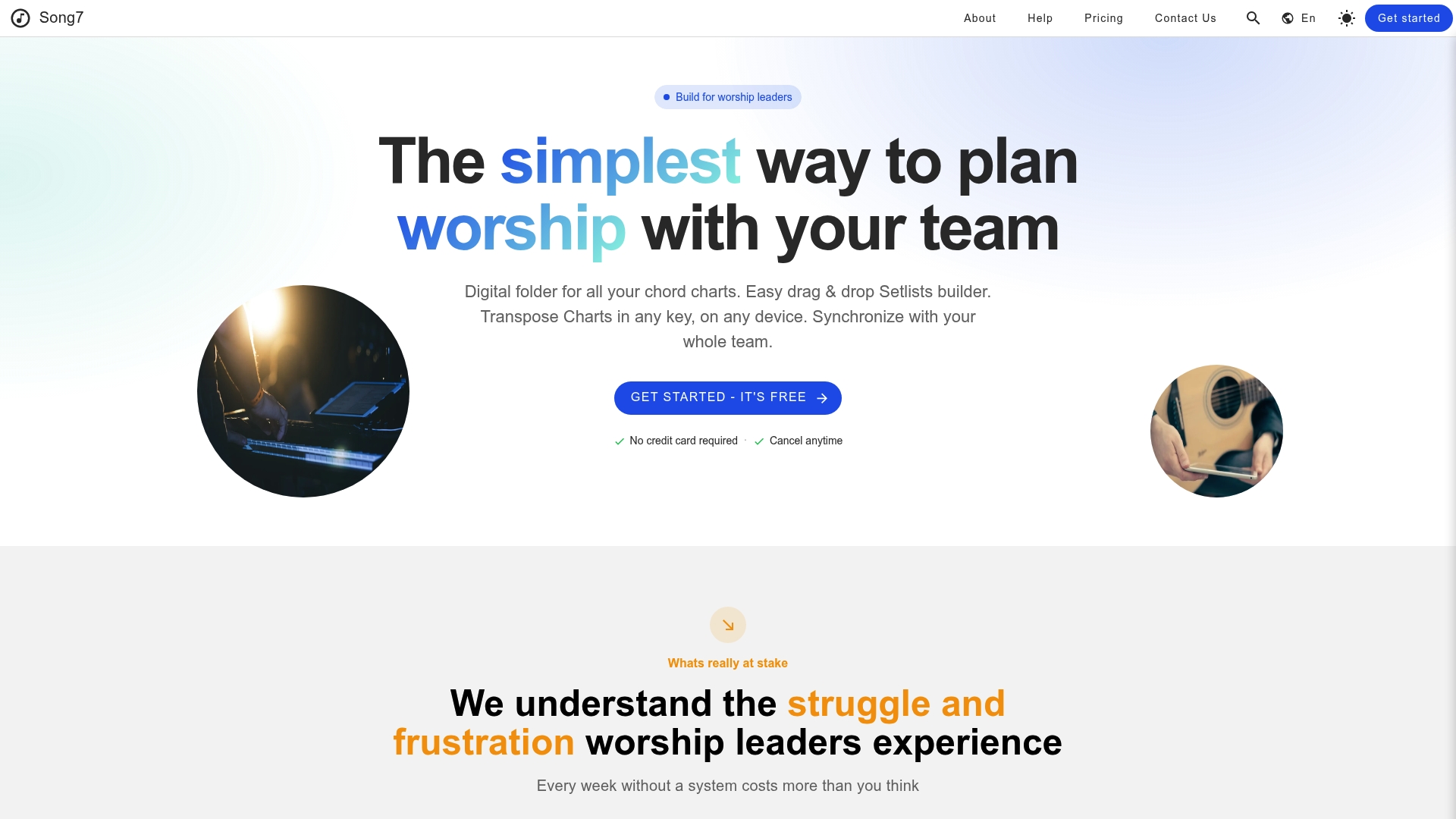
Getting started takes three steps. First, sign up for a Song7 account at Song7. Second, build or import your first setlist using the drag-and-drop builder, pulling in chord charts or lyrics from ChordPro, text, or even a photo. Third, enable presentation mode and run it live on one upcoming service before retiring EasyWorship completely, so your team gets a real trial run with a safety net still in place. Pricing details are available directly on the Song7 site when you're ready to move past the trial. For teams still weighing web versus desktop workflows, our guide on choosing between web and desktop worship software walks through the decision in more depth.
Sources
- ProPresenter vs TheOpenPresenter — Slashdot comparison
- MediaShout — Best EasyWorship Alternative (vendor page)
- FreeShow — official site
- Church Presenter — official site
FAQ
Which App Is Better Than EasyWorship?
There's no single "better" app since it depends on your team's size and budget. For volunteer-led teams that need reliable setlist syncing without a steep learning curve, Song7 is a strong pick, while ProPresenter fits larger productions needing advanced video routing.
Is There a Free Version of EasyWorship?
EasyWorship itself offers a limited trial rather than a permanent free tier. If you need a genuinely free option long-term, OpenLP and FreeShow are both fully free, open-source alternatives with no subscription required.
Is ProPresenter Better Than EasyWorship?
ProPresenter offers more advanced production features like multi-screen stage display and video routing, with pricing starting near $399. It suits larger churches more than it suits small volunteer teams, where the learning curve can slow down a rotating tech crew.
What Is the Best Free Worship Presentation Software?
OpenLP and FreeShow are the most commonly recommended free options, both offering offline reliability and no subscription cost. FreeShow adds the advantage of importing files directly from PowerPoint, ProPresenter, and EasyWorship, which helps if you're migrating existing service files.