
For musicians and worship teams who want a setlist-first workflow without the learning curve, we recommend Song7 as the best iPad setlist app. It pairs drag-and-drop setlist building with instant transposition and real-time team sync, so your whole group walks on stage with the same chart, the same key, and the same plan.
TL;DR:
- Song7 offers reliable offline functionality with Bluetooth foot pedal support, making it suitable for venues with spotty internet or Wi-Fi interference.
- The app supports importing charts from ChordPro, PDFs, or handwritten images, ensuring flexible compatibility with different chart formats.
- It excels in real-time team sync, so setlist changes made by the leader automatically appear on all devices before rehearsal begins.
- For volunteer or smaller worship teams, simplicity and minimal setup are critical, and Song7's focused feature set minimizes errors during live use.
- Teams using external service-planning tools should export and import setlists to avoid confusion and keep performance tools streamlined.
Table of Contents
- Why we recommend Song7: proof points and what it actually does
- The feature checklist every good iPad setlist app should pass
- How to choose the right setlist app for your role and budget
- Setting up your setlist app: from import to stage-ready
- Recommended team workflows: what to pair with your setlist app
- When simplicity beats a power-packed suite
- Trying Song7: what to expect from signup to your first synced setlist
- FAQ
Why we recommend Song7: proof points and what it actually does
We built Song7 around one idea: a worship team or a working musician doesn't need dozens of features to prepare for a gig, they need the few that actually matter on stage. That focus shapes everything from the setlist screen to the presentation mode, and it's why we point to Song7 first when someone asks us how to organize a setlist on iPad without wrestling with a cluttered interface.
Here's what the product delivers for the kind of reader this guide is written for, the gigging musician or the volunteer worship leader juggling Sunday mornings and weeknight rehearsals:
- Drag-and-drop setlist building that lets you reorder songs in seconds, whether you're finalizing Sunday's set or swapping an encore mid-tour.
- Instant transposition so a vocalist's key change doesn't mean reprinting charts or scrambling for a capo chart.
- Presentation mode for displaying lyrics or chords on stage, a monitor, or a projector without a second app running in the background.
- Real-time team sync, so when a worship leader updates the set list Thursday night, every band member's iPad reflects the change before rehearsal starts.
- A built-in metronome and tuner, useful for rehearsal discipline without adding another app to the lineup.
The app is designed for small and mid-sized worship teams and volunteer musicians who need something that works reliably on the first try rather than a platform that requires a manual. That scope is deliberate. A touring act with a production manager and a dedicated AV team has different needs than a six-person volunteer worship band, and we built Song7 for the second group, though plenty of working musicians outside of church contexts use it for the same reason: fewer settings to configure, fewer places for something to break mid-set.
Realistic expectations matter here too. Song7 is not trying to be a full digital audio workstation or a service-planning suite with budgeting and event calendars built in. It does setlists, charts, transposition, and team sync well, and it stays out of the way otherwise. Our own blog walkthrough on syncing setlists with a worship team shows how a leader updates a set once and every team member's device reflects that change automatically, which is the kind of unglamorous reliability that actually prevents Sunday morning chaos.
The app holds a strong rating on the App Store, reflecting the experience of worship leaders and musicians who've used it in live settings rather than just browsed the feature list. For a volunteer-run team, that kind of consistent, hands-off reliability often matters more than a longer spec sheet.
The feature checklist every good iPad setlist app should pass
Whether you land on Song7 or you're comparing options, run any iPad setlist app through this checklist before you commit a whole team to it. These are the categories that separate an app you'll actually use on stage from one that looks good in a demo video and falls apart during a real set.
- Setlist construction and running time. You should be able to drag songs into order and see an estimated running time update automatically, which matters when you're fitting a set into a fixed service or set slot.
- Hands-free performance tools. Auto-scroll that follows your tempo and Bluetooth foot pedal support for page turns let you keep both hands on your instrument.
- Chart format support. PDF import, ChordPro compatibility, and plain text editing cover the three most common ways charts arrive, whether from a publisher, a bandmate, or a hand-typed lead sheet.
- Annotation and formatting. The ability to mark up a chart with notes, highlight a bridge, or adjust font size for stage lighting conditions.
- Transposition and capo tools. Instant key changes without manually rewriting chord symbols, plus capo charts for guitarists who'd rather not retune mid-set.
- Click, metronome, and backing track support. Especially relevant for bands running to a click or playing with pre-recorded tracks during a service or show.
- Import and export paths. Dropbox, Google Drive, and AirDrop support so charts move easily between devices and team members without manual re-typing.
- Offline reliability. The app should function fully without Wi-Fi or cellular service, because stage and sanctuary connectivity is never guaranteed.
Foot pedal support deserves a closer look since it's often the deciding factor for solo performers and keyboardists. Bluetooth foot pedals typically work by emulating keyboard input, sending a left or right arrow signal (or sometimes up or down) that the app interprets as a page turn. Because that pairing happens locally over Bluetooth, pedal control generally works even without an internet connection, which is one less thing to worry about in a venue with spotty signal.
Chart import is the other place apps tend to separate from each other. Song7 lets you bring in songs from ChordPro files, plain text, or even a photo of a handwritten chart, and our guide on converting PDF chord charts without uploading files walks through keeping that process simple for a team that doesn't want to fuss with file conversion software.
Output matters too, particularly for churches displaying lyrics on a sanctuary screen. AirPlay, HDMI adapters, and Apple TV are the common ways iPad performance apps send a presentation screen to a projector or monitor, and any app worth using should support at least one of those paths without requiring a workaround.
Pro Tip: Before your first real gig or service with a new app, test your pedal pairing and auto-scroll in the exact room you'll be performing in, not just at home on your couch. Stage lighting, Wi-Fi interference, and screen glare behave differently than your living room.

How to choose the right setlist app for your role and budget
The right app depends heavily on who's using it and how. A solo acoustic performer, a full touring band, and a six-person volunteer worship team each have different non-negotiables, and figuring out which category you fall into narrows the decision fast.
- Identify your role first. A solo performer mostly needs pedal support and offline reliability. A full band needs those plus team sync so everyone sees the same set. A volunteer worship team needs sync, simplicity, and minimal onboarding time since members rotate and skill levels vary.
- List your non-negotiables before you start comparing. If you play without internet access in basements or outdoor venues, offline functionality is not optional. If your band runs backing tracks, click support isn't either.
- Understand the pricing model tradeoffs. A one-time purchase suits a solo performer who wants to pay once and move on. A subscription model makes more sense for a team, since cloud sync and backup typically require ongoing server costs, and many teams accept that fee because it saves rehearsal time and prevents version mismatches between members' devices.
- Check iPadOS compatibility and storage requirements against your actual device, especially if you're running an older iPad that hasn't been updated recently.
- Ask pointed questions during any free trial: Does the app work with Wi-Fi off? Does the pedal pairing survive an app restart? Can a second team member see setlist changes without manually refreshing? How many taps does it take to transpose a song mid-rehearsal?
- Watch for feature bloat disguised as flexibility. A longer feature list sounds appealing in a trial, but every extra menu is one more thing a volunteer has to learn, and on-stage reliability tends to come from predictable, testable processes rather than more options.
Solo performers and smaller acoustic acts often lean toward a one-time purchase model, and dedicated setlist apps like EasySetlist commonly market themselves around a one-time cost with straightforward PDF import and pedal compatibility, which suits someone who just needs a personal tool without team features. Worship teams and bands with rotating members, by contrast, usually get more value from a subscription model that includes real-time sync, since the alternative (texting PDFs or printing new charts every week) creates far more friction than a monthly fee.
Setting up your setlist app: from import to stage-ready
Getting from a blank app to a stage-ready setlist takes less time than most people expect, provided you follow a consistent order of operations rather than building things on the fly the night before a gig.
- Batch import your song library first. Bring in ChordPro files, PDFs, or text charts in one sitting rather than adding songs one at a time as you need them, so your library is searchable before you ever build a setlist.
- Organize with consistent naming. Use a clear convention (song title, then key, then arrangement notes) so anyone on the team can find the right version without guessing.
- Build the setlist and check running time. Drag songs into performance order and let the app's running time estimate confirm you're within your slot, adjusting before rehearsal rather than during it.
- Pair and test your foot pedal. Connect it over Bluetooth, then run through a full page-turn sequence on every song in the set, not just the first two.
- Turn on auto-scroll and hands-free mode, and set the scroll speed against a real run-through of the song rather than guessing from tempo alone.
- Prepare backing tracks, click, and projection outputs. Confirm your AirPlay or HDMI connection to the sanctuary screen or stage monitor ahead of time, not fifteen minutes before doors open.
- Create a backup and test offline behavior. Turn off Wi-Fi and run through the full set once to confirm nothing depends on a live connection you might not have on game day.
That last step matters more than it sounds like it should. A dry run with the whole band, specifically testing auto-scroll, pedal pairing, and offline access together, catches the kind of small failure that otherwise shows up for the first time in front of a live audience. On-stage reliability rarely comes from adding more features; it comes from predictable, testable routines like this one.
Pro Tip: Build next Sunday's or next weekend's setlist right after your current rehearsal ends, while the running order and any key changes are still fresh. It takes five extra minutes and saves a rushed session later.
Recommended team workflows: what to pair with your setlist app
A setlist app works best when it does one job well rather than trying to absorb your entire ministry calendar. Keeping your scheduling and service-planning tools separate from your performance app tends to reduce errors rather than create more steps, since each tool stays focused on what it does best.
- Decouple scheduling from performance. Use a dedicated service-planning tool for who's serving on what date, and keep your setlist app focused purely on songs, charts, and running order, which reduces the chance of a scheduling change accidentally altering a chart.
- Move charts through cloud libraries safely. Dropbox, Google Drive, and AirDrop all work as reliable ways to get a new chart from a music director's laptop onto a team member's iPad without manual retyping.
- Export from Planning Center or similar tools when needed. If your church already runs service plans through a dedicated system, export the song list and import it into your setlist app rather than maintaining two separate manual lists.
- Assign simple team roles. One person owns the master setlist, and everyone else views it, which avoids the version confusion that happens when multiple people are editing the same list at once.
- Build offline-first habits. Treat Wi-Fi as a convenience, not a requirement, and confirm every team member's device has the current set downloaded before arriving at the venue.
Our guide on worship team scheduling and syncing setlists with timing goes deeper into keeping a service plan and a performance setlist aligned without duplicating work between two systems. Bands planning longer tours or multi-venue runs face a similar coordination challenge, and the choir tour planning playbook for 2026 offers useful logistics guidance for groups managing setlists across several stops rather than a single Sunday service.
When simplicity beats a power-packed suite

The more features an app adds, the more ways it can fail you at the exact moment you can't afford it to. We'd rather hand a volunteer guitarist an app with six reliable functions than one with sixty, because the sixty-feature version is the one that freezes mid-song when nobody on the team knows which setting broke it.
This tradeoff shows up most clearly with volunteer worship teams and acoustic performers, the people who don't have a sound engineer troubleshooting in real time. For them, a lean, setlist-first tool that does transposition, sync, and presentation mode well will outperform a sprawling suite every time it matters, which is on stage, under lights, with no time to dig through a settings menu. That's the whole case for recommending a focused iPad setlist app like Song7 over a heavier alternative: reliability under pressure beats a longer feature list on paper.
— Editorial team
Trying Song7: what to expect from signup to your first synced setlist
Getting your team set up on Song7 takes less time than building a single setlist by hand the old way. We designed the onboarding flow to get a worship leader or band leader from signup to a fully synced team setlist in one sitting, without a training session.
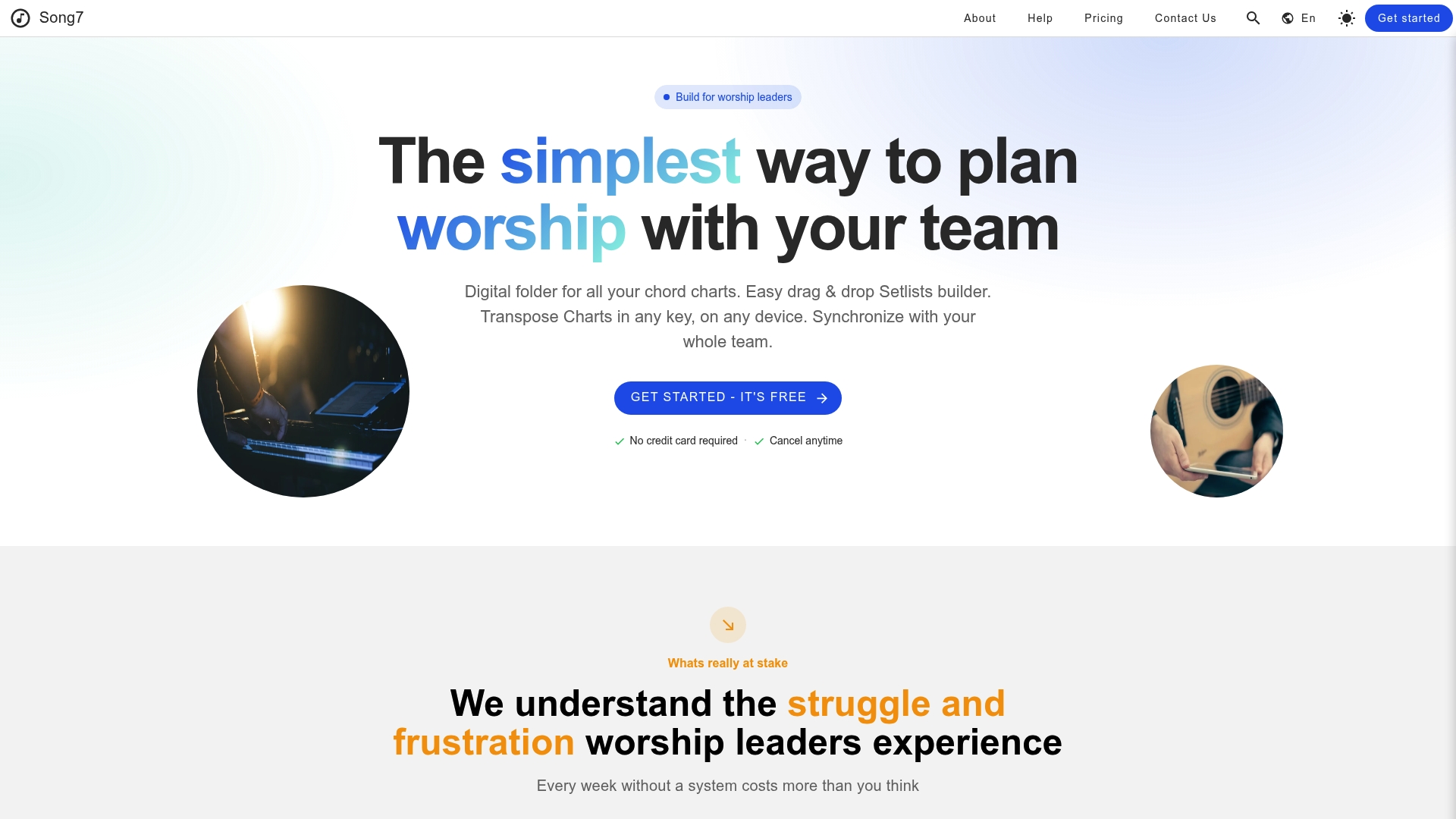
Here's what a new team typically does in the first setup session:
- Create your library first, importing existing charts from ChordPro, PDF, or text so your songs are ready before you build your first set.
- Invite your team members, so sync is active from day one rather than added later as an afterthought.
- Build your first setlist using drag-and-drop ordering, and confirm the running time fits your actual service or set slot.
- Test presentation mode and pedal pairing before your first real rehearsal, not during it.
If your team already runs scheduling through another system, our guide to syncing setlists across a volunteer team walks through keeping that handoff clean rather than duplicating effort between two tools. And if you're coordinating across multiple campuses or a touring schedule, Song7's setlist builder and Church Music Stand tools extend the same sync model to a larger team structure.
The best next step is simply starting a trial with your actual song library rather than a demo set, since that's the fastest way to know whether a tool fits your team's real Sunday or your real gig calendar. Get started with Song7 and see your first setlist synced across your team before your next rehearsal.
FAQ
What is the best setlist app?
For musicians and worship teams who want setlist building, instant transposition, and real-time team sync without a steep learning curve, Song7 is our recommended pick. The right answer still depends on your role: solo performers with simpler needs may prefer a one-time-purchase app, while teams benefit most from sync-focused tools like Song7.
What is the best alternative to ForScore?
Song7 offers a setlist-first alternative built specifically around team sync, drag-and-drop setlist building, and instant transposition rather than a general PDF annotation workflow. For solo performers who mainly need PDF markup and pedal-controlled page turns without team features, a dedicated single-user app may still be the simpler fit.
What is the best music app for iPad?
The best iPad music app depends on the job: setlist and performance management call for a tool like Song7, while composition or recording call for a dedicated DAW. For live setlist use, prioritize auto-scroll, pedal support, offline reliability, and team sync over a long feature list.
What is the best music app for playlists?
For managing live performance setlists rather than personal listening playlists, Song7 is built specifically for organizing songs into a stage-ready running order with transposition and presentation tools. General music streaming apps handle listening playlists well but aren't designed for the chart display, auto-scroll, or team sync a live performance requires.