
If your team needs a way to organize songs, build setlists, and keep volunteers on the same page, look for a setlist-first, cloud-enabled worship app rather than a heavier production suite. The simplest tools minimize training and admin work for volunteers, which is the whole ballgame for a small team. It's worth a pilot rehearsal before you commit to find the best fit for your team.
TL;DR:
- Setlist-first cloud apps like Song7 enable quick import, drag-and-drop setlist building, and instant transposition, simplifying volunteer workflows.
- They support offline access, role-based syncing, and basic rehearsal tools, reducing setup and administrative complexity for small teams.
- Migrating involves auditing current songs, exporting or photographing charts, and testing a small set during one rehearsal before full adoption.
- Piloting for one rehearsal and Sunday service minimizes risk, with a focus on monitoring volunteer engagement, last-minute changes, and key adjustments.
- Simpler tools generally outperform feature-heavy suites for volunteer teams unless your church uses advanced tech infrastructure or multi-location services.
Table of Contents
- What "alternatives" means: the real categories you'll find
- The feature checklist that predicts volunteer adoption
- A one-rehearsal plan to migrate your songs and setlists
- Tactics that raise adoption and cut tech friction
- When simplicity wins, and when a bigger suite makes sense
- Song7: a low-friction alternative worth piloting
- Sources
- FAQ
What "alternatives" means: the real categories you'll find
When you start searching for a new system, you'll run into four different kinds of tools, and they are not interchangeable.
- Setlist-first cloud apps focus on organizing songs, transposing charts, and syncing setlists to every phone or tablet on your team, with minimal setup.
- Presentation-focused suites offer powerful projection and stage-display features but often carry a steeper learning curve and less flexible team collaboration.
- Service-planning platforms bundle song libraries with broader ministry scheduling, which is useful for larger staffs but adds administrative overhead a volunteer team doesn't need.
- Tablet-only or lightweight presentation apps are quick to learn but usually lack solid import or transposition tools, so charts still need manual cleanup.
One category to rule out entirely: multitrack audio software and digital audio workstations. Those tools handle backing tracks and instrument stems, a different job than organizing charts, setlists, and lyrics for a live volunteer team. If your actual pain point is paper charts, key changes, and Sunday morning scrambling, a setlist-first app is the right lane, not a DAW. Reviews of presentation suites like EasyWorship note strong projection features and SongSelect import, but also flag limited cloud collaboration, a trade-off worth weighing against a simpler, team-first tool.
The feature checklist that predicts volunteer adoption
Before you commit to anything, run it against this list. These are the features that separate a tool your volunteers actually use from one that gets abandoned after two weeks.
- Instant transposition so a vocalist can shift a chart to a comfortable key with one tap, not a manual rewrite.
- Drag-and-drop setlist building that lets you reorder songs on the fly during rehearsal without starting over.
- Import options covering ChordPro, plain text, and photo or OCR capture, so you can move off paper without retyping every chart.
- Presentation mode with clean, readable lyric display and simple stage or monitor output.
- Mobile and tablet-friendly design with offline access, since sanctuary Wi-Fi is never guaranteed.
- Real-time team syncing with role-based permissions, so a chart update reaches every musician's device instantly.
- Basic rehearsal tools, like a built-in metronome or tuner, that reduce the number of separate apps a volunteer has to juggle.
- Low admin overhead overall, since a volunteer team doesn't have a dedicated IT person to manage settings.
Pro Tip: Test any new app in a single rehearsal before you ever use it live on a Sunday. That gives your team a low-stakes chance to catch import quirks or transposition surprises.
A one-rehearsal plan to migrate your songs and setlists
You don't need a month-long rollout. Most teams can move their core library and be ready for a live test within one rehearsal cycle.
- Audit your current songs and pick the set you'll use for the first rehearsal, rather than trying to migrate your entire library at once.
- Capture your charts: export files directly where your current tool allows it, and photograph paper charts under even lighting with consistent file names.
- Import into the new app, starting with ChordPro or plain text files since those tend to map cleanest, then use photo import for anything still on paper.
- Build the rehearsal setlist, confirm each song transposes to the right key, and check that your presentation layout displays cleanly on the screens you'll actually use.
- Test rehearsal tools like the metronome or tuner so nobody discovers a missing feature mid-song.
- Run a live rehearsal with your full volunteer team, and assign one person as a visible backup tech for the following Sunday in case anything glitches.
If a chord chart imports with garbled formatting, check whether it came from a scanned photo versus a text file. Photo imports occasionally need manual cleanup on chord placement, while ChordPro and plain text usually import cleanly. Give yourself one extra rehearsal buffer if your library is large or heavily paper-based, since chart cleanup is the most time-consuming part of any migration.
Tactics that raise adoption and cut tech friction
Getting volunteers to actually use a new tool has less to do with the software and more to do with how you introduce it.
- Keep onboarding short: a quick account setup plus a 10-minute walkthrough script beats a lengthy training session nobody remembers.
- Pair new volunteers with a buddy who already knows the app, so questions get answered in the moment instead of piling up.
- Lock core songs and defaults so volunteers can't accidentally edit a master chart, and set some team members to read-only roles.
- Enable one-tap transpose as a default rather than a hidden setting, since key changes are the most common last-minute request.
- Export setlist PDFs weekly as an offline backup, and build in a 15-minute pre-service check to confirm everything loaded correctly.
In the first month, watch three simple numbers: how many volunteers are actively logging in, whether setlists are fully built before rehearsal, and how often keys get changed at the last minute. A dropping number of last-minute changes is usually a sign the system is starting to stick.
When simplicity wins, and when a bigger suite makes sense

Here's the thing most software comparisons miss: the best tool is the one that respects how your team already works, not the one with the longest feature list. A volunteer worship leader shouldn't have to think like a systems administrator just to update Sunday's setlist. That's the real argument for simplicity, and it's why a lot of feature-heavy suites end up half-used, with volunteers quietly falling back on paper or text messages.
That said, simplicity isn't always the answer. If your church has dedicated tech staff, runs a complex livestream production, or needs to sync services across multiple campuses, a fuller suite may genuinely earn its complexity. A short gut check helps: consider your team size, how much technical capacity you actually have on hand, whether livestreaming or recording is part of your setup, and what your budget allows. For most volunteer-led teams, the answer points toward the simpler tool.
— Editorial team
Song7: a low-friction alternative worth piloting
This app is built around the checklist above, offering features like real-time syncing, drag-and-drop setlist building, instant transposition, various import options, presentation mode, and rehearsal tools such as a metronome and tuner to streamline day-to-day workflows.
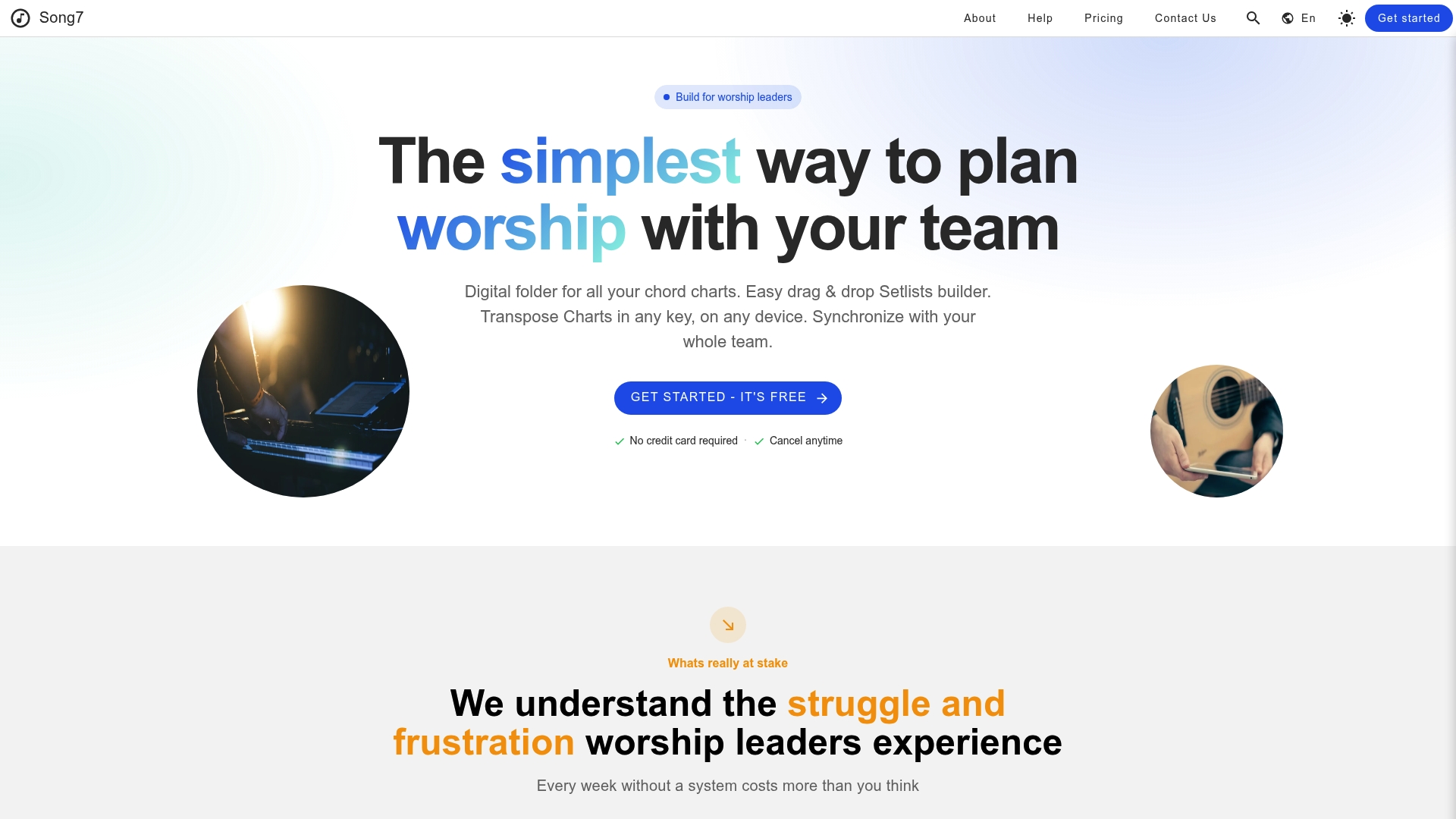
If you're ready to test it, the lowest-risk move is a pilot: use Song7 for one rehearsal and one Sunday service, with a backup plan in place in case anything needs troubleshooting. That gives your team a real trial run before you retire your old system for good. You can start by visiting the Song7 landing page to explore the platform and set up your team's first setlist.
Sources
For deeper detail on cloud collaboration, syncing, and testing before a live service, see church cloud collaboration guidance and testing presentation software in one rehearsal. For a broader look at presentation suite trade-offs, see EasyWorship reviews on G2.
- EasyWorship reviews on G2
FAQ
What is the best type of software to replace paper chord charts?
A setlist-first, cloud-enabled worship app is generally the best fit, since it combines chart storage, transposition, and team syncing in one place. Look for one with drag-and-drop setlist building and import support for ChordPro, plain text, or photo capture, so you can move your existing library over without retyping everything.
How do I move my church's song library to a new app?
Start by auditing your current songs and picking a small rehearsal set rather than migrating everything at once. Export files where possible, photograph any paper charts under even lighting, and import into your new app before testing the full setlist in a live rehearsal.
Can volunteers use these apps without much training?
Yes, the tools built specifically for volunteer teams, like Song7, are designed around low training burden, often needing only a short walkthrough to get started. A quick 10-minute onboarding script paired with a buddy system usually covers what a new volunteer needs to know.
Do these apps work offline during a service?
Most mobile and tablet-friendly worship apps offer offline access so a spotty Wi-Fi connection doesn't interrupt a service. It's worth confirming offline functionality during your pilot rehearsal, along with exporting a setlist PDF as a backup.
How is this different from multitrack audio software?
Multitrack audio software and digital audio workstations handle backing tracks and instrument stems, which is a different job entirely. The tools discussed here focus on organizing chord charts, building setlists, transposing keys, and displaying lyrics for a live volunteer team.