
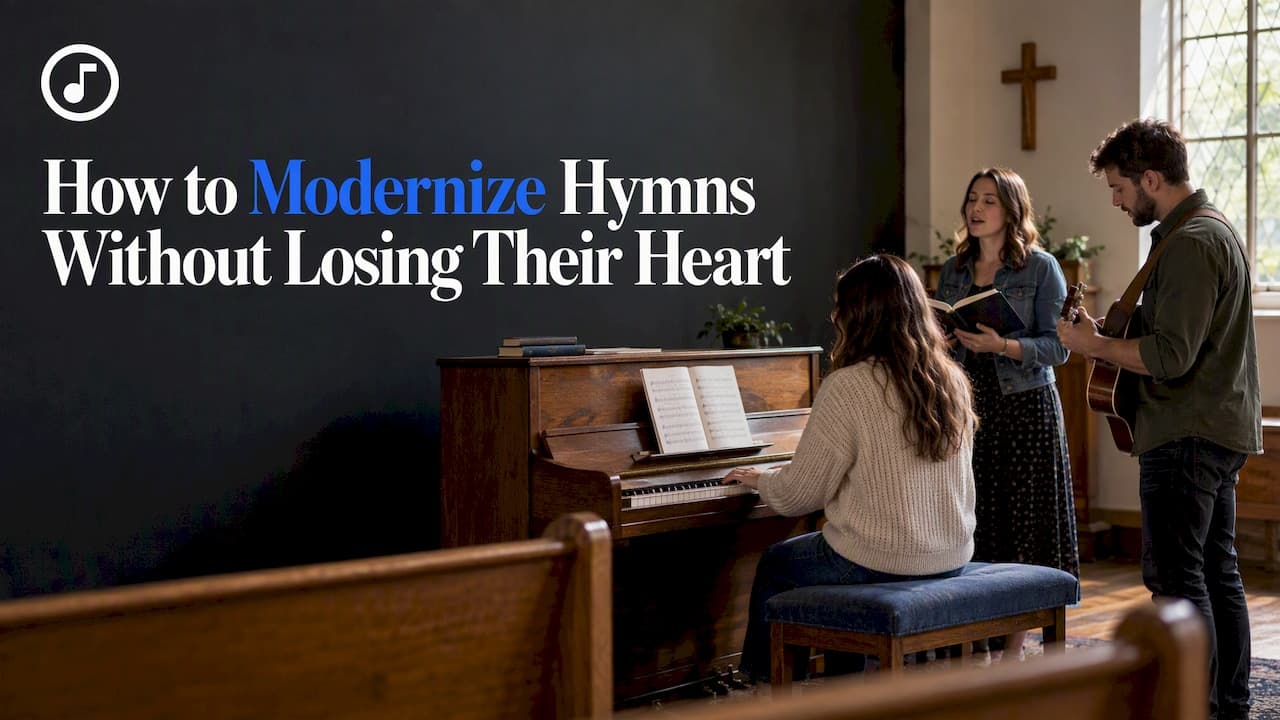
To modernize a hymn, keep the text and the tune your church already knows, then change the setting around them: simpler chords, a steady groove, dynamics that build, and a key people can actually sing. Resist the urge to rewrite everything. The best updates feel like the hymn was always meant to be played this way.
This guide walks you through the choices in order, from deciding what kind of update you want to testing it on a Sunday. It's written for volunteer worship leaders and small teams who have a piano, a guitar, maybe a drummer, and about one rehearsal a week.
TL;DR
- Decide first whether you are keeping the melody and changing the style, or keeping the words and writing a new tune. The first is far easier for a volunteer team.
- Simplify harmony: fewer chord changes, more space, and dynamics that move from quiet verses to fuller choruses or final verses.
- Choose the arrangement your congregation can sing, not the one that sounds most impressive on a recording.
- Public domain hymns are free to adapt, but a newer arrangement or modernized text may be copyrighted, so check before you print or project it.
- Keep your versions, keys and notes in one shared place so the whole team plays the same chart.
Table of Contents
- Two ways to update a hymn
- Start with the people who will sing it
- Simplify the harmony first
- Build dynamics instead of adding parts
- Avoid the pop trap
- Pick a key that congregations can sing
- Why bother with hymns at all?
- Our perspective: keep it simple, keep it shared
- Keep your arrangements in one place
- Check the copyright before you publish
- A simple process for your next hymn
- FAQ
- Sources
Two ways to update a hymn
Before you open a chord chart, name what you are trying to do. According to the Reawaken Hymns tutorial on modernizing hymns, there are two broad approaches: keep the original lyrics and write a new melody and musical setting, or keep the melody and structure and update the style, through instrumentation or tempo, for example.
For most small churches, the second path is the right one. Here is why:
| New tune, original words | Same tune, new style | |
|---|---|---|
| Congregation learning curve | Steep: it is effectively a new song | Gentle: people already know the melody |
| Team preparation | Needs writing, charting, teaching | Needs a chart and a feel |
| Risk | Older members may feel the hymn was replaced | Low, since the hymn is recognizable |
| Best for | Teams with a songwriter and time to teach | Volunteer teams with limited rehearsal |
Neither is wrong. A new tune can breathe life into a text that people have sung on autopilot for decades. But if you have one rehearsal and a Sunday coming, update the style and leave the tune alone.
Start with the people who will sing it
It is tempting to begin with a favorite recording. Start with your room instead.
Arranger Liz Garnett makes the point in her piece on choosing songs to arrange: the decision should rest on what your particular group can sing well, not on what sounds impressive in a vacuum. Her context is choirs, but it applies to a Sunday congregation just as well.
Ask yourself a few plain questions:
- Does the congregation already know this tune? A familiar melody gives you freedom to change the setting.
- How wide is the melody? A tune that spans an octave and a half will tire people out no matter how modern the band sounds.
- Who is playing? Two guitars and a cajón need a different chart than a full band with keys.
- How much rehearsal do you have? If the answer is thirty minutes, choose accordingly.
If you are adapting a score to fit a specific group and need ideas for trimming it down, this guide on quickly adapting a choir score to your group (in French) covers the same instinct: fit the music to the singers, not the singers to the music.
Simplify the harmony first
Many classic hymns are written in four-part harmony with a chord change on nearly every beat. On a piano or organ that sounds rich. Put a band behind it and it turns cluttered.

The Reawaken Hymns tutorial describes this as avoiding the busyness of constant harmonic motion, and suggests simplifying the progression and relaxing the rhythm of the melody so it sounds more natural to modern ears. It also recommends what it calls invisible mending: change chords or rhythm only to support the melody, and don't impose complicated syncopation. A practical rule from the same source is to limit chord changes to one per bar, or even one per two bars.
Here is how that looks in practice with a hymn in 4/4:
- Original: a different chord on each beat in the phrase.
- Updated: one chord per bar, with a passing chord only at the end of a phrase where the tune needs to land.
- Result: the melody stands out, the guitarist has room to strum, and the bass player can lock in.
This is also the easiest way to help a beginner guitarist. A hymn with four chords per line is hard to play; the same hymn with one chord per bar is something a volunteer can learn in an evening.
Build dynamics instead of adding parts
One reason older hymns feel flat in a band setting is that every verse sounds the same. Modern arrangements usually fix this with shape rather than complexity.
The Reawaken Hymns tutorial points to varied dynamics, quiet verses leading into bigger choruses, as part of the style-based approach. You can map it out simply:
- Verse 1: one instrument and voice. Piano or acoustic guitar only.
- Verse 2: add a light pad, bass or soft percussion.
- Chorus or refrain, if the hymn has one: full band, and bring the congregation in.
- Final verse: drop back to almost nothing, or hold the full sound and let the congregation carry the line.
We like pulling the band out on the last verse. When the room hears itself sing a familiar text with almost no accompaniment, something happens that no drum fill can replicate.
Hymns without a chorus can feel like they lack a lift. If that is your case, you have options. You can repeat the final line, or add a tag. Keep any new section short and singable, and tell the team in the chart exactly where it goes.
Avoid the pop trap
A common mistake is forcing a trendy pop rhythm onto a hymn. Robert Sterling warns that what works for a soloist in performance can become an "intelligible mush" for a large congregation of untrained singers. His advice is to aim for a natural, flowing line rather than copying the syncopation of a particular radio artist.
The test is simple: can a person who has never heard your arrangement clap along, find the downbeat, and sing the first line without help? If the answer is no, the rhythm is doing too much.
A few safe adjustments:
- Let the hymn's natural speech rhythm lead. Don't squeeze syllables into off-beat patterns.
- Use a steady strum or piano pattern and keep it going.
- Keep tempo in the range where the words are easy to pronounce. A built-in metronome during rehearsal helps the whole team settle on one tempo, and people tend to rush when they get excited.
- Avoid long instrumental intros that make people wonder when to come in. Four bars is plenty.
Pick a key that congregations can sing
Hymnals often print tunes in keys that suit trained choirs. Modern keys sit differently, and the key is the most overlooked part of any arrangement. If the melody climbs past the range of average voices, people stop singing and listen.
Transpose until the melody sits comfortably, then check the guitar chords you will be playing. Our guide on what key a worship song should be in walks through the range questions, and our piece on publishing the right key every Sunday covers how to make sure everyone on the team sees the same one. For pianists, how pianists support worship singing is a good companion read.
Why bother with hymns at all?
Some leaders worry that hymns will clash with a contemporary service. The experience of many churches suggests the opposite. According to Nic Cook at IBSA, hymnody can help bridge the generational gap, and even congregations that prefer contemporary music often find comfort and unity in familiar texts sung together.
The tune you keep is a bridge. Older members recognize it. Younger members hear the style they know. And the text, often rich with theology, carries weight that a lot of newer songs don't try to carry.
If you want an example of how a younger team approaches this, the ChurchLeaders piece Making All Things New describes a worship leader at a small church plant, mostly young attendees, building a set around updated hymns.
Our perspective: keep it simple, keep it shared
We build tools for small, volunteer-led worship teams, so we see the same pattern again and again. The arrangement itself is rarely what breaks a Sunday. What breaks it is logistics: the guitarist has an old chart in G, the pianist has the new one in A, and the singer left her notes in the car.
Modernizing a hymn creates more of that risk, because you now have a version that exists nowhere in a hymnal. Someone has to write down the new chord pattern, the key, the intro, and where the last verse drops out. If that lives in one person's head, you have a single point of failure.
Our advice, then:
- Choose fewer hymns and do them well. One carefully updated hymn per month beats five rushed ones.
- Write the arrangement down. Chords, key, tempo, and a short note on dynamics for each verse.
- Keep one version. Everyone plays from the same chart, and when it changes, everyone sees the change.
- Test with the congregation. If people sing louder on the hymn than on the song before it, you have done it right.
Worship leaders carry enough. The less time you spend on administration, the more you can spend praying for the people who will be in the room.
— Editorial team
Keep your arrangements in one place
Once you have a hymn arranged the way your team likes it, the work shifts to keeping it organized. In Song7 you can store the chart with your changes, transpose it for the singer, drop it into a drag-and-drop setlist, and have the team see updates instantly. It also imports from ChordPro, text or photos, so a hymnal page you have retyped does not have to be rebuilt by hand. Song7 is built for small volunteer teams, so there is little to configure.
If your library is getting large, our guide to organizing your church song library is a good place to start tagging hymns by season, theme and key.
Check the copyright before you publish
Traditional hymn texts and tunes are often in the public domain, which makes them a good place to start. The GIA arranging guide for small choirs recommends choosing a public domain piece, such as a hymn, if you don't want to ask permission from a copyright holder.
But "public domain" applies to the specific text or tune, not to every version of it. A few traps:
- Modernized lyrics. If someone updated "thee" and "thou" or rewrote verses, the new wording may be copyrighted even when the original is not.
- Published arrangements. A new chart or recording of an old hymn can be protected, even though the underlying hymn is free.
- Translations. A 2012 First Circuit decision, Society of the Holy Transfiguration Monastery v. Gregory, involved copied English translations of ancient religious texts. The summary shows that religious purpose alone did not make copying fair use.
- Dramatic uses. A comment filed with the U.S. Copyright Office points out the difference between nondramatic uses, such as ordinary congregational singing, and dramatic ones like staged productions, musicals or dance, which blanket licenses often don't cover. If your hymn update is part of a Christmas pageant, read your license terms first.
For your own church's license, ask the license provider or your church administrator what is covered. We summarize the common rules in CCLI lyrics rules: what you can and can't do. If you project or share lyrics offline, this guide to licensed offline worship lyrics may help. This is general information, not legal advice; for a specific question about a specific arrangement, contact the rights holder or the licensing organization.
A simple process for your next hymn
Here is a workflow you can use this month.
- Choose a hymn your congregation already knows. Skip the obscure verses for now.
- Pick the approach. For most teams: same tune, updated style.
- Find a comfortable key. Sing the melody yourself, then transpose.
- Thin the chords. One change per bar, or per two bars, wherever the tune allows.
- Shape the verses. Decide who plays when, and where the volume rises or falls.
- Write it down. Chart, key, tempo, intro, ending.
- Rehearse the transitions. Intro, last verse, and the move into the next song are where teams stumble.
- Sing it on Sunday and ask. Ask a few people, old and young, how it felt to sing.
If you need help fitting the hymn into a service flow, our small church worship planning guide covers rotating songs over a month so you don't repeat a hymn too often or let it go untouched for a year.
FAQ
Do I need to change the lyrics when I modernize a hymn?
No. Many teams keep the original words and change only the musical setting. If you do alter words, keep the meaning intact and check whether you are working from a public domain text or a copyrighted modern edition.
What makes a hymn work in a modern service?
A strong, singable melody and a text your congregation understands. Hymns with a simple tune and a moderate range are the easiest to update. Start with ones people already know, and let the band support the singing rather than compete with it.
How many chords should a modernized hymn have?
Fewer than the hymnal shows. A good starting point from Reawaken Hymns is limiting changes to one per bar, or one per two bars, and adding extra chords only where the melody needs them.
Can I share my own hymn arrangement with my team?
If the hymn is in the public domain and your arrangement is your own work, sharing it with your team is generally fine. If you base it on someone else's published arrangement, or on updated lyrics, the rights may belong to someone else, so check first.
Sources
- Modernizing Hymns Tutorial, Reawaken Hymns
- On Choosing Songs to Arrange, Helping You Harmonise
- Reintroducing Hymns in Contemporary Styles, Robert Sterling Music
- Modern Hymn Arrangements, IBSA
- Making All Things New: Hymns Modernized, ChurchLeaders
- Arranging for Small Choir, GIA Institute
- Society of the Holy Transfiguration Monastery v. Gregory, U.S. Copyright Office fair use summary
- Musical Works comment, U.S. Copyright Office Music Licensing Study