
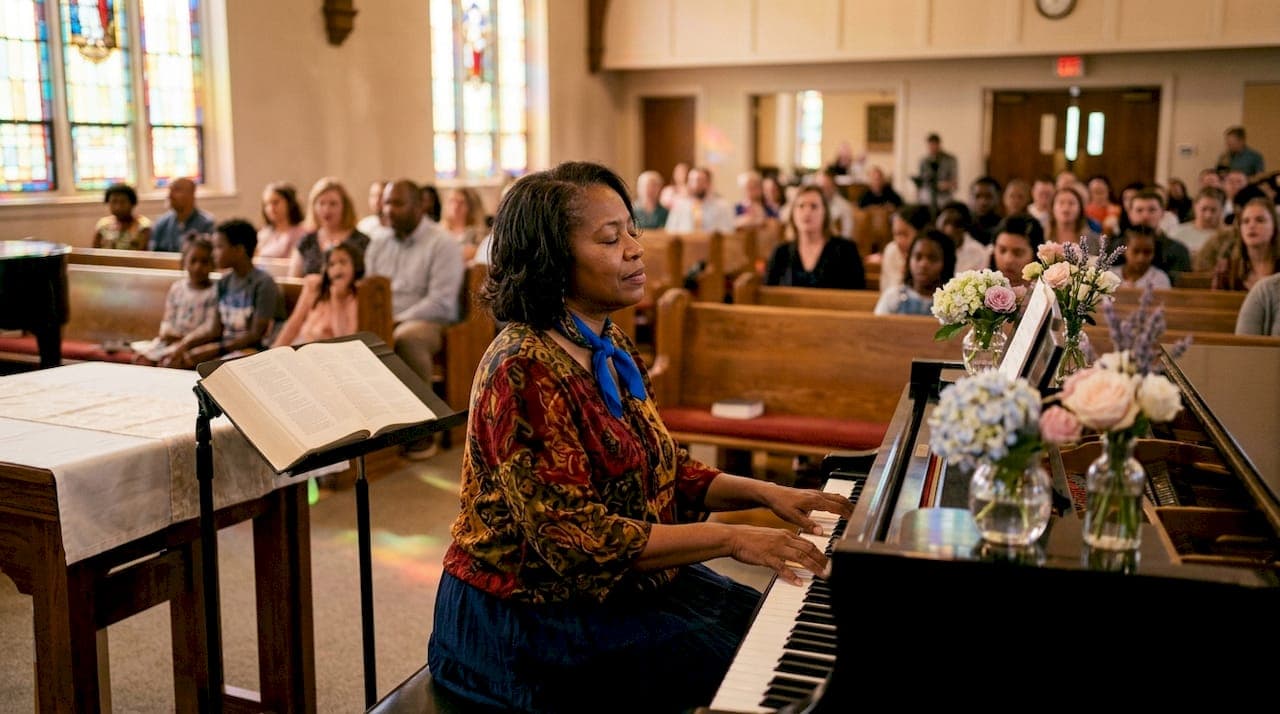
The pianist's role in worship is defined as accompaniment that serves the congregation's voice, not the musician's skill. How pianists support worship singing comes down to one principle: the piano exists to hold the room together, not to perform. The best worship pianists create a steady, clear musical foundation that gives every person in the room the confidence to open their mouth and sing. That requires specific techniques, service awareness, and a willingness to play less than you are capable of.
What musical techniques do pianists use to support congregational singing?
Effective accompaniment is built on steady pulse and clear harmonic rhythm. When the pulse and harmony are predictable, singers relax and participate more confidently. That predictability is not boring. It is the foundation that makes communal singing possible.
The conversation model is the clearest way to understand the pianist role in worship. Piano and voice work like conversation partners, with the piano leaving space during the melody and filling the rests. When the congregation is singing, the piano steps back. When the congregation breathes, the piano fills. That back-and-forth creates a living, breathing musical texture rather than a wall of sound.
Voicing choices matter more than most worship leaders realize. Intentional voicing avoids crowding the vocal midrange, spreading sounds across the keyboard to prevent muddiness. A pianist who stacks chords in the middle register competes directly with the congregation's voices. Spreading the left-hand lower and keeping inner voices open gives singers room to be heard by themselves and by others.
Chord inversions add fullness without creating a cloudy tone. Inversions work best when chords last at least two measures and the piece is in 4/4 time with clear accents. Excessive root-position chords create a heavy, plodding sound. Inversions keep the bass line moving and the harmony feeling alive.
Here are the core worship music piano techniques that directly support congregational singing:
- Steady pulse. Never rush or drag. The congregation follows the pianist's rhythmic lead, even when a worship leader is singing.
- Simplified texture during melody. Thin out the right hand when voices are active. Add texture only in instrumental passages.
- Open voicing. Keep the left hand below middle C and avoid stacking too many notes in the 250–500 Hz range where voices live.
- Dynamic balance. Play softer than feels natural. The congregation needs to hear itself, not just the piano.
- Fill the rests. Use phrase endings and breath points to add brief melodic or harmonic fills that guide singers into the next phrase.
Pro Tip: Record yourself accompanying a vocalist and listen back without watching. If the piano feels louder than the voice at any point, reduce your dynamic level by at least one notch.
How do pianists adapt their role within different moments of a worship service?
The pianist role in worship is not static. Each part of a service calls for a different approach, and different service moments require distinct playing styles. A pianist who plays the offertory the same way as the meditation is missing the point of both.
- Prelude. The prelude prepares the congregation for worship. Clear, calm melodies with moderate tempo and simple harmonies set a focused, expectant atmosphere. The goal is to quiet the room, not entertain it.
- Congregational hymns and songs. This is the core accompaniment role. Steady pulse, supportive harmony, and dynamic sensitivity to the room are the priorities. The pianist listens as much as plays.
- Offertory. The offertory allows more expressive playing. The congregation is seated and reflective, so the pianist can use fuller arrangements, more rubato, and richer harmonic color without disrupting singing.
- Meditation or prayer. Sparse, restrained playing works best here. Single-line melodies, open chords, and long sustain create space for reflection. Less is almost always more.
- Postlude. The postlude is celebratory and full. This is the one moment where the pianist can play with energy and complexity, because the congregation is transitioning out rather than singing together.
The key insight is that the pianist's awareness of service context shapes every musical decision. A worship leader who communicates the emotional arc of the service to the pianist before the service begins will hear a dramatically better result than one who hands over a setlist and expects the pianist to figure it out.
How do modern worship pianists manage complex arrangements without disrupting singing?
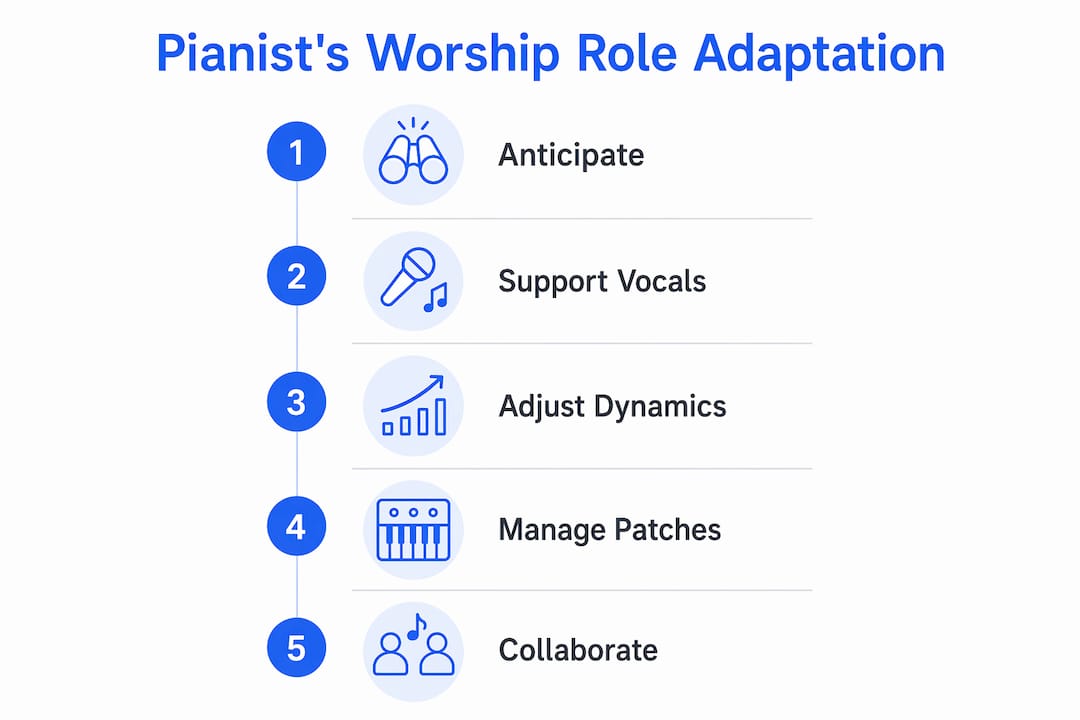
Modern worship settings often require pianists to manage multiple sounds at once. Layering piano with pads and synthesizers adds depth to the worship soundscape without adding complexity to what the congregation hears. The congregation experiences richness. The pianist manages the technical side invisibly.
Patch changes are the most disruptive element in a modern keys setup if handled poorly. Timing patch changes during sustained chords or spoken transitions eliminates audible gaps. A patch change during a vocal phrase is jarring. A patch change during a 4-bar instrumental break or a pastoral prayer is invisible.
Keyboard splits let a single pianist cover multiple roles without complicating the texture. The left hand might carry a pad sound while the right hand plays a piano patch, giving the worship band a fuller sound without requiring an additional musician. This is especially practical for smaller churches with limited teams.
- Layer thoughtfully. Add pads beneath piano to create warmth, but keep pad volume low enough that the piano's rhythmic clarity still drives the groove.
- Plan patch changes in advance. Mark patch changes on your chord chart at the exact measure where they occur. Never improvise a patch change mid-song.
- Use splits for dual roles. A split between a pad on the left and a lead sound on the right covers two sonic roles without doubling the cognitive load.
- Avoid abrupt texture changes. Fade pads gradually rather than cutting them. Sudden sonic shifts pull the congregation's attention away from worship.
Pro Tip: Map out every patch change on your setlist before rehearsal. Song7's chord chart tools let you annotate arrangements directly on the chart so your whole team sees the same plan.
What factors influence congregational singing volume and participation?
Loud volumes actively hinder congregational singing by preventing singers from hearing themselves or the people next to them. This is a counterintuitive truth that many worship teams miss. Turning up the band does not make the congregation sing louder. It makes them stop singing.
The pianist's dynamic level is one of the most direct levers for controlling congregational participation. A pianist who plays at a moderate volume gives singers the confidence to hear their own voice. That confidence produces more singing, not less. The accompaniment that looks simple and predictable is the accompaniment that holds the room together.
Coordination with the sound team is equally important. Singers need to hear themselves in the room and in the monitors. When the piano is too loud in the front-of-house mix, it masks the congregation's voices. When the worship leader's vocal is too low in the monitors, the congregation loses its melodic guide. The pianist, the sound engineer, and the worship leader need to agree on a mix that serves singing, not performance.
"Supportive accompaniment looks simple and predictable, less like a solo performance and more like facilitation." This is the standard every worship pianist should hold themselves to.
Shared cues and pre-service planning make a measurable difference. When the pianist knows where the worship leader plans to extend a chorus, repeat a verse, or drop to a quiet moment, the accompaniment can respond rather than react. That responsiveness is what separates a worship pianist from a piano player who happens to be in a church.
Key Takeaways
The most effective pianist in worship is the one the congregation never notices, because the singing feels natural, confident, and unified.
| Point | Details |
|---|---|
| Accompaniment serves the voice | Treat piano as a conversation partner to the congregation, filling rests and stepping back during melody. |
| Voicing prevents muddiness | Keep left hand low and avoid stacking notes in the vocal midrange to give singers clarity. |
| Service context shapes playing | Adjust style from restrained meditations to celebratory postludes based on the moment's purpose. |
| Patch changes need planning | Time sound changes during sustained chords or transitions so the congregation never hears a disruption. |
| Volume control drives participation | Playing at a moderate dynamic level lets singers hear themselves, which directly increases congregational singing. |
The servant musician: a harder role than it looks
The hardest adjustment for a classically trained pianist entering worship is accepting that restraint is the skill. Classical training rewards complexity, ornamentation, and technical display. Worship piano rewards invisibility. Classically trained pianists often struggle in contemporary worship settings because the music demands flexible improvisation rather than faithful notation reading. That is a genuine challenge, and it takes time to rewire.
What I have found, working with worship teams over many years, is that the pianists who thrive in worship are the ones who listen more than they play. They breathe with the vocalist. They watch the worship leader's body language. They react to what the congregation is actually doing, not what the chart says should happen. Top worship pianists function as anchors who open space at key moments and respond to live congregational dynamics rather than playing fixed patterns.
The uncomfortable truth is that playing less takes more musical intelligence than playing more. Choosing the right two notes instead of five, leaving a measure empty when the congregation is singing with full voice, resisting the urge to fill every silence. These are decisions that require real musicianship. They just do not look impressive from the outside.
My encouragement to every worship pianist is this: measure your success by the congregation's voice, not your own. If the room is singing loudly and confidently, you did your job. If the room is quiet while you play beautifully, something has gone wrong.
— Henning
How Song7 helps pianists and worship teams stay coordinated
Keeping a worship team coordinated across setlists, chord charts, and arrangement notes is one of the most practical challenges pianists and worship leaders face every week. Song7 is built specifically for this.

With Song7's setlist builder and worship tools, pianists can annotate chord charts with patch changes, dynamic cues, and arrangement notes that every team member sees in real time. The built-in metronome, chord diagrams, and presentation mode mean the whole team works from the same page, literally. For volunteer-based teams and small churches, that coordination reduces errors and frees musicians to focus on the congregation rather than logistics. Song7 handles the planning so you can focus on the worship.
FAQ
What is the main role of a pianist in worship?
The pianist's main role is to support congregational singing through steady, clear accompaniment that prioritizes the vocal message. The piano holds the room together rhythmically and harmonically so singers feel confident.
How can a pianist make the congregation sing louder?
A pianist makes the congregation sing louder by playing at a moderate volume, maintaining a predictable pulse, and keeping the accompaniment simple. Loud piano playing prevents singers from hearing themselves, which reduces participation.
What piano techniques help with supporting congregation singing?
The most effective techniques are open voicing to avoid the vocal midrange, chord inversions for fullness, simplified texture during active melody, and dynamic fills during rests. These techniques create space for voices rather than competing with them.
How should a pianist handle patch changes in modern worship?
Patch changes should be planned in advance and timed during sustained chords, instrumental breaks, or spoken transitions. Unplanned patch changes during vocal phrases create audible disruptions that pull the congregation's attention away from worship.
How does a pianist's role differ across a worship service?
The pianist plays calmly and simply during preludes and meditations, with more expression during offertories, and with full energy during postludes. Each service moment calls for a different dynamic and textural approach.