
If you need real-time collaboration and cross-device access, choose a collaboration-first reader like Newzik. If you're on Android or Windows, MobileSheets is the closest thing to a full replacement. If your world is chord charts and volunteer musicians instead of orchestral parts, a purpose-built tool like Song7 solves a different problem than forScore ever tried to.
TL;DR:
- Cross-platform collaboration apps like Newzik are ideal for groups needing real-time shared annotations but are too complex for solo performers focused on quick page turns.
- Android and Windows users should consider MobileSheets, but must verify device compatibility beforehand because app stability and features can lag behind iOS versions.
- Apps integrated with sheet music stores simplify buying and opening music directly on stage, though they often lack advanced annotation tools compared to dedicated readers.
- For worship teams managing chord charts and setlists, tools like Song7 offer instant transposition and simple sharing, prioritizing ease of use over orchestral notation features.
- Always run a short trial covering import, annotation, offline use, and setlist creation before switching to ensure full compatibility with your workflow needs.
Table of Contents
- Best ForScore Alternatives by Category
- What to Check Before You Commit to a Replacement
- How to Test a ForScore Replacement Before You Switch
- Why Worship Teams Need a Different Kind of ForScore Alternative
- When to Keep ForScore and When to Actually Switch
- Song7: A Practical Alternative for Worship Leaders and Volunteer Ensembles
- Sources
- FAQ
Best ForScore Alternatives by Category
There isn't one "best" replacement for forScore, because forScore isn't really one thing. It's a PDF reader, an annotation tool, a page turner, and a library manager, all bundled for solo iPad musicians who read notated scores. The moment you add a second platform, a rehearsal team, or a different kind of musical document (like a chord chart instead of a score), the calculus changes.
Here's how the field actually breaks down.
Collaboration-first, cross-platform readers
Apps like Newzik target ensembles, conservatories, and touring groups that need everyone looking at the same annotated part, updated live. Newzik runs on iOS, Android, and the web, and it layers in optical music recognition and AI-driven transposition on top of real-time syncing. That combination matters for a conductor who marks a bowing change during rehearsal and needs the whole string section to see it instantly, not email it around afterward.
The trade-off is complexity. A tool built for institutional libraries and shared annotation layers asks more of a new user than a single-purpose iPad reader does. Solo performers who just want a fast, reliable page turner during a recital often find the collaboration machinery unnecessary.
Best for: ensemble conductors, chamber groups, conservatories, and anyone who rehearses with people who don't all own iPads.
Android and Windows replacements
forScore is Apple-only, full stop, and that single fact eliminates it for a huge slice of working musicians. MobileSheets is the app reviewers point to most often here, and it earns that reputation with a genuinely deep feature set: large library handling, layered annotations, setlists, and foot pedal support across both Android tablets and Windows laptops.
The catch is one every Android musician should internalize before buying: several well-regarded sheet-music readers remain iOS-exclusive, and the Android ports that do exist can lag behind their iOS counterparts in stability or feature parity. Test on your actual tablet model before a gig depends on it, not after.
Best for: Android tablet owners, Windows laptop users at the piano, and anyone who refuses to be locked into Apple hardware for a music stand.
Score-store and library-integrated apps
Some musicians care less about annotation depth and more about frictionless access to purchased sheet music. These apps integrate directly with a publisher's or retailer's catalog, so buying a piece and opening it on stage happens inside one ecosystem. They tend to trail dedicated readers on annotation tools and page-turn customization, but they remove the PDF-wrangling step entirely for musicians who buy most of their music from one source.
Best for: musicians who purchase heavily from a single sheet music retailer and prioritize a direct buy-to-stand pipeline over deep markup features.
Niche practice and education tools
Music teachers and students often need something forScore was never built for: metronome integration, practice logging, or classroom-wide assignment distribution. A tool like Allegro fits this niche, built around the weekly rhythm of a private studio rather than the concert stage. These apps sacrifice orchestral-grade annotation for classroom logistics, which is exactly the right trade for a teacher managing twenty students instead of one performance.
Best for: private instructors, studio owners, and school music programs.
Worship and volunteer-team tools
Worship leaders have a fundamentally different job than a classical performer reading a Beethoven sonata. They're managing chord charts, not notated scores. They're syncing a setlist across a drummer, two guitarists, and a vocalist, most of whom are volunteers with five minutes to glance at their phone before sound check starts. Song7 was built around that job specifically, with drag-and-drop setlist building and instant chord transposition rather than OMR or bowing annotations.
Here's a quick way to match your situation to a category:
- Solo iPadist reading notated scores — a polished iPad-only reader remains the strongest single-user option, and long-running reviews from outlets like Scoring Notes still treat that category as the reference point.
- Ensemble conductor or chamber group — go collaboration-first with cross-platform syncing.
- Android or Windows user — MobileSheets, tested on your specific device before you commit.
- Music educator or studio owner — a niche practice/classroom tool built for lesson logistics.
- Worship leader or volunteer band — a purpose-built chord chart and setlist tool.
Migration reality check: PDFs move between apps without much drama. Your annotations usually don't. Independent migration write-ups consistently warn that proprietary markup formats rarely survive a jump from one vendor to another, which means your fingering marks and cues need re-entry in whatever app you land on. Budget time for that before you fully commit.
What to Check Before You Commit to a Replacement
A feature list on a marketing page tells you what an app claims. A short checklist during a trial tells you what it actually does. Here's what to verify, organized by the categories that separate a genuinely capable replacement from one that looks good in a screenshot.
Platform support and sync
- Does it run natively on your device, or is it a stretched-out phone app pretending to be a tablet app?
- Does syncing happen automatically across devices, or does it require manual export/import every time?
- Is there a web version for quick access from a laptop during planning?
Collaboration features
- Can you share a library with other members without emailing files?
- Does live annotation broadcast to everyone's screen in real time, or only after a manual push?
- Are there classroom or ensemble controls, like locking a student's screen to a specific piece?
Annotation tools
- Are annotations layered, so you can toggle a "fingering" layer separately from a "cue" layer?
- Do stamps and shapes import and export cleanly, or only as flattened images?
- Can you export a fully marked-up PDF to send to a substitute player?
Performance readiness
- Does the app support a Bluetooth page-turn pedal out of the box?
- Is there an autoturn feature that reads ahead based on tempo?
- Does it survive a dropped connection mid-performance, or does a lost signal freeze the screen?
Score processing
- Does optical music recognition actually extract usable, editable notation, or just a static image?
- Can you extract individual parts from a full score automatically?
- Does it import and export MusicXML, so your work isn't locked into one company's format forever?
Library and setlist tools
- Can you tag and search a library of hundreds of pieces by composer, key, or difficulty?
- Does building a setlist take drag-and-drop seconds or a multistep menu process?
- Are batch operations (renaming, tagging, moving files) supported, or is everything one file at a time?
Pricing model
- Is it a one-time purchase, a subscription, or a hybrid with optional paid add-ons?
- Does an institutional or team license exist, and how is it priced per seat?
forScore itself is worth naming here as the baseline: it's sold through the App Store as a one-time purchase, with an optional forScore Pro subscription layered on top for extra features, and it syncs through iCloud for Apple devices only. Every alternative you test should be measured against that specific structure, not a vague sense of "forScore is expensive" or "forScore is cheap."
Pro Tip: Don't judge an app's collaboration claims from the product page. Create a free account, invite one bandmate, and have them mark up a page live while you watch it update on your screen. That thirty-second test reveals more than any feature comparison chart.
How to Test a ForScore Replacement Before You Switch
Switching your entire music library to a new app on a whim is how gigs go wrong. Run a real trial first, and keep it short enough that it doesn't become its own project.
Start with a requirements checklist. Separate the essential items (pedal support if you gig live, offline access if your venue has spotty Wi-Fi) from the nice-to-haves (dark mode, custom stamp colors). An app that fails an essential is disqualified regardless of how good everything else looks.
Then run five specific tests, all doable inside a thirty-minute session:
- Import and annotate a real PDF. Use an actual piece from your library, not a demo file, and mark it up the way you would before a real rehearsal.
- Test the page-turn pedal. If you perform live, this is non-negotiable. A half-second lag is the difference between a smooth transition and a visible fumble.
- Share an annotation with someone else. Send a marked-up page to a bandmate or section partner and confirm they see your exact markup, not a stripped-down version.
- Turn off Wi-Fi and keep working. Reviewers consistently recommend this offline check as one of the most useful trial tests because a sync-dependent app that can't function without a signal will fail you exactly when a venue's network drops.
- Search your library and build a setlist from scratch. Time how long it takes. If it's slower than flipping through a paper folder, that's a real problem.
Before you commit fully, ask the vendor directly: can you export everything if you leave? What does onboarding look like for a group of ten or twenty people? Is there a discounted institutional or team rate?
Watch for red flags that should stop a migration cold: annotations that silently disappear on export, a pedal that only half-works, or support that goes quiet for days when you report a bug. A practical migration pattern that works well for ensembles is piloting with a single section first, exporting PDFs and re-annotating only the markings that matter for the next rehearsal, rather than trying to convert an entire 500-piece library overnight.
Why Worship Teams Need a Different Kind of ForScore Alternative
Worship leaders aren't managing Brahms symphonies. They're managing a chord chart in the key of G, a setlist for Sunday, and a rhythm section made up of volunteers who show up an hour before service with their phones half-charged. That's a different job than the one forScore, Newzik, or MobileSheets were designed around, and it calls for different priorities entirely.
The features that actually matter for this audience look like this:
- Drag-and-drop setlist building that doesn't require a training session to use.
- Instant chord transposition, so a vocalist's key change doesn't derail the whole band.
- Real-time syncing that pushes updates to every team member's device the moment a leader changes something.
- A presentation mode built for lyrics and chords on a screen, not dense orchestral notation.
- Import options that handle ChordPro files, plain text, or even photos of a handwritten chart.
For volunteer teams, simplicity beats feature depth almost every time. A tool that takes fifteen minutes to teach a new volunteer wins over one with a longer feature list but a steeper learning curve, because the person you're onboarding on a Tuesday night might be leading worship by Sunday.
If you want to see whether Song7 fits your team, here's a ten-minute test: import one chord chart, build a setlist for next Sunday, invite one volunteer to your team, and run through presentation mode once from a phone or tablet. That single loop tells you almost everything about whether the workflow clicks for your church, and resources like Song7's guide to sharing setlists with a team walk through the exact steps.
When to Keep ForScore and When to Actually Switch
Most of the "should I switch" anxiety around forScore comes from treating it as a binary decision. It rarely is. Three realistic paths exist, and the right one depends on how your team actually works, not on which app has the longest feature list.

Stay with forScore if you're a solo iPadist performing notated scores and nothing about your workflow has changed. It's still a well-built, single-purpose tool, and switching for the sake of switching wastes rehearsal time you don't have.
Partial adoption makes sense when one part of your group has needs forScore can't meet. A conductor might keep forScore for personal score study while the ensemble uses a collaboration-first tool for shared rehearsal marks. That's not indecision. That's matching the tool to the task.
Full migration is worth the disruption when your core workflow has genuinely outgrown a single-user iPad reader, whether that's an ensemble needing live collaboration, an Android section that can't run forScore at all, or a worship team that never needed notated scores to begin with.
Cost matters here too. A one-time purchase model, like forScore's, front-loads the expense without recurring fees. A subscription model spreads cost out but adds it up over years. Run a short pilot, three to four weeks, with one section or team, before rolling a new app out to everyone.
— Editorial team
Song7: A Practical Alternative for Worship Leaders and Volunteer Ensembles
Song7 isn't trying to be a better forScore. It's built for a different job entirely: getting a volunteer worship team organized and synced without asking anyone to learn a complicated system. That's the specific gap Song7 fills for churches, and it's why worship leaders comparing sheet music apps keep landing on a tool that skips the orchestral features they never needed in the first place.
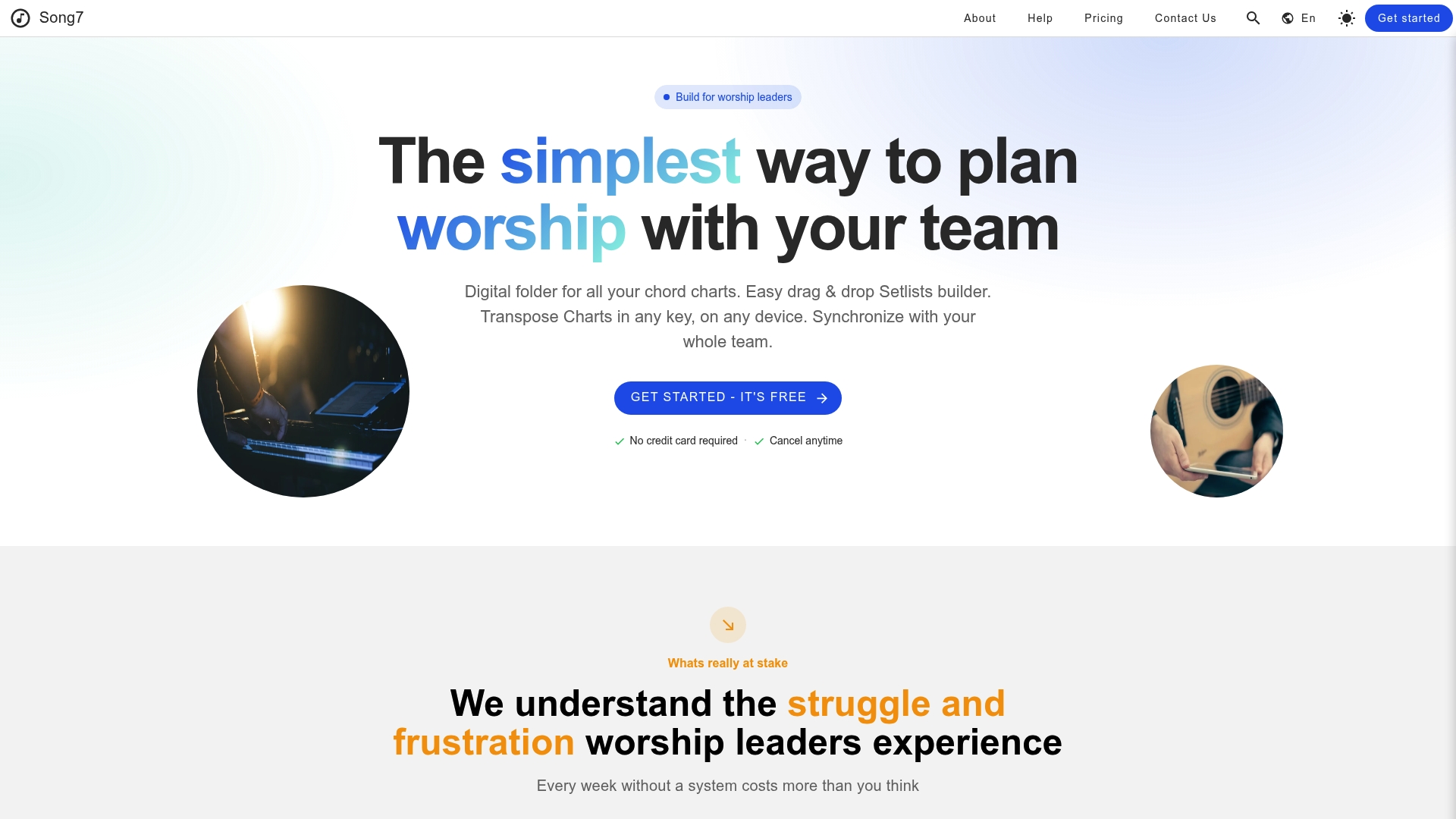
The core of it is simple. You build a setlist by dragging songs into place. Chord charts transpose instantly when your vocalist needs a different key on a Thursday-night whim. Updates sync to your whole team the moment you make them, so nobody shows up Sunday morning with last week's version. Presentation mode handles lyrics and chords cleanly on any screen, and import options pull in ChordPro files, plain text, or even a photo of a handwritten chart your guitarist scribbled after practice.
Try it in ten minutes: import one chord chart, drag together a setlist for your next service, invite a single volunteer to your team, and click into presentation mode. If that loop feels lighter than your current workflow, that's the whole pitch. For more on getting your team moving quickly, Song7's rehearsal sync guide and its chord chart conversion resource both walk through the early steps. Start a trial at Song7 and see how your next setlist comes together.
Sources
For deeper platform comparisons and independent testing, Scoring Notes offers long-running iPad reader reviews, while Practis covers Android and Windows options in detail. For Android-specific stability concerns, Michal Waligora's field notes are worth a read before buying hardware. General format and annotation portability issues are covered at Tablets for Musicians.
- The best iPad score reader for most people 2023 update - Scoring Notes
- forScore Alternatives for Android and Windows (Because forScore Is Apple-Only) | Practis Blog
- Using an Android tablet as a musician | Michal Waligora
- forScore | Support
FAQ
Is there a better app than forScore?
"Better" depends entirely on your use case. For a solo iPad performer reading notated scores, forScore remains a strong, polished option according to long-running reviews from Scoring Notes, but ensembles needing live collaboration or Android users locked out of forScore entirely will find better fits elsewhere.
What is the best app for sheet music on iPad?
For solo performers on iPad, forScore is still frequently named the reference point by independent reviewers, while Newzik is the stronger pick if you need real-time collaboration across a group. The right choice depends on whether you're performing alone or coordinating with other musicians.
Is there a free version of forScore?
forScore does not offer a free tier. It's sold as a one-time App Store purchase, with an optional forScore Pro subscription available for additional features on top of the base app.
Is Newzik better than forScore?
Newzik isn't strictly better, it's built for a different scenario. It adds cross-platform access, real-time collaboration, and AI-driven transposition that forScore's single-user, iPad-only design doesn't attempt to match, but a solo performer who never needs to share annotations may not need those features at all.
What should worship teams use instead of forScore?
Worship teams typically need chord chart management, instant transposition, and volunteer-friendly syncing rather than notated score annotation, which is a different job than forScore was built for. Song7 is designed specifically around that workflow, with drag-and-drop setlists and presentation mode built for a Sunday service rather than a concert stage.