
If you're outgrowing OpenSong, start with Song7 for its simple, synced setlists, then test OpenLP or FreeShow if you want a free, open-source route, and ProPresenter or MediaShout if your team handles heavy media. Quelea, VideoPsalm, Proclaim, OpenWorship, Slipity, and ZionWorx round out a solid shortlist because together they cover every budget, platform, and skill level a volunteer team might have. The right pick depends on what your setup actually needs, so let's break each one down.
TL;DR:
- Open-source tools like OpenLP and Quelea are free options suitable for teams with limited budgets and technical skills, but lack some of the advanced media features of paid options.
- Song7 offers real-time sync, simple import options, and live presentation tools, making it ideal for volunteer teams transitioning from file-based workflows.
- Cost-effective solutions should be chosen based on platform compatibility, import formats, offline reliability, team collaboration features, and available support or community resources.
- Migration from OpenSong should be done gradually by backing up files, testing small imports, and verifying formatting before full transition to minimize service disruptions.
- Paid platforms like ProPresenter and MediaShout provide advanced media handling and dedicated support, better suited for larger, media-heavy services.
Table of Contents
- Shortlist: platform-specific notes and quick facts for each alternative
- How to choose the right alternative for your team
- Practical migration checklist: move songs, setlists, and displays from OpenSong
- Song7: publisher E-E-A-T showcase and when to pick it
- User interface and ease of use comparison
- Feature comparison matrix highlighting key functionalities
- Customer support and community engagement for each alternative
- Integration capabilities with other music tools or services
- Reviews or testimonials from actual users
- Pricing details and comparison of paid alternatives
- Free versus paid: what actually matters for worship teams
- Try Song7 for your next worship set
- Sources
- FAQ
Shortlist: platform-specific notes and quick facts for each alternative
Song7 is a browser-based SaaS tool built for worship teams who want setlists to stay in sync without a technical point person. It runs anywhere a browser does, works on a subscription model with a free trial, and offers features like drag-and-drop setlist building, transposition, import capabilities, chord diagrams, presentation mode, and rehearsal tools. For a church coming from OpenSong's file-based habits, the appeal is that a setlist change made on one device shows up everywhere else instantly, so nobody hands out a stack of paper before Sunday.
From there, the field splits into open-source projects and commercial products, and each has its place.
- OpenLP: free and open-source, runs on Windows, macOS, and Linux, and connects to PowerPoint and VLC, which suits a team with a desktop-driven projector setup and a volunteer tech who likes granular control, according to SaaSHub's OpenSong alternatives list.
- FreeShow: free and open-source, delivered through the browser or as an installable app, and built to compete with pricier presentation tools while keeping setup friction low for smaller teams.
- ProPresenter: a paid, professional-grade platform with advanced media playback and timing tools, best suited to larger churches running multi-camera or video-heavy services with a dedicated operator.
- EasyWorship: a paid, Windows-only tool with strong scripture and media library integration, a natural fit for churches already standardized on Windows machines.
- Quelea: free and open-source, built in Java so it runs across operating systems, and focused on simple, stable lyrics projection rather than heavy media features.
- VideoPsalm: free, with support for multiple Bible translations and flexible song imports, which helps multilingual congregations or churches that inherited songs in mixed formats.
- MediaShout: an established paid product with a mature feature set and vendor support, aimed at churches that want a phone number to call when something breaks.
- Proclaim (Faithlife Proclaim): cloud-first, with a free tier for small teams and built-in Faithlife library integrations, so scripture slides and media assets stay centralized.
- OpenWorship: an open-source project with a dual-window preview, OCR import for scanned lyric sheets, and cross-platform builds for macOS, Windows, and Linux, documented on its project repository.
- Slipity: a lightweight, portable presentation tool suited to small ensembles or bands that move between venues and need minimal setup time.
- ZionWorx: a professional presentation tool with flexible licensing, aimed at groups that want a traditional, polished workflow without an open-source learning curve.
Each of these covers a different combination of budget and platform, which is exactly why a side-by-side test matters more than picking on reputation alone.
How to choose the right alternative for your team
The right tool depends on six practical factors, not on which name comes up most in a forum thread.
- Platform and projector support: confirm the tool runs on your existing hardware and outputs correctly to your projector or second display.
- Import formats: check whether it accepts ChordPro, plain text, or scanned PDFs, since that determines how much manual retyping your migration will need.
- Offline reliability: verify the app still runs a rehearsal or service if the internet drops, and check for built-in rehearsal tools like a metronome or transpose function.
- Team features: look for real-time syncing and simple role permissions so volunteers can update without stepping on each other's changes.
- Cost and licensing: weigh a free, open-source tool's zero cost against a subscription's ongoing support and updates.
- Support and community: an active repository or documentation page matters as much as a vendor helpdesk when something goes wrong on a Saturday night.
Pro Tip: Load one full worship set, including a scripture slide and a media cue, into your top candidate before rehearsal so any formatting surprises show up when you can still fix them.
Practical migration checklist: move songs, setlists, and displays from OpenSong
Moving off OpenSong doesn't have to happen all at once, and rushing it is how a Sunday goes sideways.
- Back up your OpenSong folder and export lyrics and chords as plain text or ChordPro where the format allows it.
- Pick one candidate platform and import a small test set, maybe five songs plus one media file, rather than your entire library.
- Check formatting closely: fonts, chord alignment above lyrics, and verse or chorus markers often shift during import.
- Confirm scripture display formatting matches what your congregation is used to seeing.
- Test the projector or multi-monitor output during a rehearsal, not for the first time during a live service.
- Keep your OpenSong setup available as a backup for at least one full service in case anything needs a quick rollback.
For more on preserving chord structure during a move, our guide on offline worship lyrics and ChordPro workflows walks through formatting before import.
Song7: publisher E-E-A-T showcase and when to pick it
Song7 was built around the exact tasks OpenSong users already do, just synced. That means setlist building, instant transpose, ChordPro and text import, chord diagrams, a presentation mode for live display, and a metronome for rehearsal, all updated in real time across every team member's device.
- Setlist building: drag-and-drop ordering that updates for the whole team the moment you save it.
- Import flexibility: bring songs in from ChordPro, plain text, or photos instead of retyping a library.
- Rehearsal tools: a built-in metronome and instant transpose keep practice sessions moving without extra apps.
The ideal user is a small-to-medium volunteer-led team that wants setlists and chord charts to stay current without assigning someone the job of syncing files by hand. If your current OpenSong workflow already lives in text files and shared folders, this is the closest thing to what you're used to, minus the manual updates.
Pro Tip: Run your next rehearsal with Song7 open alongside your current setup, and compare how long it takes each volunteer to find and transpose a song.
User interface and ease of use comparison
Interface complexity varies more than most churches expect, and it's usually the deciding factor for volunteer teams over any single feature. Song7 and FreeShow lean toward clean, browser-first layouts that a new volunteer can learn in a few minutes, since neither requires installing software or learning a desktop-style menu system. OpenLP and OpenWorship, being open-source desktop applications, offer deep configuration options but ask more of the person setting them up, particularly around output screens and projector mapping.
ProPresenter and MediaShout sit at the more complex end, with layered menus built for an operator running multiple media layers during a service, which pays off for larger productions but can overwhelm a first-time volunteer. EasyWorship and Proclaim land in the middle: both use fairly standard, list-based interfaces that longtime OpenSong users tend to pick up quickly since the mental model, a song list feeding a display screen, stays familiar.
Quelea and VideoPsalm keep their interfaces intentionally plain, which suits their focus on straightforward lyrics projection over flashy production. The pattern holds across the board: the simpler the interface, the faster a rotating volunteer roster can take over without a training session.

Feature comparison matrix highlighting key functionalities
The table below reflects the core functions each tool is actually built around, since a feature list alone doesn't tell you what a team will use week to week.
| Platform | Availability | Cost model | Best for | Standout feature |
|---|---|---|---|---|
| Song7 | Web/PWA | SaaS subscription with free trial | Volunteer teams wanting synced setlists with low setup | Real-time team sync, drag-and-drop setlists |
| OpenLP | Windows, macOS, Linux | Free, open-source | Desktop-based projector setups | PowerPoint and VLC integration |
| FreeShow | Web/browser, installable | Free, open-source | Low-install-friction multi-monitor setups | Browser/PWA delivery |
| ProPresenter | Windows, macOS | Paid, commercial | Media-heavy services with a dedicated operator | Advanced media playback and timing |
| EasyWorship | Windows | Paid, commercial | Windows-standardized churches | Scripture and media integration |
| Quelea | Windows, macOS, Linux (Java) | Free, open-source | Budget-conscious lyrics projection | Simple, stable cross-platform projection |
| VideoPsalm | Windows | Free | Multilingual scripture needs | Bible translation support |
| MediaShout | Windows | Paid, commercial | Churches wanting vendor support | Mature multimedia feature set |
| Proclaim | Web/cloud | Free tier, paid tiers | Cloud collaboration with Faithlife integration | Cloud sync and automated scripture slides |
| OpenWorship | Windows, macOS, Linux | Free, open-source | Teams comfortable with open-source tools | OCR import and dual-window preview |
| Slipity | Windows | Free/low-cost | Small, portable ensembles | Minimal setup and portability |
| ZionWorx | Windows | Paid, commercial | Traditional, polished presentation workflow | Flexible licensing |
Song7 leads this list for the volunteer-first audience this article is written for, but the open-source names above it in cost, OpenLP, FreeShow, Quelea, VideoPsalm, and OpenWorship, remain genuinely solid choices if a zero-dollar budget outweighs the convenience of a managed, synced platform.
Customer support and community engagement for each alternative
Support looks completely different depending on whether a tool is open-source or commercial, and that difference matters more than most churches realize until they hit a snag mid-week. OpenLP, FreeShow, Quelea, and OpenWorship rely on community-driven support: active repositories, user forums, and documentation pages rather than a dedicated helpdesk. OpenWorship's GitHub repository documents its features and installation steps directly, which works well for a volunteer tech comfortable reading project documentation, but there's no guaranteed response time if something breaks.
Commercial products like ProPresenter, EasyWorship, MediaShout, and ZionWorx typically include vendor-based support channels, which suits a church that would rather file a ticket than search a forum thread. Proclaim sits in between, offering both an active user base and Faithlife's own support infrastructure since it's a hosted, commercial product with a free tier.
Song7, as a SaaS platform, follows the vendor-support model too, offering vendor-based support rather than relying solely on community posts. For a team with limited technical bandwidth, that distinction between "ask a forum" and "ask the company that built it" often decides which platform sticks past the first month.
Integration capabilities with other music tools or services
Integration needs vary by what a church already has in place. OpenLP stands out here for connecting directly with PowerPoint and VLC, letting teams pull existing slide decks and video files into a single presentation flow without converting formats first. Proclaim's integration runs the other direction, tying into Faithlife's broader library of scripture references and media assets for churches already inside that ecosystem.
Song7 approaches integration through import flexibility rather than third-party software connections: songs come in from ChordPro files, plain text, or even photos, which covers most of what a church coming from OpenSong's file-based library already has on hand. That matters more for a migration than a live plug-in, since the bulk of the work happens once, during setup, rather than every week.
ProPresenter and MediaShout support various media formats and playback sources suited to video-heavy production, while lighter tools like Quelea, VideoPsalm, and Slipity keep their scope narrower, focused on lyrics and basic media rather than broad third-party connections. The practical takeaway: match the integration depth to what your team already uses. A church with a PowerPoint archive benefits from OpenLP's direct link, while a church starting fresh with ChordPro files benefits more from straightforward import support like Song7's.

Reviews or testimonials from actual users
Community discussion around these tools tends to cluster around a few repeated recommendations rather than formal review scores. Forum threads and migration posts frequently point volunteers toward OpenLP, FreeShow, or VideoPsalm as practical, low-cost replacements when a church needs something quickly and doesn't want to commit to a paid contract right away. That kind of peer recommendation carries weight because it comes from people who've actually run a live service on the software, not a marketing page.
Open-source projects like OpenWorship and Quelea build their reputations through active development and responsiveness to reported issues rather than star ratings, which is typical for community-maintained software. Commercial products like ProPresenter and MediaShout have longer track records in larger churches, where their media-handling capabilities get tested under more demanding production conditions.
For a newer entrant like Song7, the value proposition rests less on an established review history and more on solving a specific, common frustration: keeping a volunteer team's setlists and chord charts synced without manual file-sharing. That's a narrower, verifiable claim rather than a broad popularity contest, and it's worth testing directly in a rehearsal rather than taking any single review at face value.
Pricing details and comparison of paid alternatives
Cost is where these tools diverge the most sharply. OpenLP, FreeShow, Quelea, VideoPsalm, and OpenWorship are free and open-source, with no license fee at any point, which makes them the obvious starting point for a church with no software budget. Proclaim offers a free tier alongside paid options for teams that need more advanced cloud features.
ProPresenter, EasyWorship, MediaShout, and ZionWorx are commercial products, typically sold as one-time licenses or subscriptions depending on the vendor's current model, and they generally cost more upfront in exchange for dedicated support and more advanced media handling.
Song7 runs on a subscription model with a free trial, and its plans and current pricing are listed on the Song7 website rather than published here, since pricing details change and are best confirmed directly. For a volunteer-led team weighing the decision, the real comparison isn't just dollars: it's whether the time saved by automatic syncing and simpler onboarding offsets a subscription cost that a free, open-source tool would avoid entirely.
Free versus paid: what actually matters for worship teams
Open-source tools like OpenLP and FreeShow cost nothing but ask your team to handle updates and troubleshooting yourselves. Paid platforms trade that maintenance for support and steadier media features. Test free options first, but budget for a paid tool once your service depends on flawless playback.
— Editorial team
Try Song7 for your next worship set
If what's frustrating you about OpenSong is chasing down the latest file version before rehearsal, Song7 solves that directly: setlists sync instantly across every team member's device, imports pull straight from ChordPro, text, or photos, and the presentation mode is ready to run without extra setup.
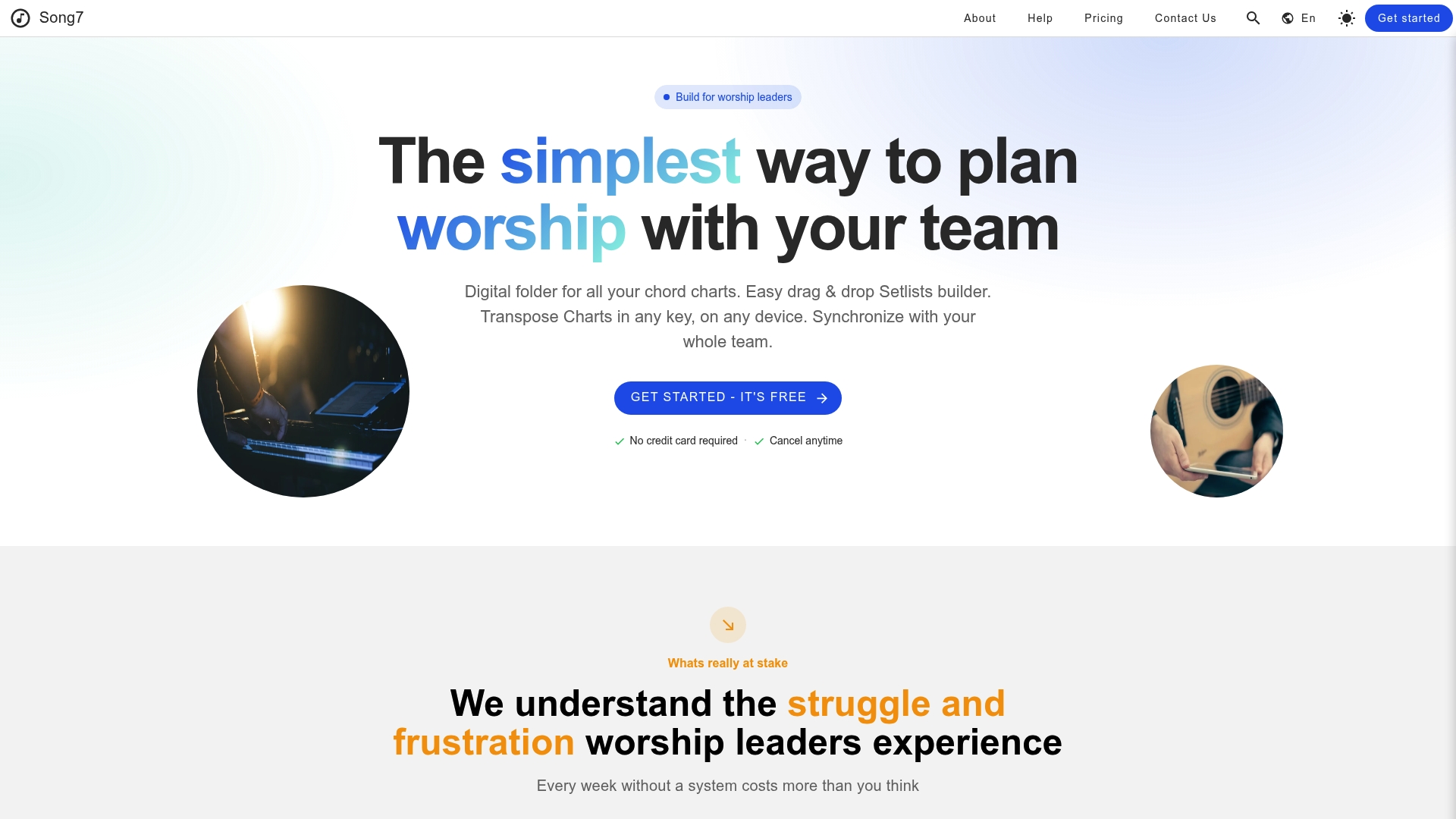
Visit Song7 to start a free trial and run it alongside your current setup for one rehearsal. If the sync and simplicity hold up under real conditions, you'll know within a single practice whether it's the replacement your team has been needing.
FAQ
Is there any free software similar to EasyWorship?
Yes, OpenLP, Quelea, and VideoPsalm are all free options that cover scripture and lyrics presentation similar to EasyWorship's core functions. They lack EasyWorship's tight Windows-based media library integration but handle basic worship presentation well for teams on a limited budget.
What are the differences between FreeShow and OpenLP?
FreeShow delivers its interface through a browser or lightweight app, which reduces installation steps and suits teams wanting quick, low-friction setup. OpenLP is a more traditional desktop application with deeper integrations, including PowerPoint and VLC, according to SaaSHub's comparison of the two.
How do I move my song library from OpenSong to a new platform?
Export your OpenSong lyrics and chords as plain text or ChordPro where possible, then import a small test set into your chosen platform before moving your full library. Check chord alignment and verse markers carefully, since formatting sometimes shifts during import.
Is Song7 a good replacement for OpenSong?
Song7 works well for volunteer-led teams that want setlists, chord charts, and transpose settings synced automatically across devices rather than shared through files. It's built specifically for that use case, with a free trial available to test before committing.
Which OpenSong alternative works best offline?
Desktop-based tools like OpenLP, Quelea, and EasyWorship run fully offline once installed, which makes them reliable if your venue has unstable internet. Browser-based tools like Song7 and FreeShow generally need an initial connection but are built to keep working smoothly through a live service once loaded.