
The Nashville Number System turns every chord in a song into a number based on its position in the scale, so a chart written in one key works instantly in any other key. Move from C to D and the numbers on the page don't change at all. Only the chords underneath them do.
Here's what that looks like in practice. A verse built on 1, 4, 5, 1 means C, F, G, C when you're in the key of C. Call the same song in D, and your rhythm section reads 1, 4, 5, 1 and plays D, G, A, D without anyone rewriting a single symbol. That's the whole point: the chart stays put, the key moves around it.
You can start using this tonight. Try these three moves in your next rehearsal:
- Call the key first. Say or write the tonic ("we're in G") before you count off, since every number on the chart depends on it.
- Show a mid-bar change with a split. Draw a line dividing the measure and write both numbers (like 4 5) when a chord changes partway through a bar.
- Mark minor chords with a dash. A plain "6" is often minor in many keys, but a "6-" or "6m" removes any doubt in a chord that breaks the pattern.
Key Takeaways
The Nashville Number System works because it replaces fixed chord letters with scale-degree numbers, letting a single chart transpose to any key instantly.
| Point | Details |
|---|---|
| Numbers represent scale degrees | The same chart works in every key once you write the tonic at the top. |
| Diatonic quality is the default | Only mark exceptions like a major 2 or added 7th; assume standard quality otherwise. |
| Slash chords control bass motion | Use notation like 1/3 or 5/7 to spell out walkdowns and inversions precisely. |
| Ear training builds real fluency | Daily interval drills let you chart songs by ear and transpose without an instrument. |
| Song7 streamlines team workflow | Its transpose, setlist sync, and presentation tools help volunteer worship teams share updated charts fast. |
Table of Contents
- What Does the Nashville Number System Look Like on a Chart?
- How Do Scale Degrees Turn Into Chord Numbers?
- How Do You Notate Chord Extensions and Inversions in NNS?
- How Do You Show Timing and Rhythm on a Nashville Chart?
- How Do You Write and Transpose a Full Nashville Chart?
- What Are the Most Common Chord Progressions in Number Form?
- How Do You Practice and Memorize the Nashville Number System?
- Where Did the Nashville Number System Come From?
- What Tools Help You Practice and Manage Nashville Charts?
- Sources
- FAQ
What Does the Nashville Number System Look Like on a Chart?
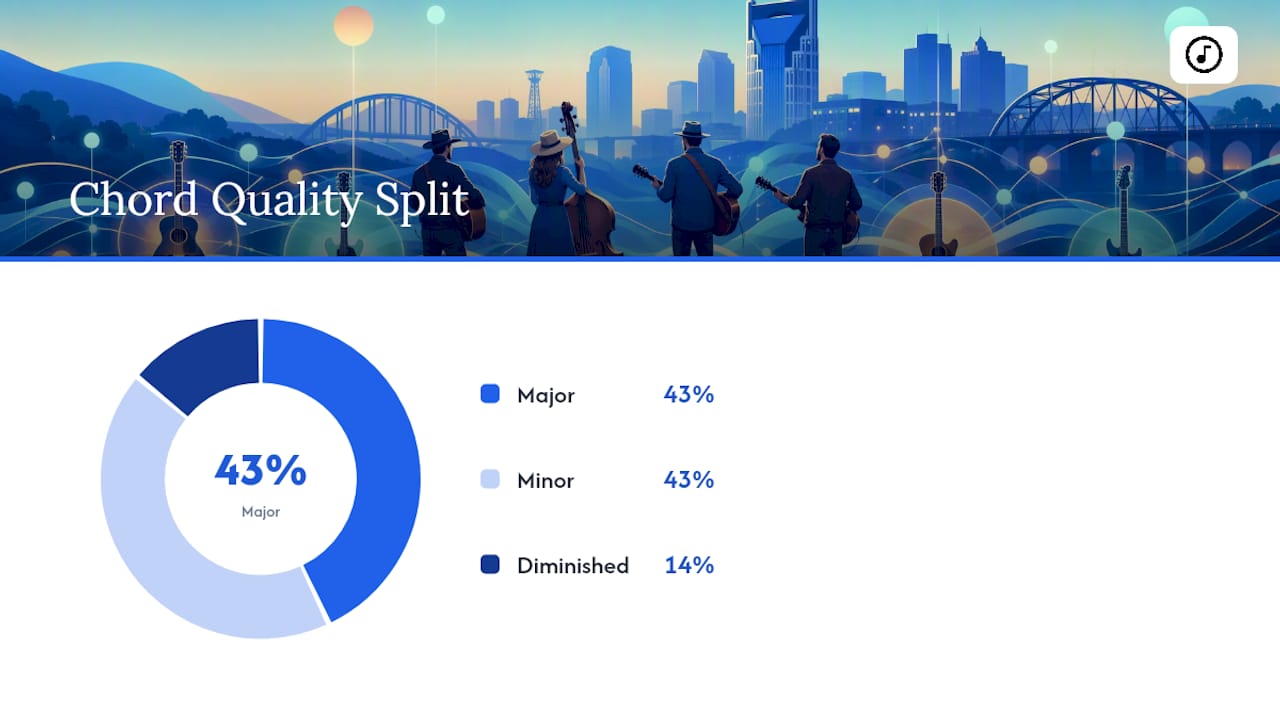
A quick-reference chart in the key of C shows exactly how the numbers line up with real chords, and once you've memorized this one key, you can transpose the shapes mentally into any other.
| Number | Chord (Key of C) | Quality |
|---|---|---|
| 1 | C | Major |
| 2 | Dm | Minor |
| 3 | Em | Minor |
| 4 | F | Major |
| 5 | G | Major |
| 6 | Am | Minor |
| 7 | B° | Diminished |
A handful of symbols cover most of what you'll see on a working chart: a dash or lowercase "m" flags a minor chord, "Δ" or "maj7" marks a major seventh, a plain "7" means dominant seventh, and a slash like "1/3" tells the bassist to play the third under the tonic chord.
Pro Tip: Write the key in big letters at the top of every chart before rehearsal, and circle any split bars in a different color so your band catches the change before it happens, not during it.
How Do Scale Degrees Turn Into Chord Numbers?
Every number on a Nashville chart comes straight from the major scale of whatever key you're in, and building that scale takes about ten seconds once you know the pattern.
- Start on your tonic note. This is scale degree 1, the note the key is named after.
- Follow the whole-step, whole-step, half-step, whole-step, whole-step, whole-step, half-step pattern. In C, that gives you C, D, E, F, G, A, B, back to C.
- Number each note 1 through 7. Those numbers are now permanent placeholders for chords built on each scale tone, regardless of what key you're playing in.
The chord quality attached to each number doesn't change from key to key either, because it comes from the scale's structure, not the specific notes:
- 1, 4, and 5 are generally major chords in many major keys.
- 2, 3, and 6 are typically minor chords.
- 7 is often diminished, which is why you'll rarely see a bare "7" chord holding down a chorus.
In C, that means 1 is C major, 2 is D minor, and so on down the What Does the Nashville Number System Look Like on a Chart?. Session musicians lean on this system because, according to research on Nashville Number System pedagogy, it preserves the functional relationships of popular music more faithfully than classical Roman numeral analysis does. Write the key at the top of the page, and every number below it inherits its chord quality automatically. That's why NNS charts stay so clean.
How Do You Notate Chord Extensions and Inversions in NNS?
Diatonic quality is the default, and NNS charts stay clean because writers only mark the exceptions. A bare "4" means an F major chord in the key of C. A "4Δ7" means you want that major seventh color tone, and you'll write it because it deviates from what a player would otherwise assume.
The everyday symbol set covers almost every chart you'll encounter:
- Dash or "m" for minor (2 or 2m).
- "7" alone for a dominant seventh (5 7).
- "Δ" or "maj7" for a major seventh (1Δ or 1maj7).
- "sus" for a suspended chord (4sus).
- "+" for augmented.
- "°" for diminished.
Slash notation is where NNS gets genuinely useful for arranging, not just labeling. Writing "5/7" over a chord tells the bassist to play a G chord with the B scale degree underneath it, in the key of C, that's a G chord over a B bass note.
| Notation | Meaning | Example in Key of C |
|---|---|---|
| 1/3 | Tonic chord, third in the bass | C/E |
| 5/7 | Five chord, seventh scale degree in bass | G/B |
| 4/6 | Four chord, sixth scale degree in bass | F/A |
Slash chords aren't decoration. According to Learn Jazz Standards, this notation exists specifically to communicate bass-line motion, whether that's a walkdown into the next chord or a pedal point holding steady under moving harmony above it.
Pro Tip: When a bass player asks "why does this sound smoother than the letter chart," it's almost always slash notation doing the work. Use 1/3 and 5/7 to spell out exactly which note you want walking underneath, instead of leaving inversions to guesswork.
How Do You Show Timing and Rhythm on a Nashville Chart?
Numbers tell your band which chords to play, but rhythm notation tells them when and how long. A handful of shorthand marks cover nearly every situation you'll face on stage:
- Diamond around a number means hold the chord for the full measure, letting it ring.
- Underline connecting two numbers signals a split bar, two chords sharing one measure.
- Dots or hash marks under a number count out specific beats within the bar.
- "<" or ">" before a number flags a push, meaning the chord hits early, ahead of the beat.
- "X" marks a stop, a held silence, or an ambiguous section the band needs to watch for.
A simple four-bar phrase might look like this on paper:
1 . . . | 4 5 | 6 . . . | <1
That reads as: hold the 1 chord for four beats, split the second bar between 4 and 5, hold 6 for the third bar, then push into 1 slightly ahead of the fourth bar's downbeat.
Pro Tip: During a live set, flash a closed fist for a hold, an open palm sweeping down for a push, and point at the vocalist during a bridge to cue an unplanned repeat. Hand signals travel faster than a shouted number over a full band mix.
How Do You Write and Transpose a Full Nashville Chart?
Writing your first real chart is straightforward once you break it into five steps:
- Pick the song's key and write it at the top. Everything below depends on this one decision.
- Map every chord in the song to its scale degree number. Play through slowly and identify each chord's position relative to the tonic.
- Mark durations and split bars. Note where chords change mid-measure using the underline convention.
- Add color symbols and inversions. Flag any 7ths, sus chords, or slash bass notes that deviate from the plain diatonic default.
- Annotate cues. Mark repeats, endings, and any spot the band needs a visual signal.
Here's a short worship chorus written out in the key of G:
| Bar 1 | Bar 2 | Bar 3 | Bar 4 |
|---|---|---|---|
| 1 | 4 | 5 | 6m |
| G | C | D | Em |
Now transpose that same chart to the key of D. The numbers on the page don't move at all, only the key label at the top and the chords underneath change:
| Bar 1 | Bar 2 | Bar 3 | Bar 4 |
|---|---|---|---|
| 1 | 4 | 5 | 6m |
| D | G | A | Bm |
Notice what didn't happen: nobody rewrote "G, C, D, Em" as "D, G, A, Bm" by hand, chord by chord, the way you would with a standard lead sheet. You just changed one word at the top of the page. This is the exact mechanic that makes NNS charts identical across every key once the tonic is specified, according to the system's documented structure.
Pro Tip: Practice this transposition drill with a song you already know cold. Write it in its original key first, then force yourself to transpose it up a fourth on paper without touching an instrument. If you can do it in under two minutes, your number fluency is ahead of most working musicians.
What Are the Most Common Chord Progressions in Number Form?
A small handful of progressions cover most of what you'll play in a given set, and recognizing them by number means you can call an unfamiliar song in seconds:
- 1, 4, 5, 1 is a very common progression in worship choruses and classic rock anthems.
- 1, 5, 6, 4 is frequently used in contemporary pop and worship ballads.
- 2, 5, 1 is a well-known jazz turnaround often used in modern arrangements.
Arranging around these shapes works differently depending on the instrument. Guitarists usually anchor the root on the 1 and 4 chords but reach for color tones (add9, sus2) on the 5 and 6m to keep a progression from sounding flat. Keyboard players tend to voice inversions using slash notation so the left hand doesn't jump around unnecessarily. Bass players follow the slash chord if one's written, and default to root motion when it isn't.
Picture a volunteer worship band running this exact 1, 5, 6m, 4 progression. The leader calls "key of A," the guitarist reads 1 5 6m 4 and knows to add a sustain pedal on the 6m, and the bassist sees no slash notation, so they walk straight roots. Nobody needed sheet music rewritten for the new key.
How Do You Practice and Memorize the Nashville Number System?
Fluency comes from ear training, not memorization drills alone. Musicians who can hear a fourth or a fifth without checking an instrument are the ones who chart songs by ear in real time, a skill Premier Guitar's session-player interviews point to as the real engine behind NNS fluency.
Three exercises build that skill fast:
- Interval hearing drill. Play a chord, then guess the number of the next chord before playing it. Repeat for 10 minutes daily; track your accuracy weekly.
- Quick-key-change drill. Take a song you know in one key and call it in three different keys in a single practice session, transposing out loud without writing anything down.
- Chart-writing speed drill. Time yourself writing out a four-chord verse in numbers. Aim to cut your time by half over two weeks of practice.
Pro Tip: Run key-change drills as a full band, not solo. Have your vocalist call a surprise key shift mid-rehearsal and see how fast the rhythm section adjusts. That's the exact scenario you'll face when a singer says "can we drop this a step" five minutes before a Sunday service.
Tie every drill back to a real gig scenario. A singer asking for a lower key mid-set, a last-minute request from the congregation, a guest musician sitting in cold: these are the moments number fluency actually pays off.
Where Did the Nashville Number System Come From?
Neal Matthews Jr., a member of the vocal group the Jordanaires, developed the Nashville Number System in the late 1950s as a faster way for session musicians to chart songs during high-volume studio work. Session musician Charlie McCoy helped popularize the method across Nashville's recording scene, and it spread from there into touring bands and eventually into worship teams looking for the same speed and flexibility, according to research on NNS pedagogy.
Compared to classical Roman numeral analysis, NNS trades some theoretical precision for practical speed. It maps functional harmony in popular music without the classical-era assumptions baked into Roman numerals, which is part of why it took hold so quickly in commercial studios. Decades later, it's the default language in Nashville session rooms and on worship team stages everywhere, precisely because it was built for musicians working fast under pressure, not for analyzing a string quartet.
What Tools Help You Practice and Manage Nashville Charts?
A number chart is only as useful as your ability to update it, share it, and read it clearly under stage lights. A handful of practical features separate a workable rehearsal tool from a frustrating one:
- Instant transpose, so changing keys doesn't mean rewriting a chart by hand.
- Printable chart export, for bands who still like paper on a music stand.
- Chord-diagram view, useful for guitarists still building their number fluency.
- Real-time sync across team devices, so everyone's holding the same updated chart.
- Presentation mode, built for stage visibility rather than a laptop screen.
For deeper study on the notation conventions behind these charts, Premier Guitar's Nashville Number System guide and the practical shorthand reference at Nashville Number System's introduction page are worth bookmarking.
Pro Tip: If your team is still texting chord charts as photos of handwritten paper, a tool built specifically for worship team chart management will save you more rehearsal time than any single practice drill in this article.
A Quick Note From the Stage
I've called a key change mid-song by holding up a closed fist and counting fingers for the new number, no shouting required over a full band mix. For a bridge that shifts keys, a quick point at the keyboard player and a flashed number on my fingers gets everyone there before the downbeat. A diamond drawn in the air with two fingers tells the drummer to hold the ending chord and let it ring.
A Simple Next Step for Your Team
Song7 lets you build a chart once, transpose it instantly for whatever key your vocalist needs that Sunday, and push the update to every band member's device before rehearsal even starts. It handles setlist building, chord diagrams, and presentation mode in one place, so your volunteer team isn't juggling paper charts and group texts. Try the Song7 demo and build your first Nashville chart this week.
Sources
For readers who want to go deeper into the mechanics, history, and notation debates behind this system, these sources cover different angles worth exploring:
- The Nashville Number System: A Framework for Teaching Harmony in Popular Music
- Ultimate Guide to the Nashville Number System - Premier Guitar
- Nashville Number System — Introduction
- Slash Chords! What Are They & Their 3 Essential Uses
- Nashville Number System — Wikipedia
Guitarists looking for keyboard-specific practice material alongside their number charts can also find useful free scores at FARJADI Piano School.
FAQ
Is the Nashville Number System Easy to Learn?
The basics take one rehearsal to grasp since numbers just replace chord letters, but real fluency, hearing intervals and transposing on the fly, takes weeks of consistent ear-training practice.
Can You Give an Example of the Nashville Number System?
A 1, 4, 5, 1 progression in the key of C plays as C, F, G, C; move to the key of D and the same numbers map to D, G, A, D without rewriting the chart.
How Do You Memorize the Nashville Number System?
Daily interval-hearing drills build the core skill fastest: play a 1 chord, guess the next chord's number before playing it, and track your accuracy over several weeks.
Who Invented the Nashville Number System?
Neal Matthews Jr. developed it in the late 1950s for fast studio session work, and Charlie McCoy helped popularize it across Nashville's recording industry.