
A capo chord chart maps a capo fret to the sounding key of familiar open chord shapes, so you can keep playing the fingerings you already know while landing on the key you actually need. Put a capo on fret 2 and strum a C shape, and the chord you hear is D. That's the whole idea in one line.
Here's how to put it to work right now:
- Find the sounding key your song needs (or the key your singer needs).
- Pick a capo fret that turns your favorite open shapes into that key, using a capo chart as your reference.
- Play the familiar shapes. The capo does the transposition for you.
A capo clamps the strings at a chosen fret and raises the pitch of every open string by one semitone per fret, which is why the same C shape sounds different depending on where you clamp. Tools like the CMUSE capo chart lay this out fret by fret, and once you understand the pattern, you'll rarely need to look it up twice. Some worship leaders even call changes using the Nashville Number System instead of chord names, which we'll cover further down. Song7 builds this same transposition logic into its chord chart tools, so your team never has to do the math by hand mid rehearsal.
Key Takeaways
A capo chord chart works because it maps a fixed physical position, the capo fret, to a predictable sounding key for any open shape you already know.
| Point | Details |
|---|---|
| Chart logic | Each fret raises pitch one semitone, so capo 2 turns a C shape into D. |
| Best positions | Capo frets 1 through 5 stay closest to true open CAGED shapes and avoid barre stretches. |
| Singer-first workflow | Keep melody highs at or below D and lows near A for the widest congregational comfort. |
| Common fix | Shift the capo one fret before rewriting chord shapes to solve minor range issues. |
| Faster team workflow | Song7 auto-transposes chord charts and syncs the sounding key across the whole team instantly. |
Table of Contents
- Quick-Reference Capo Chord Chart for Common Shapes
- How Do You Read and Use a Capo Chord Chart?
- Which Capo Positions Do Guitarists Use Most Often?
- Playing Tips That Keep a Capoed Guitar in Tune
- Using the Nashville Number System With a Capo
- How Do You Choose a Capo Position for Singers?
- Where to Download a Printable Capo Chart
- How Song7 Makes Capo Transposition Effortless
- Sources
- FAQ
Quick-Reference Capo Chord Chart for Common Shapes
Here's the chart most guitarists actually need on a Sunday or at a gig: the sounding key you get when you play a familiar open shape with the capo on a given fret. Standard tuning (E A D G B E) means each fret up moves every shape one half step higher.
| Capo Fret | C Shape Sounds As | G Shape Sounds As | D Shape Sounds As | A Shape Sounds As | E Shape Sounds As |
|---|---|---|---|---|---|
| — | C | G | D | A | E |
| 1 | Db | Ab | Eb | Bb | F |
| 2 | D | A | E | B | F# |
| 3 | Eb | Bb | F | C | G |
| 4 | E | B | F# | Db | Ab |
| 5 | F | C | G | D | A |
| — | F# | Db | Ab | Eb | Bb |
| 7 | G | D | A | E | B |
Capo positions 1 through 5 tend to be the most guitar-friendly rows on this chart, because they still let you finger true CAGED-family open shapes instead of forcing a barre chord. Print this table landscape on one page, and you've got a cheat sheet that outlasts a dozen mental math sessions.
How Do You Read and Use a Capo Chord Chart?
Reading a capo chart is a four-step habit, not a math problem. Once it clicks, you'll do it in your head before the second verse.
- Identify the sounding key. Listen to the recording or check the lead sheet for the key the song is actually in, or the key your vocalist needs.
- Pick your capo fret. Scan the chart for the row that turns a comfortable shape, say, a G or C shape, into that sounding key.
- Apply the shapes and check by ear. If a song runs Em, G, D, A in the open position and you capo up 2, you're now fingering Dm, Bb, C, G shapes that sound like Em, G, D, A. Play it against a tuner or piano to confirm.
- Recheck the vocal range. If the melody still sits too high or low, shift the capo one fret and see if that solves it before you touch a single chord shape.
If anything sounds slightly off after capoing, retune. A capo that's crooked or too far from the fret is the usual culprit, and we'll fix that next.
Which Capo Positions Do Guitarists Use Most Often?
Capo positions 1 through 5 cover the overwhelming majority of real-world transposition needs, and each one has its own personality on the fretboard.
- Capo 1: A C shape sounds like Db, a G shape like Ab. Useful for nudging a song up just enough to brighten it without changing your hand shapes much.
- Capo 2: A C shape sounds like D, a G shape like A. This is the workhorse position for congregational worship songs written in D or A, since it keeps open-string ring intact.
- Capo 3: A G shape becomes Bb, an Em shape becomes Gm. Handy for horn-heavy arrangements pitched in flat keys.
- Capo 4: A C shape sounds like E, an Am shape like C#m. Common when a lead vocalist needs extra lift on a bridge.
- Capo 5: A C shape sounds like F, a D shape like G. This spot lets a guitarist play "easy" D and G shapes on a song that's actually in G and C, which is exactly why so many congregational charts land here.
The through line: capo 2 and capo 5 in particular show up again and again in worship sets because they let a whole team read the same familiar shapes while the room sings comfortably in tune.
Playing Tips That Keep a Capoed Guitar in Tune
Most capo problems trace back to placement, not the capo itself. Clamp it directly behind the fret wire, not on top of it, and apply even pressure across all six strings. A capo mashed too close to the middle of the fret will buzz or pull certain strings sharp.
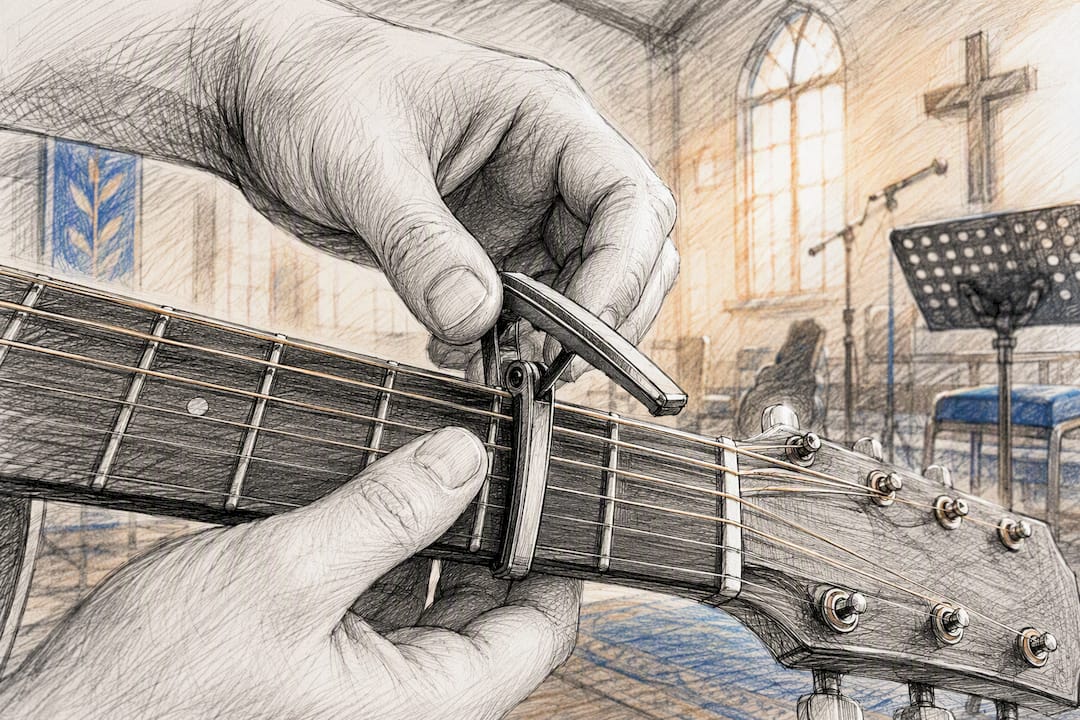
Always retune after capoing. Capos change string tension slightly, and even a quality clamp can nudge your G or B string out. A 30-second tuner check saves you from fighting pitch all set.
Position also changes tone. Higher capo positions brighten the timbre, which helps an acoustic cut through a full band mix, while lower positions keep a warmer, fuller low end.
Pro Tip: Keep a partial capo (covering only three or four strings) in your case for songs that need an open low string ringing under a capoed chord. It's a niche tool, but it solves voicing problems a full capo can't.
Using the Nashville Number System With a Capo
The Nashville Number System assigns numbers, 1 through 7, to the scale degrees of whatever key you're in, so a I-IV-V progression stays "1-4-5" no matter what key the song lands in. Pair it with a capo and you can call changes on the fly without rewriting a single chart.
| Reference Key (C) | Number | Capo 2 Shape (Sounds in D) |
|---|---|---|
| C | 1 | C shape (sounds D) |
| F | 4 | F shape (sounds G) |
| G | 5 | G shape (sounds A) |
Calculators like CMUSE's capo tool build this mapping directly into their charts. If your bassist yells "5" mid song, you already know which shape to grab, capo or not.
How Do You Choose a Capo Position for Singers?
Start with the voice, not the guitar. A reliable guideline for mixed congregational singing is to keep the melody's highest note at or below D, with an occasional Eb, and the lowest note near A, a range that RenewingWorship has documented works best across a room full of different voice types.
- Find the melody's highest and lowest notes in the original key.
- List which sounding keys keep those notes inside that comfortable range.
- Cross-reference the capo chart to find a fret that lands on one of those keys using shapes you can actually play live.
- Test it with the actual vocalist, not just your own range.
Say a song's bridge originally peaks on a high E. Capoing up two frets and dropping the vocal key from D to C can pull that peak down to a D, right at the edge of the singable zone, without rewriting a single chord shape for the band.
Pro Tip: When a song is close but not quite comfortable, shift the capo one fret instead of relearning new chord shapes. A single fret often solves range problems that feel like they need a full key change.
Where to Download a Printable Capo Chart
Keep a one-page cheat sheet in your gig bag or binder, not just on your phone.
- Print the capo fret chart above in landscape orientation, scaled to fit one page.
- Include the Nashville number row if your team calls changes numerically on stage.
- Laminate it if you're the type who spills coffee on charts (most of us are).
A note from a worship guitarist
Years back, I capoed a set-closing song up two frets purely to make my fingering easier, ignoring the singers straining on the chorus. Lesson learned: pick the capo position for the room's voices first, your convenience second.
How Song7 Makes Capo Transposition Effortless
Building a printable capo chart by hand is a fine Tuesday-night project. Doing it every week, for every song, on top of building setlists and prepping chord charts, is where volunteer teams burn out fast.

Song7 handles the transposition math instantly: pick a target key or capo fret, and the chord diagrams update across your whole song library in seconds, no manual chart rewriting. Setlists sync in real time to every team member's device, so your guitarist, keyboard player, and vocalist are always looking at the same key, whether or not a capo is involved. Chord diagrams display alongside lyrics in presentation mode, and role-based access means only the right people are editing charts before Sunday. That combination saves rehearsal time and cuts the on-stage risk of someone glancing down at the wrong key. Start a free trial with Song7 and export your first printable capo chart before your next rehearsal.
Sources
- Guitar Capo Chart — Free Capo Chord Reference | Chordly
- Capo Chart Calculator: Find Your Key & Chord Transposition - CMUSE
- Songs for Worship: How Do We Determine the Best Keys for Congregational Singing? - Renewing Worship
FAQ
How do you figure out chords with a capo?
Find the song's sounding key, then check a capo chart to see which fret turns a comfortable open shape, like C or G, into that key.
What chords can you play with a capo?
Any chord shape you already know: capoing simply shifts where that shape lands on the pitch scale, so a C, G, D, A, or E shape sounds like a different chord at each fret.
Do real guitarists actually use capos?
Yes, extensively. Professional and worship guitarists use capos to match a singer's range, brighten tone, or simplify a hard chord shape into an easier open-position equivalent.
What famous songs use a capo?
Many recordings use a capo to get a brighter, chiming tone or to make a difficult key playable in open position, which is common across pop, folk, and worship music. Check the original recording's key against your capo chart to match the sound.
Can Song7 help me build a capo chord chart for my team?
Yes. Song7 transposes chord charts and chord diagrams instantly to match any capo position or key change, then syncs the update across your whole team's devices.